Rajasthan CMO Reaffirms Role of Parliamentary Committees
Synopsis
The Chief Minister's Office of Rajasthan on 16 July 2026 reaffirmed that parliamentary committees are a cornerstone of democratic governance, enabling thorough deliberation on policies and schemes — a statement aligned with the state's 'Our Pioneering Rajasthan' campaign.
Key Takeaways
The Chief Minister's Office of Rajasthan posted the statement on 16 July 2026 via its official X account.
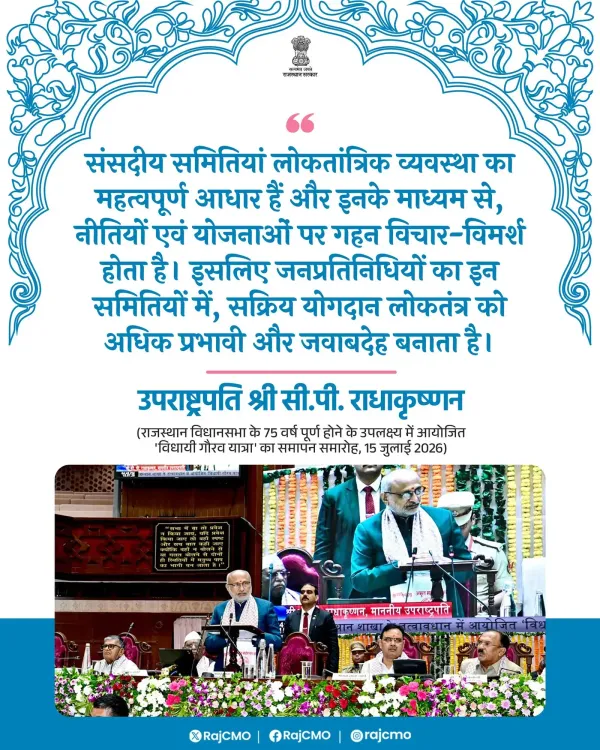
The post describes parliamentary committees as 'an important foundation of the democratic system.' It highlights the committees' role in enabling 'in-depth deliberation on policies and schemes.' The statement was tagged under #आपणो_अग्रणी_राजस्थान ('Our Pioneering Rajasthan'), the state government's governance campaign.
India's parliamentary committee system has been in continuous operation since 1952 , replicated in state assemblies including Rajasthan's unicameral legislature.
Upcoming budget and monsoon session committee reports will be a key indicator of how this stated commitment translates into practice.
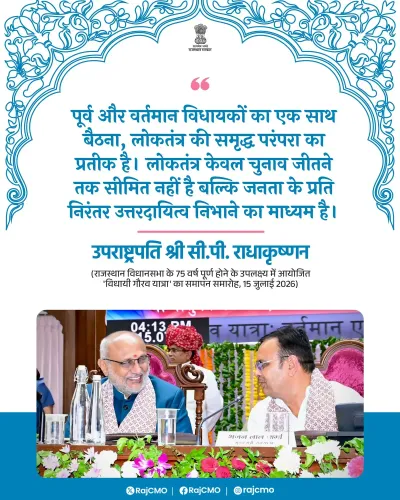
The Chief Minister's Office of Rajasthan on Thursday, 16 July 2026, posted a statement on X underscoring the foundational importance of parliamentary committees in a democratic system, affirming that such bodies enable deep deliberation on policies and schemes.
The post, addressed to @CPR_VP and tagged under the campaign hashtag #आपणो_अग्रणी_राजस्थान ('Our Pioneering Rajasthan'), stated: 'Parliamentary committees are an important foundation of the democratic system, and through them, in-depth deliberation on policies and schemes takes place.'
Context
Parliamentary committees — both standing and ad-hoc — are the principal mechanism through which legislatures scrutinise executive action, examine budgetary allocations, and review proposed legislation outside the full house. In Rajasthan, the unicameral Rajasthan Legislative Assembly operates a set of such committees mirroring the structure established at the national level under the Rules of Procedure and Conduct of Business framed in 1952.
The CMO's statement positions these bodies not merely as procedural instruments but as pillars of democratic governance, a framing consistent with periodic affirmations made by successive state governments across India.
Policy Backdrop
India's committee system was institutionalised at the time of the first Parliament and has been continuously replicated in state assemblies. These bodies allow legislators to call witnesses, examine departmental demands for grants, and produce reports that inform floor debates — functions that the full house, constrained by time, cannot perform alone.
Successive governments in Rajasthan have periodically invoked the committee system as evidence of participatory and transparent governance, particularly during budget and monsoon sessions when legislative activity is at its peak.
Stakeholders and Impact
The primary stakeholders are Rajasthan Legislative Assembly members who sit on these committees, along with civil servants, policy experts, and citizens whose interests are represented through the scrutiny process. Effective committee functioning directly affects the quality of legislation and the accountability of the state executive.
For the broader public, robust committee oversight translates into better-examined schemes and more accountable spending of public funds — outcomes that align with the #आपणो_अग्रणी_राजस्थान ('Our Pioneering Rajasthan') vision articulated by the current state government.
What's Next
Observers of Rajasthan's legislative calendar will watch for committee reports and recommendations emerging from the upcoming budget or monsoon session of the Rajasthan Legislative Assembly. Any formal committee findings on flagship state schemes could give substance to the CMO's reaffirmation of their role.
The statement signals that the state government intends to project legislative oversight as a governance strength, a posture that may shape how future policy announcements are framed and reviewed within the assembly's committee structure.
Point of View
The post strategically links institutional process to a political brand. The mention of @CPR_VP — an unverified interlocutor — suggests the statement may be part of a structured engagement with a policy or research audience rather than a standalone declaration. Whether the rhetoric translates into measurable strengthening of committee functioning will be tested in the assembly's next active session.
NationPress
15 Oct 2026
Frequently Asked Questions
What are parliamentary committees in India?
Parliamentary committees are standing or ad-hoc bodies of the legislature that scrutinise bills, budgets, and policies in detail outside the full house. They were institutionalised under the Rules of Procedure framed in 1952 and function in both Parliament and state assemblies.
Why did the Rajasthan CMO post about parliamentary committees?
The Chief Minister's Office of Rajasthan posted on 16 July 2026 to reaffirm the democratic importance of parliamentary committees, stating they enable in-depth deliberation on policies and schemes. The post was part of the state's 'Our Pioneering Rajasthan' campaign.
What is the Aapno Agrni Rajasthan campaign?
'Aapno Agrni Rajasthan' (Our Pioneering Rajasthan) is a governance and branding campaign used by the current Rajasthan state government to highlight its policy and development initiatives.
How do Rajasthan Legislative Assembly committees work?
The Rajasthan Legislative Assembly operates committees that mirror the national parliamentary structure. These bodies examine departmental grants, review legislation, and produce reports that inform floor debates, allowing legislators to conduct detailed oversight of the state executive.
What should we watch for next in Rajasthan's legislative committees?
Reports and recommendations from Rajasthan Assembly committees during the upcoming budget or monsoon session will indicate whether the CMO's stated commitment to committee-driven deliberation translates into concrete legislative outcomes.