Rajasthan CMO backs PM Modi's four-pillar welfare push
Synopsis
The Chief Minister's Office of Rajasthan on 23 July 2026 reaffirmed that under PM Narendra Modi's leadership, holistic development of farmers, labourers, women, and youth is being ensured — positioning the state as a leading implementer of central welfare priorities.
Key Takeaways
The Chief Minister's Office of Rajasthan posted on 23 July 2026 emphasising welfare for four key groups under PM Modi's leadership.
The four groups cited are farmers, labourers, women, and youth — all central to BJP's national welfare agenda.
CM Bhajan Lal Sharma was tagged in the post, signalling state-level ownership of the message.
Central schemes such as PM-KISAN , Pradhan Mantri Ujjwala Yojana , and Skill India Mission form the policy backbone of this four-pillar framework.
The hashtag #आपणो_अग्रणी_राजस्थान ('Our Leading Rajasthan') frames the state as a front-runner in implementing central priorities.
Rajasthan's next state budget and scheme reviews will test how this commitment translates into concrete allocations.
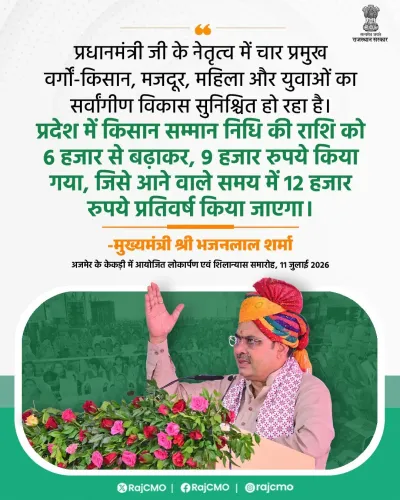
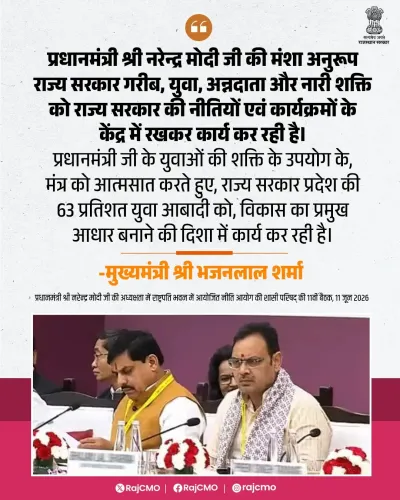
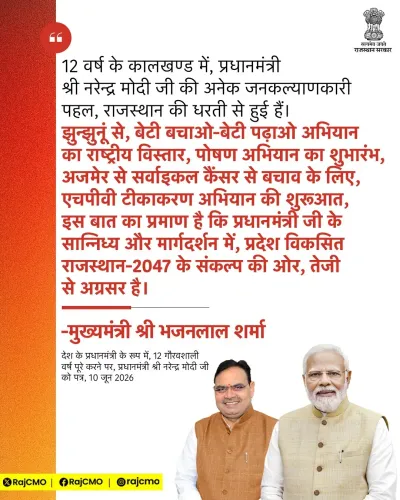
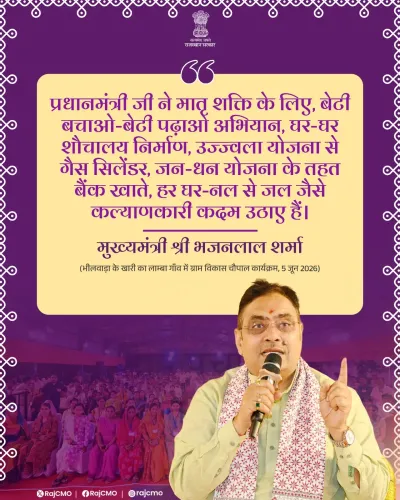
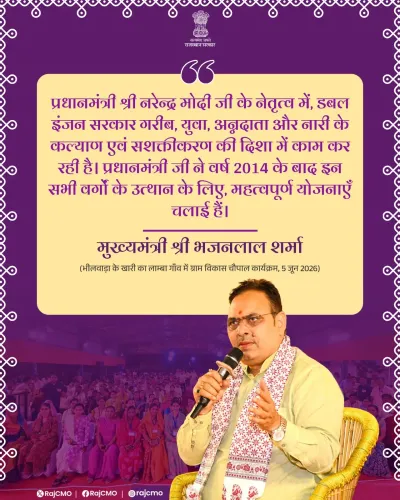
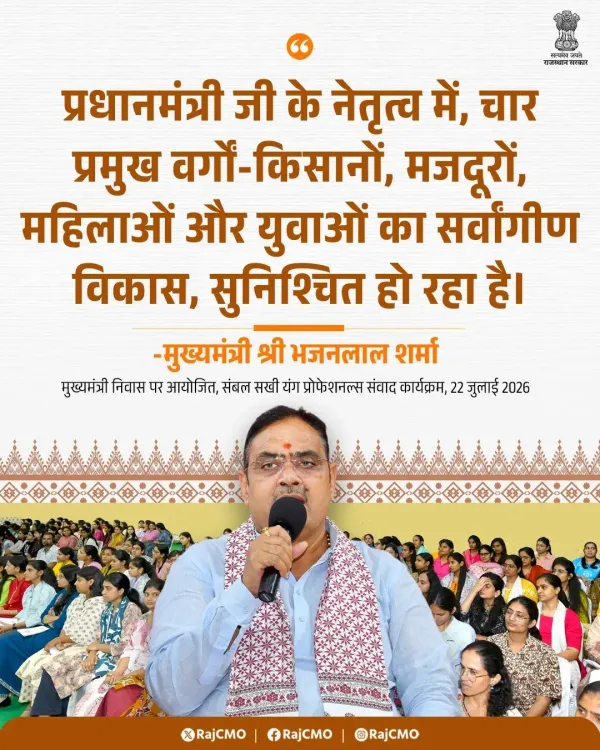
The Chief Minister's Office of Rajasthan on Thursday, 23 July 2026 posted on X, affirming that under the leadership of Prime Minister Narendra Modi, the all-round development of four key groups — farmers, labourers, women, and youth — is being ensured across the country, with Chief Minister Bhajan Lal Sharma tagged in the message.
The post, shared under the hashtag #आपणो_अग्रणी_राजस्थान ('Our Leading Rajasthan'), declared: 'प्रधानमंत्री जी के नेतृत्व में, चार प्रमुख वर्गों — किसानों, मजदूरों, महिलाओं और युवाओं का सर्वांगीण विकास, सुनिश्चित हो रहा है' — translated as, 'Under the leadership of the Prime Minister, the holistic development of four key sections — farmers, labourers, women, and youth — is being ensured.'
Context
The message positions Rajasthan's BJP government as an active participant in a national welfare agenda centred on four demographic groups that carry significant electoral and social weight. The hashtag 'Our Leading Rajasthan' signals the state government's intent to project itself as a front-runner in implementing centrally driven development priorities.
Chief Minister Bhajan Lal Sharma, who assumed office in December 2023, has consistently framed Rajasthan's governance as aligned with New Delhi's policy direction under Prime Minister Modi.
Policy Backdrop
Several flagship central schemes underpin the four-pillar framework cited in the post. The PM-KISAN scheme, launched in 2019, provides direct income support to farmers. The Pradhan Mantri Ujjwala Yojana, rolled out in 2016, expanded LPG access for women in low-income households, and the Skill India Mission, initiated in 2015, targets youth employment and vocational training.
Labour protections were further consolidated through a set of labour code reforms passed by Parliament between 2019 and 2020, addressing the welfare of the working class — the second of the four groups highlighted in the post.
Stakeholders and Impact
The four groups named — farmers, labourers, women, and youth — together represent a broad cross-section of Rajasthan's population, which is predominantly rural. State-level implementation of centrally sponsored schemes directly affects the livelihoods of millions in these categories across the state's 33 districts.
This communication pattern, where BJP-governed states publicly echo central welfare messaging, reinforces vertical policy continuity between the Union government and state administrations, signalling to beneficiaries that both tiers of government are aligned on delivery.
What's Next
Rajasthan's next state budget presentation and any mid-term reviews of centrally sponsored schemes for these four groups will be closely watched as indicators of how the state translates this stated commitment into measurable allocations and outcomes.
The broader pattern of BJP-ruled states amplifying central welfare messaging suggests that such communications will continue to serve as a political and administrative signal ahead of any review of scheme performance or electoral cycles.
Point of View
The communication simultaneously credits the Prime Minister and stakes a claim for the state government's own delivery record. The four-group framework of farmers, labourers, women, and youth is not incidental — it maps almost exactly onto the BJP's core electoral coalition. Ahead of any scheme reviews or budgetary cycles, such messaging serves both as a political signal and a governance accountability benchmark.
NationPress
23 Jul 2026
Frequently Asked Questions
What did the Rajasthan CMO post about on 23 July 2026?
The Rajasthan Chief Minister's Office posted that under PM Narendra Modi's leadership, the holistic development of four key groups — farmers, labourers, women, and youth — is being ensured in the country.
Who is the Chief Minister of Rajasthan in 2026?
Bhajan Lal Sharma is the Chief Minister of Rajasthan, having taken office in December 2023 as a BJP leader.
What is the meaning of the hashtag Aapno Agrani Rajasthan?
The hashtag #आपणो_अग्रणी_राजस्थान translates to 'Our Leading Rajasthan' and is used by the Rajasthan government to project the state as a front-runner in governance and development.
Which central schemes support farmers, women, and youth in Rajasthan?
Key central schemes include PM-KISAN for farmers (launched 2019), Pradhan Mantri Ujjwala Yojana for women (2016), and the Skill India Mission for youth (2015), all of which are implemented in Rajasthan.
Why does the BJP highlight farmers, labourers, women, and youth in its messaging?
These four groups represent a broad cross-section of India's population and are central to the BJP's electoral and welfare strategy, making them a recurring focus in communications from both central and state BJP governments.