Rajasthan CMO Invokes Ram Mandir, Article 370 in Independence Day Message
Synopsis
The Chief Minister's Office of Rajasthan marked Independence Day eve 2026 with a Hindi post invoking the Ram Mandir construction, Article 370 abrogation, and India's cross-border military assertiveness, tagging CM Bhajanlal Sharma under the hashtag #आपणो_अग्रणी_राजस्थान.
Key Takeaways
The Rajasthan CMO posted an Independence Day message on 14 August 2026 tagging Chief Minister Bhajanlal Sharma .
The post cited the Ram Mandir inauguration in Ayodhya (January 2024) as a defining national achievement.
It referenced the abrogation of Article 370 on 5 August 2019 , which reorganised Jammu and Kashmir into two union territories.
The phrase 'strikes the enemy in his own home' echoes the rhetoric surrounding the 2016 Uri surgical strikes and 2019 Balakot air strikes .
The hashtag #आपणो_अग्रणी_राजस्थान ties the national narrative to Rajasthan's state-level BJP branding.
Bhajanlal Sharma has served as Chief Minister of Rajasthan since December 2023 .
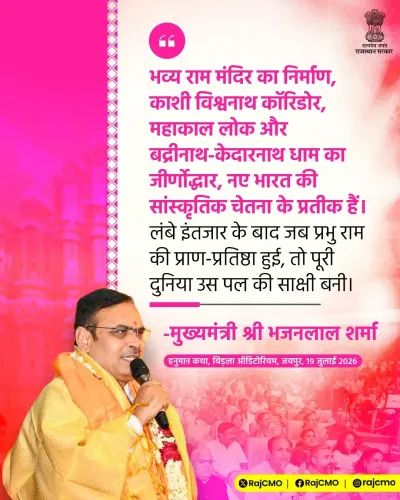
On the eve of Independence Day, the Chief Minister's Office of Rajasthan posted a sharp, nationally-charged message on 14 August 2026, invoking three of the BJP's defining achievements — the construction of the Ram Mandir in Ayodhya, the abrogation of Article 370, and India's posture of striking enemies 'in their own homes' — and tagging Chief Minister Bhajanlal Sharma directly.
The post, in Hindi, declared: 'Ayodhya mein bhavya Ram Mandir ka nirman hua, waheen Anuchchhed 370 ko samaapt kiya gaya. Aaj ka naya Bharat dushman ko, uske ghar mein ghuskar maarta hai.' — ('The grand Ram Mandir was built in Ayodhya, and Article 370 was abolished. Today's new India strikes the enemy in his own home.') The hashtag #आपणो_अग्रणी_राजस्थान ('Our Leading Rajasthan') anchored the message to the state's BJP branding.
Three pillars of the BJP's 'New India' narrative
Each reference in the post carries distinct political weight. The Ram Mandir in Ayodhya was inaugurated in January 2024, following a landmark 2019 Supreme Court verdict that cleared the path for construction after decades of legal dispute. For the BJP and its base, the temple's completion represents a civilisational promise fulfilled.
Article 370, which granted Jammu and Kashmir a degree of special autonomy, was abrogated by Parliament on 5 August 2019, reorganising the region into two union territories. The move remains one of the most consequential and contested constitutional acts in recent Indian history — celebrated by BJP supporters as a national integration milestone, challenged by critics in the courts and in public debate.
The third element — striking the enemy 'in his own home' — is a rhetorical callback to India's cross-border military responses, a posture that gained salience after the 2016 Uri surgical strikes and the 2019 Balakot air strikes. The language is deliberate: it frames India not as reactive but as assertive.
Rajasthan's BJP voice in a national chorus
State BJP governments routinely synchronise their Independence Day messaging with the central government's ideological framing. For Rajasthan, which has been governed by Chief Minister Bhajanlal Sharma since December 2023, the post is part of a broader effort to project alignment with Prime Minister Modi's 'New India' vision while reinforcing the state unit's own identity through the #आपणो_अग्रणी_राजस्थान campaign.
The message is aimed squarely at the BJP's core voter base — stitching together religious sentiment, constitutional nationalism, and security assertiveness into a single Independence Day frame. Three achievements. One sentence each. No ambiguity about the intended audience.
As India marks another Independence Day, Rajasthan's ruling establishment has made its ideological coordinates unmistakably clear — and the question now is whether governance deliverables on the ground match the boldness of the rhetoric.
Point of View
Particularly ahead of electoral cycles. By compressing Ram Mandir, Article 370, and cross-border military assertiveness into a single message, the Rajasthan CMO is signalling continuity with the Modi government's 'New India' brand rather than articulating a distinct state agenda. The move reflects a broader pattern where governance performance at the state level is deliberately framed within the vocabulary of national civilisational and security achievements. Whether Rajasthan's own development record can sustain that borrowed momentum is the political question that will define the state's next electoral contest.
NationPress
28 Sept 2026
Frequently Asked Questions
What did the Rajasthan CMO post on Independence Day 2026?
The Rajasthan Chief Minister's Office posted a Hindi message on 14 August 2026 invoking the construction of the Ram Mandir in Ayodhya, the abrogation of Article 370, and India's assertive cross-border military posture, tagging Chief Minister Bhajanlal Sharma.
When was the Ram Mandir in Ayodhya inaugurated?
The Ram Mandir in Ayodhya was inaugurated in January 2024, following a 2019 Supreme Court verdict and a bhumi pujan ceremony in 2020.
When was Article 370 abrogated?
Article 370 was abrogated by Parliament on 5 August 2019, reorganising Jammu and Kashmir into two union territories — Jammu and Kashmir, and Ladakh.
Who is Bhajanlal Sharma?
Bhajanlal Sharma is the Chief Minister of Rajasthan from the BJP, in office since December 2023.
What does the hashtag #आपणो_अग्रणी_राजस्थान mean?
The hashtag translates from Rajasthani/Hindi as 'Our Leading Rajasthan' and is part of the state BJP government's branding campaign to project Rajasthan as a frontrunner in development and governance.