CM Bhajanlal Hails Ram Mandir, Kashi, Mahakal as Cultural Symbols
Synopsis
The Chief Minister's Office of Rajasthan, on 19 July 2026, described the Ram Mandir, Kashi Vishwanath Corridor, Mahakal Lok, and Badrinath-Kedarnath Dham restoration as symbols of new India's cultural consciousness, aligning state messaging with national BJP cultural priorities.
Key Takeaways
The Rajasthan CMO posted on 19 July 2026 invoking four major Hindu pilgrimage infrastructure projects as symbols of India's cultural awakening.
The Ram Mandir in Ayodhya was inaugurated in January 2024 following the Supreme Court's 2019 verdict .
The Kashi Vishwanath Corridor in Varanasi was inaugurated in December 2021 , and Mahakal Lok in Ujjain saw its Phase-1 launch in 2022 .
Badrinath-Kedarnath Dham upgrades in Uttarakhand have been ongoing under central Char Dham infrastructure schemes since 2014 .
CM Bhajanlal Sharma has led Rajasthan since December 2023 , consistently aligning state communications with national BJP cultural narratives.
The post used the hashtag #AapnoAgraneeRajasthan , a recurring state government branding motif.
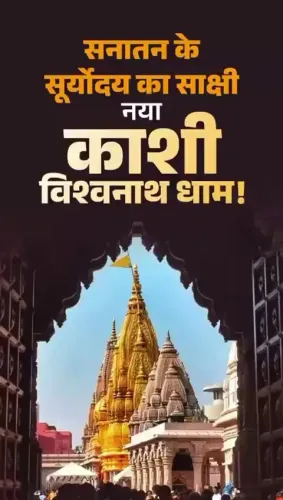
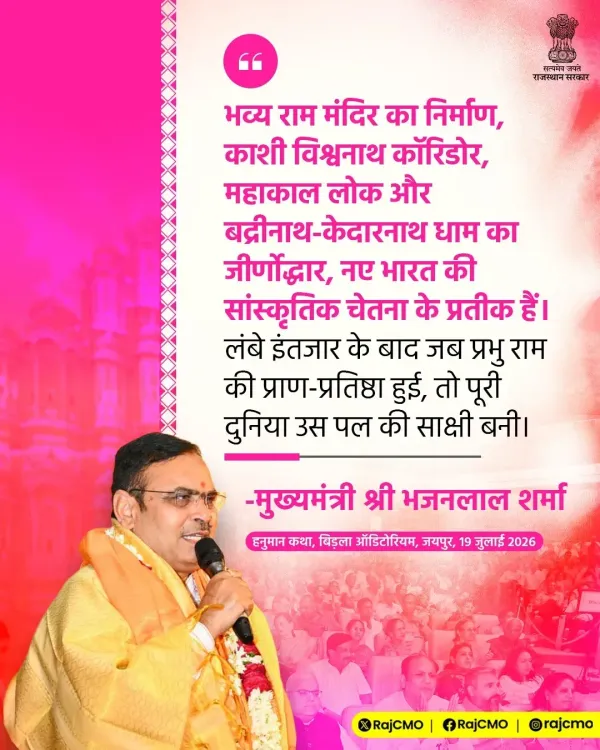
The Chief Minister's Office of Rajasthan, representing Chief Minister Bhajanlal Sharma, posted on Sunday, 19 July 2026, describing four major Hindu pilgrimage infrastructure projects as symbols of the cultural awakening of a new India. The post, shared on the official @RajCMO account, invoked the Ram Mandir in Ayodhya, the Kashi Vishwanath Corridor in Varanasi, Mahakal Lok in Ujjain, and the Badrinath-Kedarnath Dham restoration in Uttarakhand.
The Hindi-language post stated: 'Bhavy Ram Mandir ka nirman, Kashi Vishwanath Corridor, Mahakal Lok aur Badrinath-Kedarnath Dham ka jirnoddhar naye Bharat ki sanskritik chetna ke pratik hain' — translated as: 'The construction of the grand Ram Mandir, the Kashi Vishwanath Corridor, Mahakal Lok, and the restoration of Badrinath-Kedarnath Dham are symbols of the cultural consciousness of new India.' The post was tagged with the hashtag #AapnoAgraneeRajasthan ('Our Leading Rajasthan') and mentioned @BhajanlalBjp.
Context
The four projects cited span multiple states and were executed primarily under central government stewardship between 2019 and 2024. The Ram Mandir in Ayodhya was constructed following the Supreme Court's landmark 2019 verdict and was inaugurated in January 2024. The Kashi Vishwanath Corridor in Varanasi was formally inaugurated by Prime Minister Narendra Modi in December 2021, linking the ancient temple to the Ganga riverfront.
The Mahakal Lok corridor at the Mahakaleshwar Temple in Ujjain saw its Phase-1 inauguration in 2022, funded through central schemes. The Badrinath-Kedarnath Dham upgrades in Uttarakhand form part of the broader Char Dham all-weather road and shrine restoration initiative advanced since 2014.
Policy Backdrop
These projects collectively represent a sustained central policy focus on upgrading major Hindu pilgrimage sites through dedicated access corridors, modern amenities, and heritage conservation. The approach has been replicated across multiple states, combining religious tourism infrastructure with cultural identity messaging. Rajasthan's ruling BJP government, which came to power in December 2023 under Chief Minister Bhajanlal Sharma, has consistently aligned its state-level communications with national cultural priorities articulated at the Centre.
The hashtag #AapnoAgraneeRajasthan — meaning 'Our Leading Rajasthan' — is a recurring motif in the state government's social media outreach, framing Rajasthan's governance within a broader national development narrative.
Stakeholders and Impact
Pilgrims and the religious tourism sector are the most direct beneficiaries of the projects cited. Improved infrastructure at Ayodhya, Varanasi, Ujjain, and the Char Dham circuit has significantly expanded visitor capacity and accessibility. Temple trusts in Uttar Pradesh and Uttarakhand have been central to managing the upgraded sites.
For Rajasthan, which itself hosts major pilgrimage destinations, the messaging signals the state government's intent to position itself within the same cultural infrastructure narrative, potentially foreshadowing state-level investments in religious tourism.
What's Next
Observers will watch for further state-level endorsements or joint events between the Rajasthan government and the Centre on additional temple or heritage corridor projects. References to expanded pilgrimage circuits may appear in upcoming state budget sessions or central allocations for 2026-27. The post's framing suggests continued BJP alignment between Jaipur and New Delhi on cultural governance as a political and policy priority.
Point of View
Tying a state BJP government to the most visible religious infrastructure achievements of the Modi era. By invoking all four marquee projects in a single post, the messaging reinforces the party's identity as the custodian of Hindu heritage at both the national and state level. For Chief Minister Bhajanlal Sharma — still consolidating his position after a December 2023 election win — associating Rajasthan's brand with these nationally resonant symbols serves a dual purpose: domestic constituency reinforcement and visibility within the BJP's national hierarchy. The pattern is consistent with a broader BJP strategy of using cultural governance as a continuous political thread between election cycles.
NationPress
19 Oct 2026
Frequently Asked Questions
What is the Ram Mandir in Ayodhya and when was it inaugurated?
The Ram Mandir is a grand Hindu temple built in Ayodhya, Uttar Pradesh , following the Supreme Court's 2019 verdict awarding the disputed site for temple construction. It was inaugurated in January 2024 .
What is the Kashi Vishwanath Corridor?
The Kashi Vishwanath Corridor is a large redevelopment project in Varanasi, Uttar Pradesh , that created a wide, modern passage linking the ancient Kashi Vishwanath temple to the Ganga riverfront . It was inaugurated by Prime Minister Narendra Modi in December 2021 .
What is Mahakal Lok in Ujjain?
Mahakal Lok is an expanded corridor and beautification project at the Mahakaleshwar Temple in Ujjain, Madhya Pradesh . Its Phase-1 was inaugurated in 2022 with central government funding, significantly enhancing the pilgrimage experience.
Why did the Rajasthan CMO post about temple projects outside Rajasthan?
The post reflects the Rajasthan BJP government's practice of aligning state-level messaging with national cultural priorities championed by the party. Chief Minister Bhajanlal Sharma's office uses such posts to reinforce the BJP's identity as a guardian of Hindu heritage across India.
What are the Badrinath-Kedarnath Dham restoration projects?
These are ongoing infrastructure and restoration upgrades at the Badrinath and Kedarnath shrines in Uttarakhand , part of the central government's Char Dham all-weather road and shrine development initiative advanced since 2014 .