CM Dhami Hails Temple Rejuvenation as India's Cultural Renaissance
Synopsis
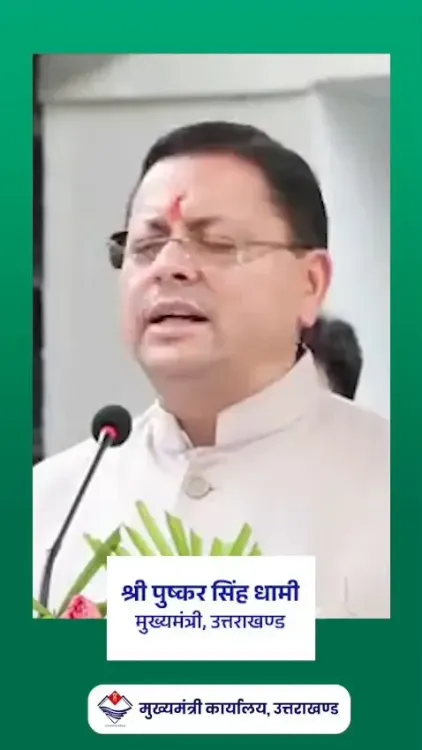
Chief Minister Pushkar Singh Dhami has described the sweeping rejuvenation of major Hindu temples — from Ayodhya and Somnath to Kedarnath and Badrinath — as a defining symbol of India's cultural renaissance, in a statement shared by the Uttarakhand CMO on 13 July 2026.
Key Takeaways
The Uttarakhand CMO on 13 July 2026 quoted CM Pushkar Singh Dhami calling temple rejuvenation across India a symbol of 'cultural renaissance.' Six major pilgrimage sites were named: Ayodhya, Somnath, Kedarnath, Kashi Vishwanath, Mahakaleshwar , and Badrinath Dham .
The PRASAD scheme , launched in 2014-15 , underpins national-level pilgrimage infrastructure upgrades at these sites.
The Ram Mandir in Ayodhya was consecrated in January 2024 ; the Kashi Vishwanath Corridor was launched in 2019 .
Uttarakhand's Char Dham road connectivity project , started around 2016 , has improved access to Badrinath and Kedarnath .
The statement reinforces Uttarakhand's positioning as a premier spiritual and cultural tourism destination.
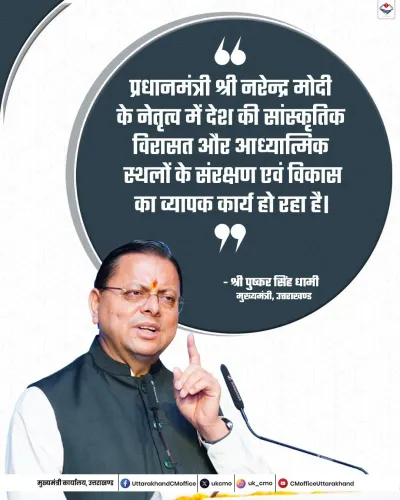
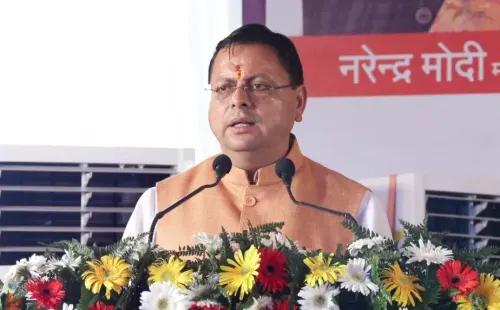
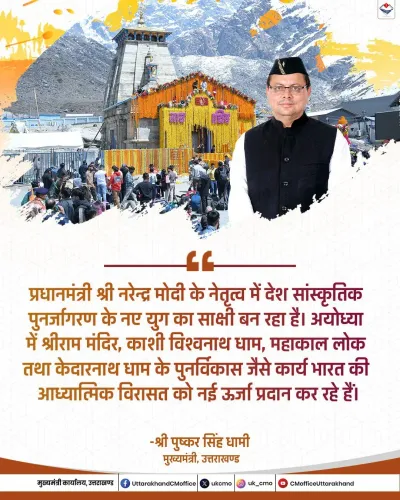
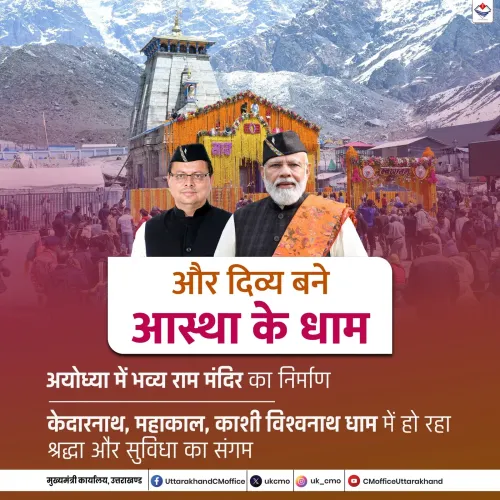
The Chief Minister's Office of Uttarakhand on Monday, 13 July 2026 shared a statement by Chief Minister Pushkar Singh Dhami describing the large-scale rejuvenation of Hindu temples across India — from Ayodhya to Somnath, Kedarnath to Kashi Vishwanath, and Mahakaleshwar to Badrinath Dham — as a symbol of the country's ongoing cultural renaissance.
Context
Dhami's statement, quoted verbatim by the official CMO handle, reads: 'Ayodhya se Somnath tak, Kedarnath ji se lekar Kashi Vishwanath tak, Mahakal se Shri Badrinath Dham tak mandiron ka kayakalp, Bharat ki saanskritik punerjagaran yatra ka pratik hai' — ('From Ayodhya to Somnath, from Kedarnath to Kashi Vishwanath, from Mahakal to Shri Badrinath Dham, the rejuvenation of temples is a symbol of India's cultural renaissance journey.')
The remark draws together six of the most prominent pilgrimage sites in India, spanning the states of Uttar Pradesh, Gujarat, Uttarakhand, and Madhya Pradesh, each of which has seen significant infrastructure or heritage redevelopment work in recent years.
Policy Backdrop
The temple redevelopment drive gained momentum after 2014, when the central government introduced the PRASAD scheme (Pilgrimage Rejuvenation and Spiritual, Heritage Augmentation Drive) under the Ministry of Tourism to upgrade pilgrimage infrastructure nationwide.
The Kashi Vishwanath Corridor in Varanasi was launched in 2019 to modernise the temple precinct, while the Ram Mandir in Ayodhya was consecrated in January 2024 following years of reconstruction. In Uttarakhand, the Char Dham road connectivity project, initiated around 2016, has improved access to Badrinath and Kedarnath. The Mahakaleshwar Temple in Ujjain has similarly been redeveloped as part of heritage conservation efforts.
These projects typically involve central-state coordination covering corridor construction, lighting upgrades, pilgrim amenities, and road and rail connectivity — a model that Uttarakhand has actively participated in given its position as the gateway to the Himalayan Char Dham circuit.
Stakeholders and Impact
The primary beneficiaries of this temple rejuvenation wave are pilgrims and the broader religious tourism sector. Improved infrastructure at major shrines has translated into record footfall at several sites, boosting local economies dependent on hospitality, transport, and ancillary services.
For Uttarakhand specifically, Kedarnath and Badrinath are central to the state's tourism revenue and identity. Chief Minister Dhami has consistently positioned the state as a spiritual and cultural destination, and his framing of temple redevelopment as a 'cultural renaissance' reinforces that brand at the national level.
What's Next
Observers will watch for the next phase of funding allocations for Char Dham infrastructure in Uttarakhand's state budget, as well as any announcements on new heritage corridors or pilgrim facilities at Badrinath and Kedarnath.
At the national level, parliamentary discussions on heritage scheme expansions and the inclusion of additional pilgrimage sites under central funding frameworks are likely to reflect the momentum signalled by statements such as Dhami's. The cultural-renaissance narrative is expected to remain a prominent thread in both state and central political communication ahead of forthcoming electoral cycles.
Point of View
Consolidating the BJP's decade-long narrative that temple restoration and Hindu heritage are central to India's national identity. By stringing together six sites across four states, the Uttarakhand CM aligns himself with a pan-India cultural project that transcends state boundaries and reinforces the party's ideological continuity from the Ram Mandir consecration to ongoing Char Dham development. For Uttarakhand, where pilgrimage tourism is an economic pillar, such framing also serves a practical purpose: anchoring state identity to a nationally resonant theme ahead of future electoral cycles. The 'cultural renaissance' framing is increasingly a standard rhetorical device among BJP chief ministers, suggesting coordinated messaging rather than an isolated local statement.
NationPress
12 Oct 2026
Frequently Asked Questions
What did CM Pushkar Singh Dhami say about temple rejuvenation in India?
CM Dhami stated that the rejuvenation of temples from Ayodhya to Somnath, Kedarnath to Kashi Vishwanath, and Mahakaleshwar to Badrinath Dham is a symbol of India's cultural renaissance journey, as quoted by the Uttarakhand CMO on 13 July 2026.
Which temples were mentioned in Dhami's cultural renaissance statement?
Dhami named six sites: Ayodhya, Somnath, Kedarnath, Kashi Vishwanath (Varanasi), Mahakaleshwar (Ujjain), and Badrinath Dham — spanning Uttar Pradesh, Gujarat, Uttarakhand, and Madhya Pradesh.
What is the PRASAD scheme and how does it relate to temple development in India?
The PRASAD scheme (Pilgrimage Rejuvenation and Spiritual, Heritage Augmentation Drive) was introduced in 2014-15 by the Ministry of Tourism to develop and modernise pilgrimage infrastructure across India, covering sites like Varanasi and the Char Dham circuit.
What infrastructure projects have been completed at Kedarnath and Badrinath?
The Char Dham road connectivity project, initiated around 2016, has significantly improved road access to both Kedarnath and Badrinath in Uttarakhand, complementing broader pilgrim facility upgrades at the two Himalayan shrines.
When was the Ram Mandir in Ayodhya consecrated?
The Ram Mandir in Ayodhya was consecrated in January 2024 following the completion of its reconstruction, making it one of the most prominent milestones in the temple rejuvenation wave referenced by CM Dhami.