Amit Shah credits Modi for completing decades-old cultural, national goals
Synopsis
Union Home Minister Amit Shah on 20 June 2026 credited PM Narendra Modi with completing a series of long-pending milestones — from the abrogation of Article 370 to the construction of Ram Mandir and redevelopment of Kashi Vishwanath, Mahakal Lok, and Somnath — framing them as decades-old promises fulfilled.
Key Takeaways
Amit Shah publicly credited PM Narendra Modi with completing five major cultural and constitutional milestones in a post on 20 June 2026 .
Article 370 was abrogated via presidential order and parliamentary legislation in August 2019 , ending Jammu and Kashmir's special autonomous status.
The Ram Mandir in Ayodhya followed a November 2019 Supreme Court verdict, with the foundation stone laid in 2020 .
The Kashi Vishwanath Corridor in Varanasi was inaugurated in 2021 ; Mahakal Lok at Ujjain 's Mahakaleshwar Temple was opened in 2022 .
The Somnath Swarnimization project refers to gold-plating and beautification of the ancient Shiva temple in Gujarat .
Shah's statement bundles a constitutional change with religious-heritage infrastructure projects as part of a unified BJP delivery narrative.
Union Home Minister Amit Shah on Saturday, 20 June 2026, publicly credited Prime Minister Narendra Modi with completing a series of long-pending cultural and constitutional milestones, listing the abrogation of Article 370, the construction of the Ram Mandir in Ayodhya, the Kashi Vishwanath Corridor, Mahakal Lok in Ujjain, and the Somnath Swarnimization as achievements delivered one after another under the BJP-led government.
Context
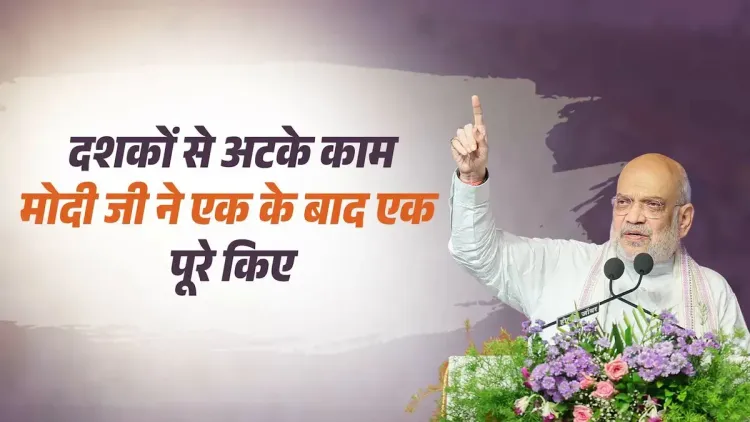
Shah's post, written in Hindi, states: 'Article 370 khatam, Ram Mandir ka nirman, Kashi Vishwanath Corridor, Mahakal Lok aur Somnath Swarnimikaran, dashakon se atke kaam Modi ji ne ek ke baad ek poore kiye' — translated as, 'Abolition of Article 370, construction of Ram Mandir, Kashi Vishwanath Corridor, Mahakal Lok and Somnath Swarnimization — work stalled for decades, Modi ji completed one after another.' The statement bundles a constitutional change with multiple religious-heritage infrastructure projects under a single political narrative of delivery.
The post was accompanied by a video, suggesting it may be part of a broader campaign communication or event coverage, though the specific occasion was not stated in the post itself.
Policy Backdrop
Article 370, which granted special autonomous status to Jammu and Kashmir, was abrogated via presidential order and parliamentary legislation in August 2019 — a move the BJP had promised in its election manifestos for decades. In November 2019, the Supreme Court cleared the path for the construction of the Ram Mandir at Ayodhya, with the foundation stone laid in 2020.
The Kashi Vishwanath Corridor in Varanasi, which links the ancient temple with the Ganga ghats, was inaugurated in 2021. The Mahakaleshwar Corridor — referred to as Mahakal Lok — at Ujjain's Mahakaleshwar Temple was opened in 2022. The Somnath beautification and gold-plating works, referred to as 'Swarnimization', relate to the ancient Shiva temple in Gujarat, a site with deep historical and political significance for the BJP.
Stakeholders and Impact
The initiatives cited span a wide set of stakeholders. Residents of Jammu and Kashmir have been directly affected by the constitutional reorganisation of the region following the 2019 abrogation. Hindu pilgrims and the broader tourism sector have seen significant infrastructure investment at Ayodhya, Varanasi, Ujjain, and Somnath, with corridor projects aimed at improving accessibility and visitor experience at some of India's most visited religious sites.
The redevelopment projects also carry economic implications for local communities dependent on pilgrimage tourism, while the constitutional change in Jammu and Kashmir continues to carry political and security dimensions that remain subjects of ongoing national debate.
What's Next
The BJP-led central government has signalled continued focus on heritage and religious-site redevelopment. Further phases of corridor projects at other Jyotirlinga sites are being watched, and related announcements could feature in upcoming union or state budgets and parliamentary sessions. Shah's post, framing these as a coherent record of delivery, is likely to form part of the party's political messaging ahead of electoral cycles.
Point of View
Weaving together a constitutional action — the abrogation of Article 370 — and a set of high-profile religious-heritage projects into a single narrative of governance delivery. The framing of these as 'work stalled for decades' is consistent with the BJP's long-standing electoral positioning, which casts the party as the fulfilment of promises made to a Hindu cultural majority. By listing these milestones together, Shah is reinforcing the ideological coherence of the Modi government's record ahead of what is likely an electorally sensitive period. The post also signals that cultural and civilisational achievements will remain a central pillar of the party's political communication strategy.
NationPress
19 Sept 2026
Frequently Asked Questions
What did Amit Shah say about PM Modi on 20 June 2026?
Amit Shah posted on X crediting PM Narendra Modi with completing five long-pending milestones: the abrogation of Article 370, the construction of Ram Mandir in Ayodhya, the Kashi Vishwanath Corridor, Mahakal Lok in Ujjain, and the Somnath Swarnimization project.
When was Article 370 abrogated?
Article 370 was abrogated in August 2019 through a presidential order and legislation passed in Parliament, ending Jammu and Kashmir's special autonomous status.
What is Mahakal Lok?
Mahakal Lok is the corridor and redevelopment project at the Mahakaleshwar Temple in Ujjain, Madhya Pradesh, which was opened in 2022 as part of the central government's religious-heritage infrastructure programme.
What is the Somnath Swarnimization project?
The Somnath Swarnimization refers to gold-plating and beautification works at the ancient Somnath Temple in Gujarat, one of the twelve Jyotirlinga shrines and a site of significant political and religious importance.
What is the Kashi Vishwanath Corridor?
The Kashi Vishwanath Corridor is an infrastructure project in Varanasi that links the Kashi Vishwanath Temple directly with the Ganga ghats; it was inaugurated in 2021 and is among the central government's flagship heritage redevelopment projects.