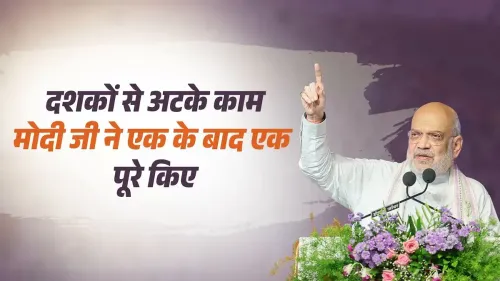
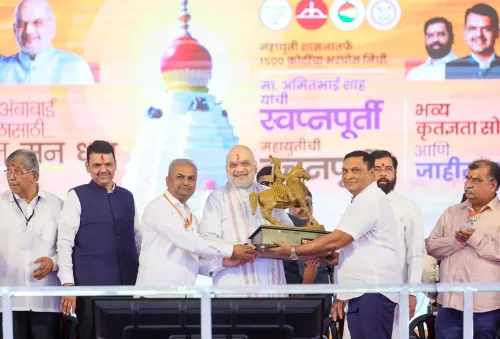
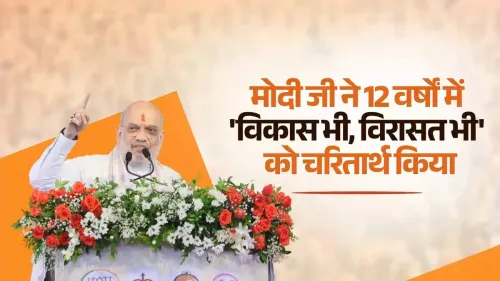
Amit Shah Marks 12 Years of Modi Govt With Vikas-Virasat Pitch
Synopsis
Union Home Minister Amit Shah on June 18, 2026, marked 12 years of the Modi government by listing achievements spanning the Ram Mandir, Ayushman Bharat, 668 repatriated artefacts, and classical status for 11 Indian languages, calling it a golden era of development and heritage.
Key Takeaways
Amit Shah described the Modi government's 12-year tenure as a 'golden period' combining development and cultural heritage.
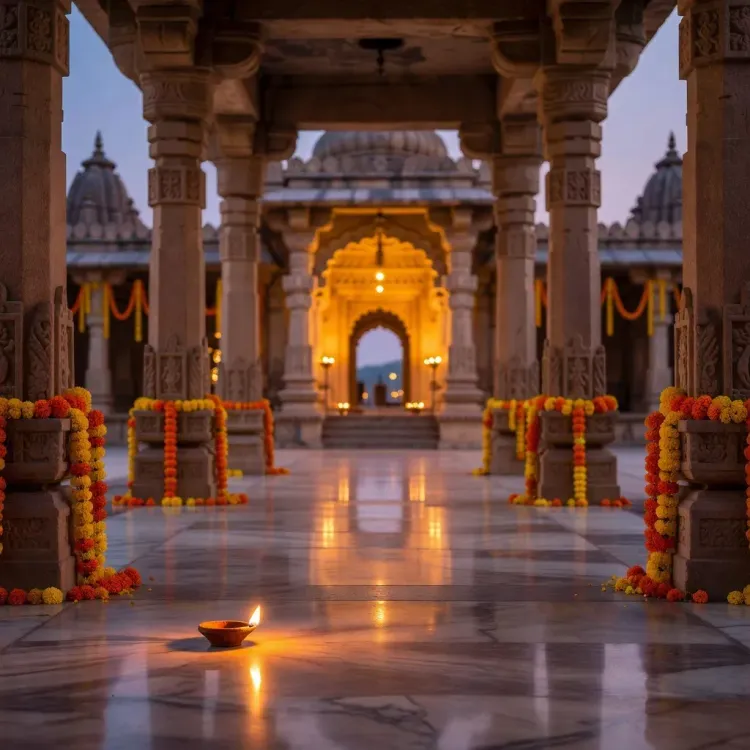
Major religious infrastructure cited includes the Shri Ram Mandir (Ayodhya) , Kashi Vishwanath Corridor (Varanasi) , and Mahakal Lok (Ujjain) .
Welfare schemes highlighted: PM Awas Yojana , Ayushman Bharat , and food security programmes alongside Make in India .
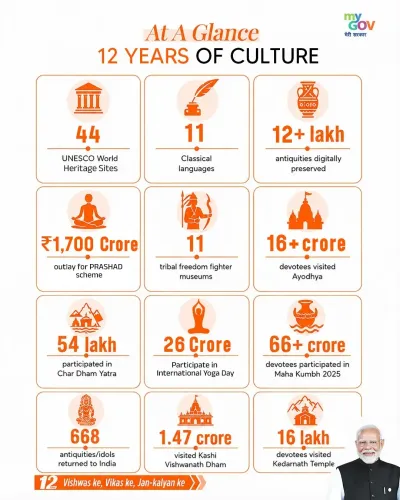
1 crore records digitised and 668 ancient artefacts repatriated as part of the heritage agenda.
11 Indian languages granted classical language status and 11 tribal freedom-struggle museums established.
The post was shared under the hashtag #12YearsOfVikasBhiVirasatBhi , signalling a coordinated BJP communication push.
Union Home Minister Amit Shah on Thursday, June 18, 2026, posted a sweeping tribute to the Modi government's 12-year record, framing it as a 'golden period' where development and heritage advanced together. The post, shared under the hashtag #12YearsOfVikasBhiVirasatBhi, cited religious infrastructure, welfare schemes, and cultural restoration as twin pillars of the government's tenure.
Context
Shah wrote in Hindi that the 12 years of the Modi government have been a 'vikas aur virasat ke sangam ka swarnim kaalakhand' — 'a golden era at the confluence of development and heritage.' He specifically named the construction of the Shri Ram Mandir in Ayodhya, the Kashi Vishwanath Corridor in Varanasi, and the Ujjain Mahakal Lok as landmark cultural achievements. On the welfare front, he highlighted schemes including PM Awas Yojana, Ayushman Bharat, and food security programmes, alongside the Make in India initiative and infrastructure expansion.
The post also listed four specific heritage milestones: the digitisation of 1 crore records, the repatriation of 668 ancient artefacts, the establishment of 11 tribal freedom-struggle museums, and the conferral of classical language status on 11 Indian languages. Shah concluded that these steps demonstrate development and heritage are 'complementary to each other.'
Policy Backdrop
The Shri Ram Mandir in Ayodhya was inaugurated in January 2024 after a decades-long legal and political journey, representing a defining moment for the ruling BJP's cultural agenda. The Kashi Vishwanath Corridor, completed in December 2021, redeveloped the area around one of Hinduism's most sacred temples in Varanasi, Uttar Pradesh. The Mahakal Lok corridor in Ujjain, Madhya Pradesh, was inaugurated in October 2022.
PM Awas Yojana, launched in 2015, targets housing for the rural and urban poor. Ayushman Bharat, rolled out in 2018, provides health insurance cover to economically vulnerable families for secondary and tertiary care. The Make in India initiative was announced in September 2014 to boost domestic manufacturing and attract foreign investment. Repatriation of antiquities gained significant momentum from 2014 onward through agreements with foreign museums and governments.
Classical language recognition in India has a precedent dating to 2004, when Tamil was first accorded the status, followed by Sanskrit in 2005. The current government has significantly expanded the list. The tribal freedom-struggle museums are part of a broader effort to mainstream the contributions of indigenous communities to India's independence movement.
Stakeholders and Impact
The post addresses multiple constituencies simultaneously: urban and rural beneficiaries of welfare schemes, Hindu pilgrims who have seen major religious sites upgraded, tribal communities whose historical contributions are being institutionally recognised, and the manufacturing and infrastructure sectors energised by policy initiatives. This breadth reflects the BJP's electoral coalition-building strategy ahead of future state and national polls.
Heritage organisations and archivists stand to benefit from the digitisation drive, while tribal communities gain symbolic and institutional recognition through dedicated museums. The 11 Indian languages now holding classical status represent a cultural acknowledgement for millions of speakers across regions, potentially influencing education and cultural funding policy.
What's Next
Parliamentary discussions on the next phase of classical language implementation — including funding for research chairs, universities, and digital archives — are expected in upcoming budget sessions. The operationalisation status of the 11 tribal freedom-struggle museums is also likely to draw scrutiny from opposition benches and civil society groups tracking their progress. As the BJP marks this governance milestone, the 'Vikas Bhi, Virasat Bhi' framing is expected to feature prominently in the party's communication strategy through the electoral cycle.
Point of View
The message positions cultural nationalism not as a distraction from governance but as governance itself. This framing is designed to consolidate both the party's ideological base and its broader welfare-recipient voter bloc simultaneously. With the '12 years' milestone being marked publicly and hashtagged, the post signals the start of a sustained retrospective campaign that will likely anchor BJP's messaging in the near-term electoral calendar.
NationPress
17 Sept 2026
Frequently Asked Questions
What is the '12 Years of Vikas Bhi Virasat Bhi' campaign about?
It is a BJP communication campaign marking 12 years of the Modi government, highlighting achievements in infrastructure, welfare schemes, religious heritage projects, and cultural initiatives such as classical language recognition and artefact repatriation.
Which religious projects did Amit Shah mention in his post?
Amit Shah cited the Shri Ram Mandir in Ayodhya, the Kashi Vishwanath Corridor in Varanasi, and the Mahakal Lok corridor in Ujjain as key religious infrastructure milestones of the Modi government.
How many artefacts have been repatriated to India under the Modi government?
Amit Shah's post states that 668 ancient artefacts have been returned to India, a process that gained momentum from 2014 onward through agreements with foreign museums and governments.
Which Indian languages were given classical language status by the Modi government?
Amit Shah's post states that 11 Indian languages have been granted classical language status under the Modi government, though the specific languages named in the post are not individually listed.
What is the Ayushman Bharat scheme mentioned by Amit Shah?
Ayushman Bharat is a national health insurance scheme launched in 2018 that provides cover for secondary and tertiary medical care to economically vulnerable families across India.