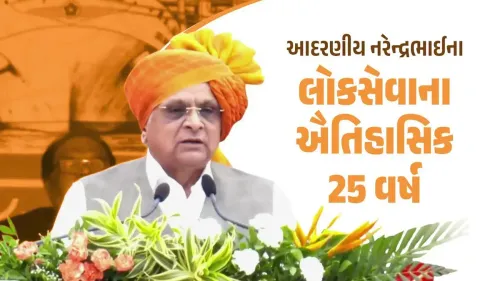
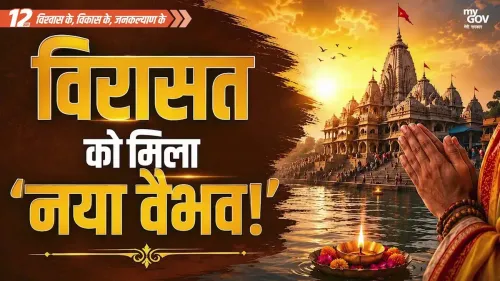
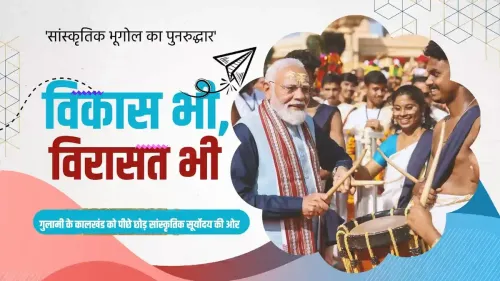
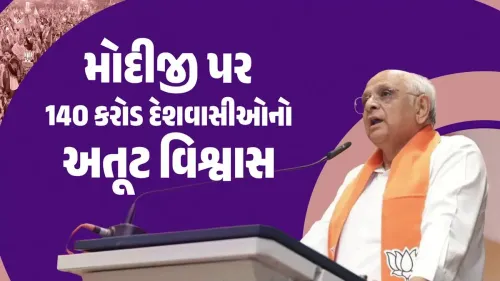
CM Bhupendra Patel Hails 12 Years of Modi's Heritage Revival

Synopsis
Gujarat CM Bhupendra Patel praised PM Modi's 12-year record on heritage revival, highlighting the transformation of Somnath and Pavagadh in Gujarat alongside national projects at Ayodhya, Kashi, and Ujjain as emblems of the 'Vikas Bhi, Virasat Bhi' vision.
Key Takeaways
Gujarat CM Bhupendra Patel posted on 18 June 2026 marking 12 years of the Modi government's cultural and heritage agenda.
He cited the Ram Temple in Ayodhya (consecrated 22 January 2024 ), Kashi Vishwanath Corridor (inaugurated December 2021 ), and Mahakal Lok in Ujjain (opened 2022 ) as landmark achievements.
Gujarat's Somnath Dhaam — the first Jyotirlinga — has undergone extensive redevelopment under central and state heritage schemes since 2014.
The Pavagadh Shaktipeeth in Gujarat saw the shikhar dhwaj reinstalled after what Patel described as five centuries , a milestone he called a matter of 'supreme pride' for the state.
Patel framed these achievements as the foundation of #ViksitBharat , linking cultural heritage to India's broader development vision for 2047.
Gujarat Chief Minister Bhupendra Patel on Thursday, 18 June 2026, credited Prime Minister Narendra Modi's twelve years in office with driving a 'great cultural renaissance' in India, citing the transformation of major Hindu pilgrimage sites as proof of the government's dual commitment to development and heritage. Patel specifically highlighted Gujarat's own gains — the rejuvenation of Somnath Dhaam and the reinstallation of the shikhar dhwaj (pinnacle flag) at Pavagadh Shaktipeeth after what he described as five centuries of wait.
Context
In his post on X, Patel wrote that under Modi's 'visionary leadership' India has fulfilled the resolve of 'Vikas Bhi, Virasat Bhi' ('Development as well as Heritage'), which he called the guiding principle of Viksit Bharat. He named the Ram Temple in Ayodhya, the Kashi Vishwanath Corridor, and the Mahakal Lok in Ujjain as symbols of 'new India's unbreakable faith.' The post was tagged #12YearsOfVikasBhiVirasatBhi and #ViksitBharat, framing the anniversary as both a cultural and developmental milestone.
The twelve-year mark referenced in the post aligns with May 2014, when the BJP-led National Democratic Alliance came to power at the Centre. Since then, heritage corridor and restoration projects have been executed at several Jyotirlinga and Shaktipeeth sites, with the central government positioning these as religious revival combined with tourism infrastructure investment.
Policy Backdrop
The Kashi Vishwanath Corridor in Varanasi was inaugurated in December 2021, widening pilgrim access and redeveloping the area around one of Hinduism's most revered Shiva temples. The Mahakal Lok corridor in Ujjain followed in 2022, extending the same heritage-tourism framework to the Mahakaleshwar Jyotirlinga. The Ram Temple pran-pratishtha ceremony — the consecration of the main sanctum — was held on 22 January 2024, marking the culmination of a decades-long legal and social movement.
In Gujarat, Somnath — the first among the twelve Jyotirlingas — has seen successive phases of redevelopment incorporated into state tourism master plans and central schemes since 2014. Pavagadh, a hilltop Shaktipeeth in the Champaner heritage zone, is associated with the Mahakali temple and has been the subject of restoration efforts that, according to Patel's post, culminated in the re-hoisting of the shikhar dhwaj for the first time in five centuries.
Stakeholders and Impact
Hindu devotees across India and the Gujarat tourism sector stand as the most direct beneficiaries of these projects. Improved pilgrim infrastructure at Somnath and Pavagadh has drawn increased footfall, feeding hotels, transport operators, and local artisan economies. Heritage conservation bodies have also been involved in site documentation and restoration at several of these corridors.
For the BJP, the projects carry significant political weight — they reinforce the party's identity as a champion of Hindu cultural revival while simultaneously being presented as economic multipliers under the Viksit Bharat 2047 vision. Chief Minister Patel's post underscores Gujarat's role as a model state in this framework, given its early and prominent focus on both Somnath and Pavagadh alongside its industrial growth narrative.
What's Next
Attention is now turning to additional state-level heritage corridor proposals and potential central funding announcements in the 2025-26 Union Budget cycle for temple-adjacent infrastructure. Gujarat is expected to push for further investment in pilgrimage circuits linking Somnath, Dwarka, Pavagadh, and Ambaji — four of the state's most visited religious sites. The 'Vikas Bhi, Virasat Bhi' slogan, now anchored to a twelve-year milestone, is likely to feature prominently in BJP's political messaging ahead of upcoming electoral cycles.
Point of View
Virasat Bhi' slogan alongside Viksit Bharat 2047, the party is reinforcing the argument that religious and cultural investment is inseparable from economic development, not a distraction from it. The enumeration of specific sites across multiple states signals a coordinated messaging exercise ahead of what is expected to be an electorally active period. Gujarat's positioning as a model for this dual-track governance approach also serves to elevate Patel's own profile within the BJP's federal hierarchy.
NationPress
19 Sept 2026
Frequently Asked Questions
What is 'Vikas Bhi Virasat Bhi' and what does it mean?
'Vikas Bhi Virasat Bhi' is a BJP government slogan meaning 'Development as well as Heritage,' used to describe its policy of investing in cultural and religious site restoration alongside economic infrastructure. CM Patel invoked it to mark 12 years of the Modi government.
What work has been done at Somnath temple under the Modi government?
The Somnath temple complex in Gujarat — the first of the twelve Jyotirlingas — has undergone redevelopment of its surrounding area including improved pilgrim facilities, promenade construction, and tourism infrastructure upgrades as part of central and state heritage schemes since 2014.
What is the significance of the Pavagadh shikhar dhwaj reinstallation?
The shikhar dhwaj, or pinnacle flag, is a sacred marker atop a Hindu temple's spire. CM Patel's post states it was reinstalled at the Pavagadh Mahakali Shaktipeeth after five centuries, which he described as a moment of supreme pride for Gujarat.
When was the Ram Temple in Ayodhya consecrated?
The Ram Temple in Ayodhya was consecrated in a pran-pratishtha ceremony on 22 January 2024 , marking the culmination of a decades-long legal and social movement following a Supreme Court verdict.
What is the Viksit Bharat vision mentioned in CM Patel's post?
Viksit Bharat, meaning 'Developed India,' is the Modi government's framework for making India a fully developed nation by 2047, the centenary of independence. CM Patel's post positions cultural heritage revival as a core pillar of this vision.