Rajasthan CMO Calls Citizens to Lead Road Safety Drive
Synopsis
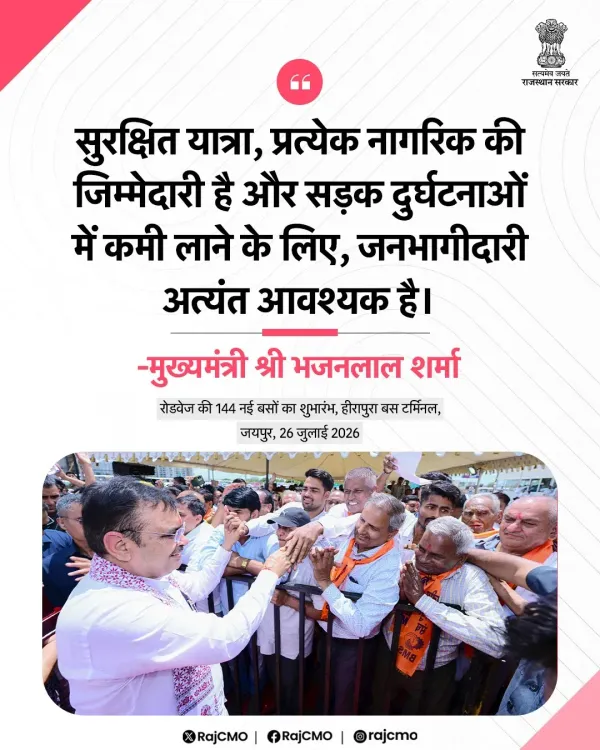
The Chief Minister's Office of Rajasthan on 27 July 2026 emphasised that safe travel is every citizen's responsibility and called for active public participation to reduce road accidents, tagging CM Bhajanlal Sharma under the 'Our Leading Rajasthan' governance brand.
Key Takeaways
The Chief Minister's Office of Rajasthan posted on 27 July 2026 stressing road safety as a shared civic duty.
The message directly tags Chief Minister Bhajanlal Sharma , signalling executive-level priority.
The post calls public participation 'absolutely essential' to reduce road accidents in the state.
The hashtag #आपणो_अग्रणी_राजस्थान ('Our Leading Rajasthan') links road safety to the state government's broader citizen-centric governance identity.
The messaging aligns with the Motor Vehicles (Amendment) Act, 2019 and India's commitments under the global Decade of Action for Road Safety .
Analysts expect possible follow-up in the form of structured awareness drives or coordination with national road safety campaigns.
The Chief Minister's Office of Rajasthan on Monday, 27 July 2026, underscored that road safety is a shared civic responsibility, urging active public participation to bring down the number of road accidents across the state. The post, directed at Chief Minister Bhajanlal Sharma, invoked the hashtag #आपणो_अग्रणी_राजस्थान ('Our Leading Rajasthan'), signalling the message as part of a broader state-led governance campaign.
Context
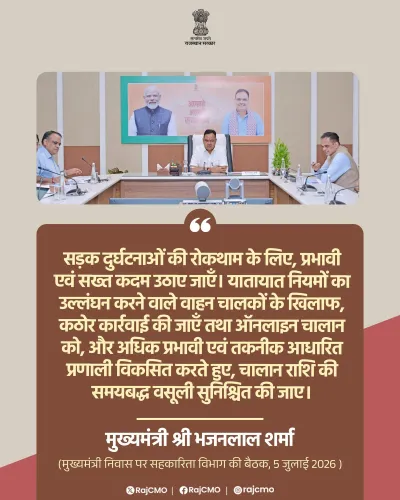
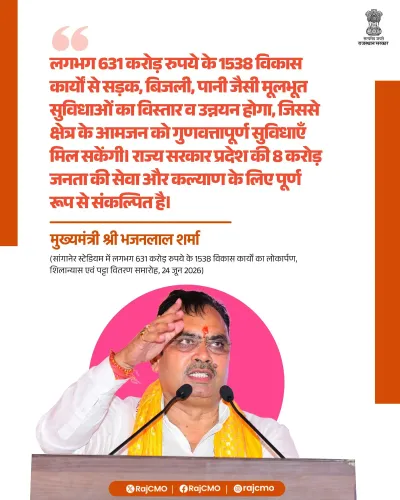
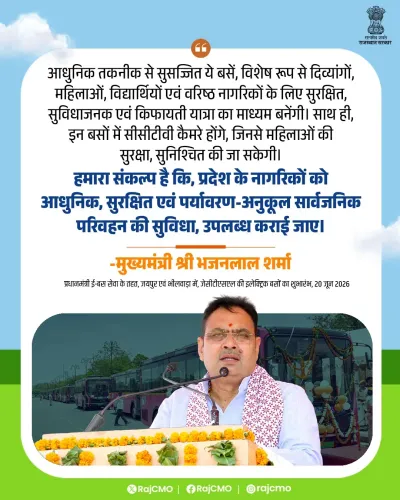
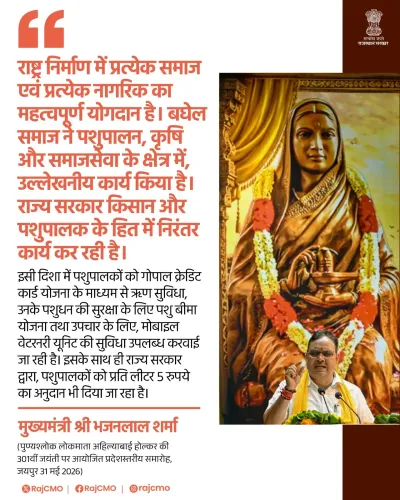
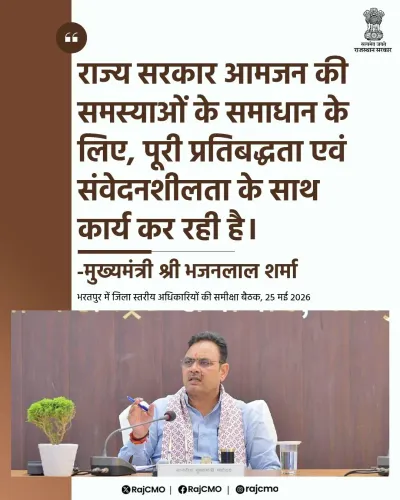
The CMO's post states, 'सुरक्षित यात्रा, प्रत्येक नागरिक की जिम्मेदारी है' — 'Safe travel is every citizen's responsibility' — and adds that public participation is absolutely essential to reduce road accidents. By tagging Chief Minister Bhajanlal Sharma's personal handle, the office signals that the message carries the weight of the highest executive in the state. The accompanying image reinforces the public-awareness character of the communication.
Policy Backdrop
Road safety messaging in Rajasthan sits within a well-established national framework. The Motor Vehicles (Amendment) Act, 2019 introduced significantly steeper penalties for traffic violations and mandated stricter safety standards, creating the legal backbone that state governments are expected to complement with on-ground awareness. India has also committed to the Decade of Action for Road Safety, a global framework that sets targets for halving road fatalities. States like Rajasthan are expected to translate these national commitments into localised campaigns and enforcement drives.
The hashtag #आपणो_अग्रणी_राजस्थान ('Our Leading Rajasthan') has been used by the Rajasthan government under Chief Minister Bhajanlal Sharma, who took office in December 2023, to brand a range of citizen-centric governance initiatives. Attaching road safety to this identity positions the issue as a flagship governance priority rather than a routine advisory.
Stakeholders and Impact
The primary audience is Rajasthan's general public — every road user, from daily commuters on state highways to residents navigating city traffic. By framing safe travel as a citizen's responsibility rather than solely a government function, the messaging seeks to shift behavioural norms at the individual level. This approach is consistent with a pattern seen across Indian states, where enforcement alone has proven insufficient and community-level ownership is increasingly viewed as critical to sustained reduction in fatalities.
Secondary stakeholders include traffic police, district administrations, and civil society organisations that typically partner with state governments to amplify road safety drives. Schools, transport unions, and local bodies are also common partners in such campaigns.
What's Next
The emphasis on public participation suggests the state may be preparing or already running structured awareness programmes — potentially including community outreach, school sensitisation drives, or coordination with national campaigns timed around high-risk periods such as festival seasons and highway travel peaks. Observers will watch whether this communication is followed by specific policy announcements, dedicated road safety weeks, or measurable targets tied to accident reduction in Rajasthan. The invocation of Chief Minister Sharma's handle indicates that executive-level attention to the issue is likely to translate into administrative follow-through in the coming weeks.
Point of View
The Bhajanlal Sharma administration is hedging accountability while building a participatory narrative around road safety. Attaching the message to the 'Aapno Agrani Rajasthan' brand elevates it from a routine advisory to a plank of governance identity, which is consistent with BJP-ruled states increasingly using social media to project proactive administration. The timing and tagging pattern suggest this is not an isolated post but a signal of a campaign in motion. Whether it translates into measurable outcomes — lower fatality rates or concrete programme launches — will be the real test of the political messaging.
NationPress
27 Jul 2026
Frequently Asked Questions
What did the Rajasthan CMO post about road safety on 27 July 2026?
The Chief Minister's Office of Rajasthan posted that safe travel is every citizen's responsibility and that public participation is absolutely essential to reduce road accidents in the state.
Who is Bhajanlal Sharma and why was he tagged in the road safety post?
Bhajanlal Sharma is the Chief Minister of Rajasthan, in office since December 2023. The CMO tagged his personal handle to signal that the road safety message carries executive-level endorsement.
What is the Aapno Agrani Rajasthan hashtag used in the post?
'Aapno Agrani Rajasthan' translates to 'Our Leading Rajasthan' and is a branding hashtag used by the Rajasthan government under CM Bhajanlal Sharma to unify citizen-centric governance campaigns.
What is India's national framework for road safety that Rajasthan's messaging aligns with?
India's road safety efforts are anchored in the Motor Vehicles (Amendment) Act, 2019, which introduced stricter penalties, and the global Decade of Action for Road Safety, which targets a significant reduction in road fatalities.
What can citizens expect to follow from Rajasthan's road safety awareness push?
Based on the state's pattern of governance campaigns, observers anticipate structured public awareness programmes, possible road safety weeks, and coordination with national campaigns, particularly ahead of high-traffic festival periods.