Tejashwi Yadav demands action after AK-47 used on Bihar students

Synopsis
RJD leader Tejashwi Yadav on 27 July 2026 condemned Bihar police for allegedly firing an AK-47 at student protesters, calling it India's first such Police Manual violation. He demanded immediate suspension of the district SP and senior officers, and accountability from the state Home Minister.
Key Takeaways
Tejashwi Yadav shared video evidence on 27 July 2026 of a Bihar police officer allegedly firing an AK-47 at student demonstrators.
Yadav called it the first case in India where an AK-47 was used against a student protest in violation of the Police Manual.
He demanded the immediate suspension of the district Superintendent of Police and senior officers.
Yadav called for the Bihar Home Minister's accountability to be fixed, warning of anarchy if no action is taken.
He described Chief Minister Nitish Kumar as a 'selected, not elected' CM, escalating political pressure on the state government.
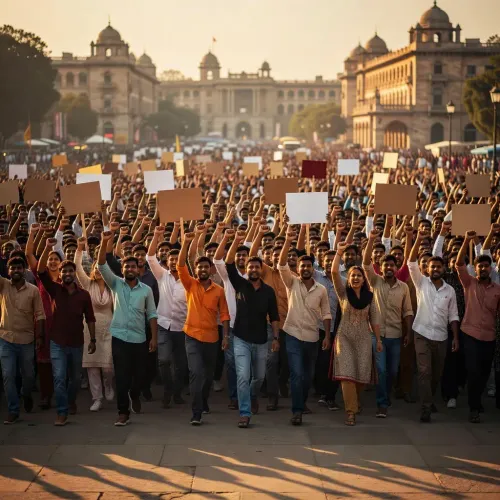
Peaceful protest is a constitutional right under Article 19, Yadav asserted, and the pattern must not be allowed to continue against any citizen group.
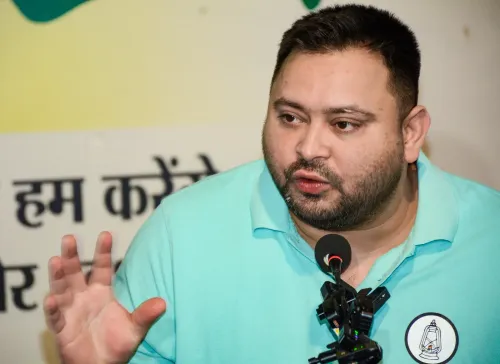
RJD leader Tejashwi Yadav on Monday, 27 July 2026, sharply condemned an incident in Bihar in which a police personnel allegedly fired an AK-47 rifle at student protesters, calling it the first such case in the country where a police manual was violated by using an assault rifle against a peaceful demonstration. Yadav demanded the immediate suspension of the district Superintendent of Police and senior officers, and called for the Home Minister's accountability to be fixed.
Context
Yadav shared a video of the alleged incident on X, writing: 'देखिए कैसे बिहार में छात्र प्रदर्शनकारियों पर पुलिसकर्मी AK-47 से गोली चला रहा है?' ('See how a police officer is firing an AK-47 at student protesters in Bihar?'). He described it as the first instance in the entire country where an AK-47 was used against any student protest in violation of the Police Manual. Peaceful protest, he emphasised, is a constitutional right of citizens in a democracy.
Yadav broadened the charge into a systemic warning, asking whether BJP governments would similarly open fire on lawyers, doctors, teachers, judges, women, farmers, and youth fighting for their rights if this 'precedent' were allowed to stand. He further raised the hypothetical — and pointed — question of whether any police officer could then fire upon any leader, minister, or Chief Minister at any time and place without cause.
Policy Backdrop
Indian police manuals across states prescribe a strict use-of-force protocol for crowd control, requiring graduated responses — from verbal warnings and lathi charges to rubber bullets — before live ammunition is ever authorised. The use of military-grade assault rifles such as the AK-47 in civilian protest situations falls well outside these prescribed norms and has no documented precedent in standard crowd-control operations in India.
Debates over police accountability and adherence to use-of-force guidelines have recurred in India since the 1970s, particularly in incidents involving student agitations, agrarian protests, and civil rights demonstrations. Opposition parties have consistently used such episodes to demand departmental action against district-level officers and ministerial accountability, citing Article 19 of the Constitution, which guarantees citizens the right to peaceful assembly.
Stakeholders and Impact
The most immediate stakeholders are the student protesters in Bihar who were present at the demonstration, as well as the police personnel involved and the senior officers of the district concerned. Yadav explicitly called for the suspension of the district SP and higher-ranking officers, arguing that responsibility cannot rest solely with the individual who pulled the trigger.
Yadav also directed sharp political criticism at Bihar Chief Minister Nitish Kumar, calling him an 'Elected नहीं Selected CM' ('not an elected but a selected Chief Minister') and saying the public had not chosen a person of 'criminal disposition' to lead the state. He warned that without fixing the Home Minister's accountability, the state would descend into anarchy. The intervention is likely to intensify pressure on the state government ahead of any official inquiry.
What's Next
Political observers will watch for an official response from the Bihar Home Department or the Chief Minister's office, any government-ordered inquiry into the firing incident, and possible departmental action against the officers named in Yadav's demand. The Bihar opposition is expected to raise the matter in the state legislature and may call for a judicial probe.
If the incident is confirmed by an independent inquiry, it could set a significant legal and procedural precedent for how police use-of-force complaints are adjudicated in India, and could energise student and civil-society groups across Bihar ahead of future agitations.
Point of View
A military-grade weapon, in a civilian protest setting, which, if confirmed, would represent a genuine procedural rupture from standard crowd-control doctrine. By widening the hypothetical to include lawyers, doctors, and judges, Yadav is attempting to convert a local law-and-order controversy into a broader civil-liberties argument with cross-constituency appeal. The 'selected not elected' framing against Chief Minister Nitish Kumar signals that the RJD intends to keep governance accountability at the centre of its political messaging as Bihar's political cycle progresses.
NationPress
27 Jul 2026
Frequently Asked Questions
What did Tejashwi Yadav say about the Bihar police AK-47 firing?
Tejashwi Yadav condemned Bihar police for allegedly firing an AK-47 at student protesters, calling it the first such case in India where a Police Manual was violated by using an assault rifle against a peaceful demonstration. He demanded the suspension of the district SP and senior officers and accountability from the Home Minister.
Is it legal for Indian police to use AK-47 rifles against protesters?
Indian police manuals prescribe a graduated use-of-force protocol for crowd control. The use of military-grade assault rifles such as the AK-47 in civilian protest situations falls outside standard crowd-control norms and has no documented precedent in routine police operations against demonstrators.
Who is Tejashwi Yadav?
Tejashwi Yadav is the Leader of the Opposition in the Bihar Legislative Assembly and a senior leader of the Rashtriya Janata Dal (RJD). He previously served as Deputy Chief Minister of Bihar.
What action did Tejashwi Yadav demand after the Bihar firing incident?
Yadav demanded the immediate suspension of the district Superintendent of Police and higher-ranking officers, and called for the Bihar Home Minister's accountability to be fixed, warning that inaction would lead to anarchy in the state.
What did Tejashwi Yadav say about Bihar Chief Minister Nitish Kumar?
Yadav referred to Chief Minister Nitish Kumar as a 'selected, not elected' Chief Minister, asserting that the public had not chosen a person of criminal disposition to lead Bihar.