Rajasthan CMO credits PM Modi on heritage repatriation, pilgrimage development
Synopsis
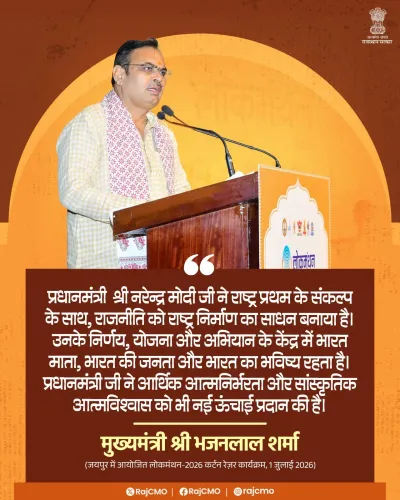
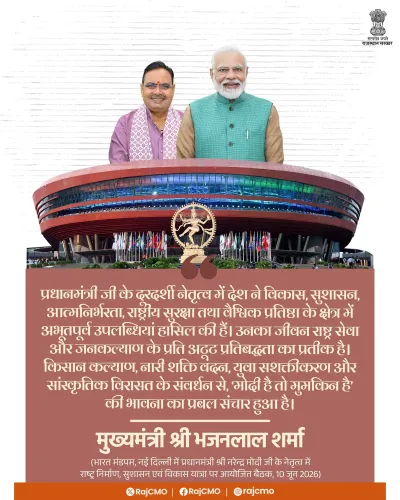
The Chief Minister's Office of Rajasthan praised PM Modi's record on repatriating ancient artefacts and developing pilgrimage sites, tagging CM Bhajanlal Sharma under the hashtag 'Our Foremost Rajasthan' in a cultural-identity-forward post on 20 November 2026.
Key Takeaways
The Chief Minister's Office of Rajasthan posted on 20 November 2026 crediting PM Narendra Modi with historic cultural and heritage achievements.
Two key themes cited: repatriation of ancient artefacts from foreign countries and large-scale development of religious pilgrimage sites ( aasthadhaams ).
CM Bhajanlal Sharma was tagged, linking the state government's identity to the central BJP cultural narrative.
The post is framed under the hashtag #आपणो_अग्रणी_राजस्थान ('Our Foremost Rajasthan'), a recurring state branding motif.
No specific new scheme, date, or statistic was announced — the post is a statement of political and cultural positioning.
From recovering centuries-old treasures scattered across foreign museums to transforming pilgrimage sites into centres of national pride, the Chief Minister's Office of Rajasthan has invoked a sweeping cultural narrative — crediting Prime Minister Narendra Modi's leadership with a series of what it calls historic acts of national consciousness, in a post on Friday, 20 November 2026.
The post, tagged to Chief Minister Bhajanlal Sharma under the hashtag #आपणो_अग्रणी_राजस्थान ('Our Foremost Rajasthan'), weaves together two distinct but symbolically linked policy threads: the repatriation of ancient cultural artefacts from abroad, and the large-scale development of aasthadhaams — revered places of faith. Together, the message frames these as milestones of 'national consciousness' under Modi's watch.
Repatriation of ancient artefacts: a signature diplomatic push
The return of India's ancient heritage from foreign collections has been one of the more visible cultural-diplomatic achievements cited by the central government in recent years. Statues, idols, and antiquities — many removed during colonial-era excavations or through illicit trade — have made their way back to India through bilateral negotiations and voluntary restitutions, with the Prime Minister personally receiving several such returns. For a BJP-led government that has consistently placed cultural identity at the centre of its governance narrative, each repatriation carries political as well as historical weight.
Rajasthan, with its rich reservoir of ancient temples, forts, and artefacts, has a direct stake in this agenda. The state is home to several heritage sites whose antiquities have historically found their way into private collections and foreign institutions.
Pilgrimage development and the 'aasthadham' agenda
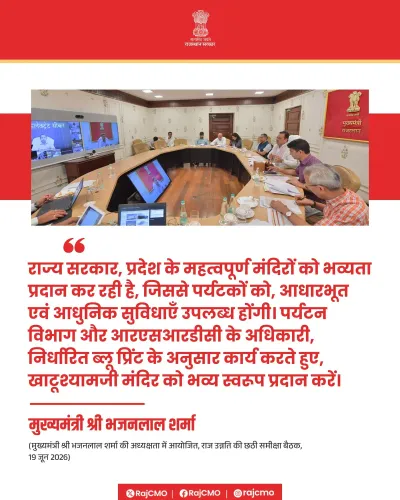
The second pillar of the post — development of places of faith — reflects a broader infrastructure thrust visible in projects such as the Kashi Vishwanath Corridor in Varanasi, the Mahakal Lok in Ujjain, and the Ram Temple in Ayodhya, all executed or accelerated under central government patronage. For Rajasthan specifically, pilgrim infrastructure at sites such as Pushkar, Nathdwara, and Khatushyamji falls within the ambit of this national template.
The state CMO's framing aligns Bhajanlal Sharma's government firmly with the central BJP narrative — presenting Rajasthan not merely as a beneficiary of these initiatives but as an active participant in a larger civilisational project.
A campaign message dressed as a cultural dispatch
The hashtag #आपणो_अग्रणी_राजस्थान — translating roughly to 'Our Leading Rajasthan' — is a recurring motif in the state government's communications, designed to reinforce the image of a proactive, forward-looking administration. By anchoring this message in PM Modi's national cultural record, the CMO signals that Rajasthan's governance identity is inseparable from the BJP's broader civilisational politics.
What the post does not specify is any concrete new scheme, date, or project — leaving the narrative as a statement of political positioning rather than a policy announcement. The religious communities and heritage conservation sector who stand to gain most from these initiatives will be watching for state-level follow-through that gives this rhetoric a street address.
Point of View
The communication collapses the distinction between governance and identity politics. For CM Bhajanlal Sharma, still consolidating his authority after the BJP's return to power in Rajasthan, being seen as a faithful executor of Modi's civilisational vision is itself a political asset. The absence of any new concrete announcement suggests this is brand maintenance, not a policy signal — but in India's current political economy, that distinction matters less than it once did.
NationPress
20 Nov 2026
Frequently Asked Questions
What ancient artefacts has India repatriated under PM Modi?
India has recovered hundreds of antiquities from countries including the United States, United Kingdom, Australia, and several European nations through diplomatic negotiations and voluntary restitutions, with PM Modi personally receiving several returned items during bilateral visits.
What is the hashtag #आपणो_अग्रणी_राजस्थान about?
It translates to 'Our Foremost Rajasthan' and is a recurring campaign hashtag used by the Bhajanlal Sharma government to brand Rajasthan as a proactive, leading state under BJP rule.
Who is Bhajanlal Sharma?
Bhajanlal Sharma is the Chief Minister of Rajasthan and a senior BJP leader who took office after the BJP's victory in the 2023 Rajasthan assembly elections.
Which pilgrimage sites in Rajasthan could benefit from central government development schemes?
Key pilgrimage sites in Rajasthan include Pushkar, Nathdwara, and Khatushyamji, which have historically been targets for state and central government infrastructure upgrades aligned with the broader religious tourism agenda.
What is India's national policy on cultural heritage repatriation?
India actively pursues the return of smuggled or illegally exported antiquities through the Archaeological Survey of India, bilateral treaties, and diplomatic engagement, a policy that has gained significant momentum and visibility under the current central government.