Rajasthan CMO salutes five achievers as state's pride
Synopsis
The Chief Minister's Office of Rajasthan on 9 August 2026 publicly honoured five individuals — Arundhati Chaudhary, Yashveer Singh, Rahul Sharma, Mona Agarwal, and Sandhya Vishnoi — calling them the pride of the state and urging youth to draw inspiration from them.
Key Takeaways
The Chief Minister's Office of Rajasthan named five individuals as the pride of the state on 9 August 2026 .
Those honoured are Arundhati Chaudhary , Yashveer Singh , Rahul Sharma , Mona Agarwal , and Sandhya Vishnoi .
The post was tagged to Chief Minister Bhajanlal Sharma and carried the hashtag #आपणो_अग्रणी_राजस्थान .
The CMO explicitly called on Rajasthan's youth to draw inspiration from the five individuals.
The specific achievements that prompted the recognition were not detailed in the official post.
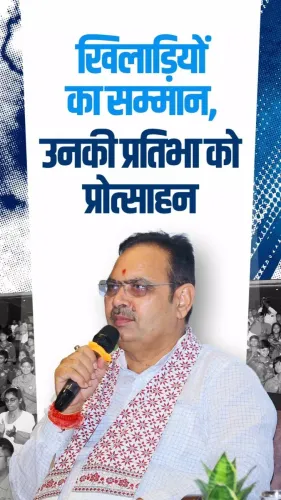
Five names. One message from the highest office in Rajasthan: these are the people your children should look up to. The Chief Minister's Office of Rajasthan on Sunday, 9 August 2026 spotlighted Arundhati Chaudhary, Yashveer Singh, Rahul Sharma, Mona Agarwal, and Sandhya Vishnoi as the pride of the state, calling on the youth of Rajasthan to draw inspiration from them.
The post, tagged to Chief Minister Bhajanlal Sharma with the hashtag #आपणो_अग्रणी_राजस्थान ('Our Leading Rajasthan'), reads: 'Arundhati Chaudhary, Yashveer Singh, Rahul Sharma, Mona Agarwal and Sandhya Vishnoi are the pride of the state, and the youth should draw inspiration from them.'
Five names the CMO wants Rajasthan to remember
Official recognition from a state's chief ministerial office carries weight beyond a social-media post — it signals that an achievement has crossed the threshold from personal success to public symbol. By naming all five individuals directly and pairing the tribute with the state's aspirational hashtag, the Rajasthan government is deliberately weaving their stories into the larger narrative of a forward-moving state.
State governments across India have long used official handles to amplify individual accomplishments, turning local heroes into motivational touchstones for younger residents. The choice to invoke youth explicitly — 'the youth should draw inspiration' — suggests the CMO is positioning these five as role models in an active, ongoing conversation with the next generation.
Bhajanlal Sharma's brand of state pride
Chief Minister Bhajanlal Sharma, who took office in December 2023, has leaned into the idea of Rajasthan as an 'agrani' — a leading, pioneering — state since assuming charge. The hashtag #आपणो_अग्रणी_राजस्थान has become a recurring motif in the CMO's communication strategy, used to frame everything from infrastructure wins to individual achievements under a single, pride-forward identity.
Recognising citizens by name on the official handle is consistent with that approach: it makes abstract state progress personal and relatable. Whether these recognitions are tied to a specific government scheme, award programme, or recent competitive result has not been specified in the post.
The kicker is straightforward: when a government puts five names in front of an entire state's youth and says 'look here', it is making a bet — that these individuals' journeys are compelling enough to move the next generation. Rajasthan's young people will decide if that bet pays off.
Point of View
Who has consistently deployed the 'agrani Rajasthan' frame since December 2023, such posts serve a dual function: they reward achievers and simultaneously reinforce the government's narrative of a state on the rise. The youth-directed call to 'draw inspiration' is also a soft signal that the administration is thinking about its next electoral constituency. Whether the recognition translates into tangible policy support — scholarships, scheme linkages, public felicitations — will determine its lasting impact beyond the news cycle.
NationPress
23 Sept 2026
Frequently Asked Questions
Who are the five people Rajasthan CMO called the pride of the state?
The Rajasthan Chief Minister's Office named Arundhati Chaudhary, Yashveer Singh, Rahul Sharma, Mona Agarwal, and Sandhya Vishnoi as the pride of the state in a post on 9 August 2026.
Why did the Rajasthan CMO post about these five individuals?
The CMO honoured them as role models for Rajasthan's youth, urging young people to draw inspiration from them, though the specific achievements that prompted the tribute were not detailed in the official post.
Who is the Chief Minister of Rajasthan in 2026?
Bhajanlal Sharma of the BJP has been the Chief Minister of Rajasthan since December 2023 and was tagged in the tribute post.
What does the hashtag Aapno Agrani Rajasthan mean?
'Aapno Agrani Rajasthan' translates to 'Our Leading Rajasthan' and is a recurring hashtag used by the Rajasthan CMO to project the state as a pioneering, forward-moving entity.
Is Mona Agarwal from Rajasthan?
The Rajasthan CMO's post identifies Mona Agarwal as one of five individuals who are the pride of Rajasthan, though no further biographical detail was provided in the official post.