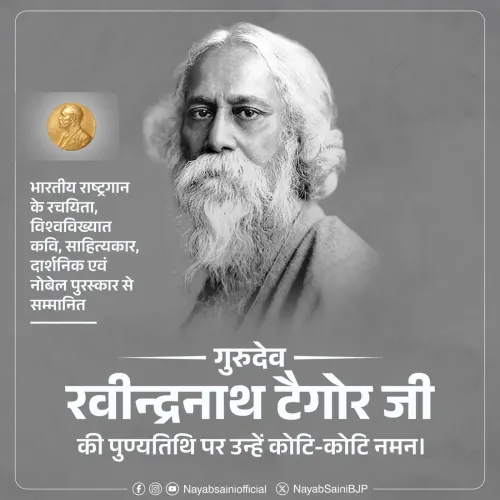
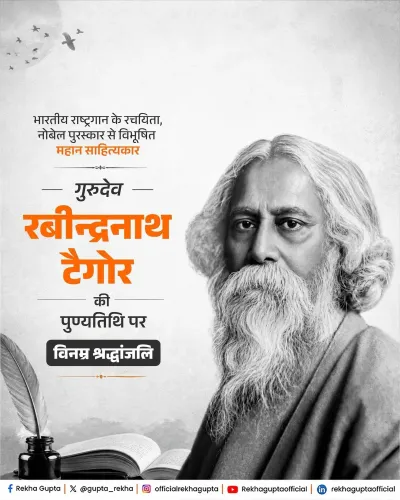
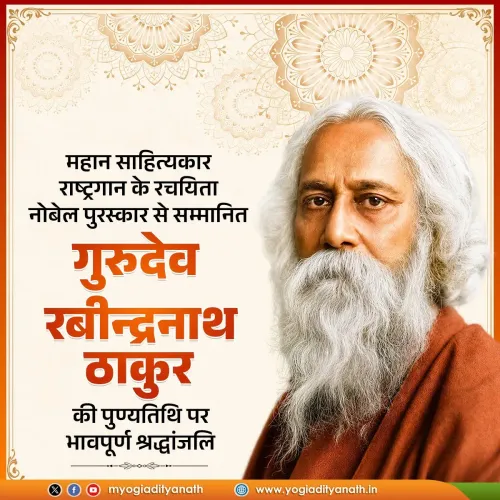
Rajasthan CMO pays tribute to Tagore on his death anniversary
Synopsis
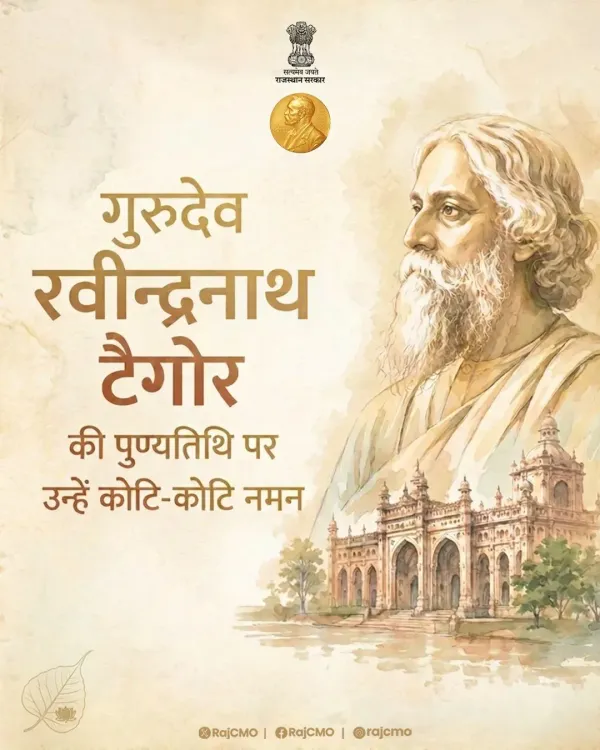
The Chief Minister's Office of Rajasthan honoured Rabindranath Tagore on his death anniversary on 7 August 2026, saluting the Nobel laureate's literary genius, his composition of the national anthem, and his enduring influence on Indian culture and human values.
Key Takeaways
Rabindranath Tagore's death anniversary falls on 7 August , the date he passed away in 1941 .
Tagore received the Nobel Prize in Literature in 1913 for Gitanjali , the first non-European to win the honour.
He composed Jana Gana Mana , adopted as India's national anthem.
He founded Visva-Bharati University in Santiniketan, pioneering a philosophy of education rooted in nature and creativity.
The Chief Minister's Office of Rajasthan joined a nationwide tradition of state governments observing Tagore's anniversary since 1947.
On the death anniversary of Rabindranath Tagore — Nobel laureate, composer of India's national anthem, and the poet who gave Indian civilisation a global voice — the Chief Minister's Office of Rajasthan offered a reverential tribute on 7 August 2026, bowing to a legacy that has endured for over eight decades.
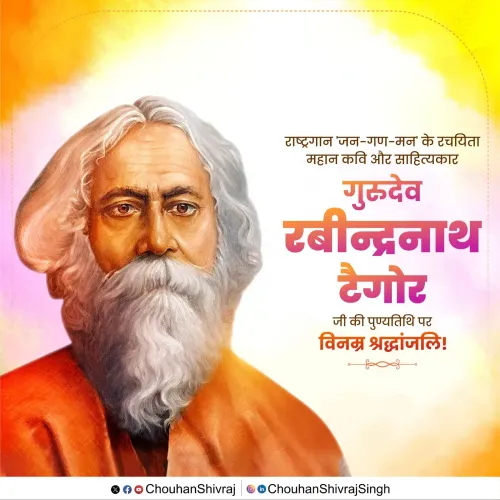
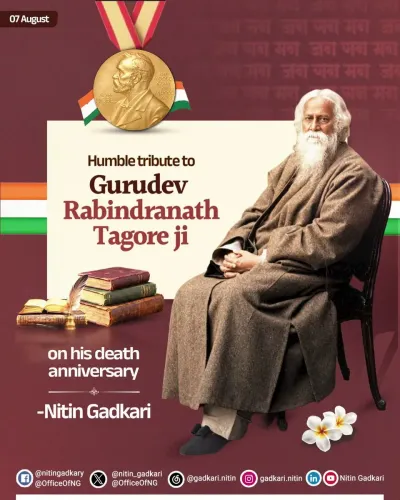
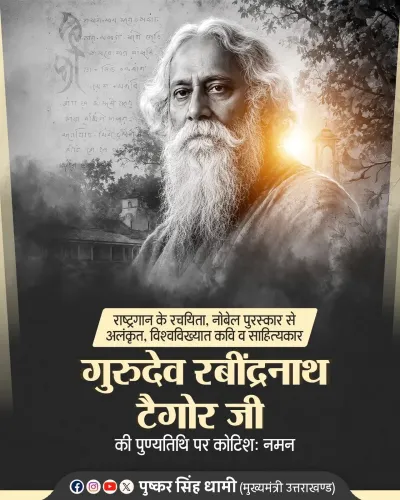
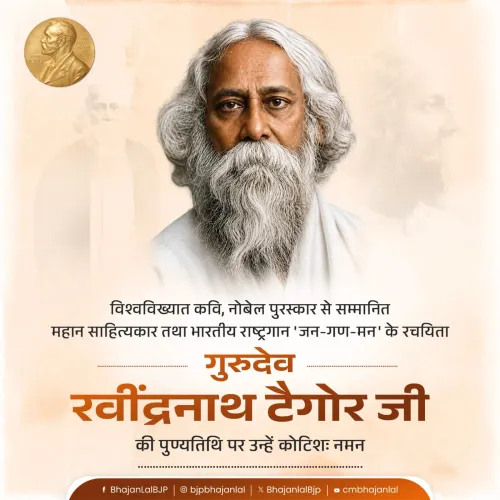
The post, shared in Hindi, paid homage to Tagore as 'rashtragan ke rachayita' (composer of the national anthem) and the recipient of the Nobel Prize in Literature, honouring him through the words: his timeless literary works, music, philosophy of education, and commitment to human values gave Indian culture its place on the world stage.
The man behind Jana Gana Mana
Rabindranath Tagore was born on 7 May 1861 in Calcutta and passed away on 7 August 1941 — the date India observes each year as his punyatithi (death anniversary). He was awarded the Nobel Prize in Literature in 1913 for his poetry collection Gitanjali, becoming the first non-European to receive the honour. His composition Jana Gana Mana was adopted as India's national anthem, a fact that alone places him at the very foundation of the republic's identity.
Beyond verse, Tagore founded Visva-Bharati University in Santiniketan, West Bengal — a living experiment in education rooted in nature, creativity, and the synthesis of Indian and global thought. His influence stretched across literature, music, painting, and social reform, making him one of the most complete intellectuals modern India has produced.
A ritual of remembrance, year after year
State governments across India have observed Tagore's death anniversary since 1947, issuing commemorative statements that reaffirm his role in shaping the country's cultural identity. The Rajasthan CMO's tribute follows this national pattern — a collective act of memory that connects citizens to a shared heritage, without new policy announcements or schemes attached.
The message from Jaipur underlines that Tagore's ideology, creativity, and patriotism continue to inspire 'karon logon ko' — crores of people — to this day. That is not rhetoric. It is simply the arithmetic of a poet who wrote the words every Indian child learns before they learn anything else.
Point of View
Using a universally revered figure to signal continuity with India's composite heritage. For Rajasthan's CMO, the tribute carries no partisan edge: Tagore transcends political lines, which is precisely why his anniversaries function as safe but meaningful moments of institutional solidarity. The pattern also reflects how Indian public institutions use cultural commemoration as soft governance — reinforcing shared identity without legislative action.
NationPress
7 Aug 2026
Frequently Asked Questions
When is Rabindranath Tagore's death anniversary?
Rabindranath Tagore's death anniversary falls on 7 August . He passed away on 7 August 1941 in Calcutta.
Why did Rajasthan CMO pay tribute to Tagore?
The Chief Minister's Office of Rajasthan paid tribute to Tagore on his death anniversary, 7 August 2026 , honouring his contributions to Indian literature, music, education, and the composition of the national anthem.
What Nobel Prize did Rabindranath Tagore win?
Rabindranath Tagore won the Nobel Prize in Literature in 1913 for his poetry collection Gitanjali , becoming the first non-European to receive the award.
Who composed India's national anthem Jana Gana Mana?
Rabindranath Tagore composed Jana Gana Mana, which was adopted as India's national anthem after independence.
What is Visva-Bharati University and who founded it?
Visva-Bharati University in Santiniketan, West Bengal, was founded by Rabindranath Tagore as an experimental institution blending Indian and global educational philosophies, with nature and creativity at its core.