Rajasthan CMO urges MLAs to stay accessible to constituents
Synopsis
The Chief Minister's Office of Rajasthan on 16 July 2026 publicly directed state MLAs to remain accessible to constituents and resolve their problems with sensitivity, reinforcing the state's grassroots governance push under the #AapnoAgraniRajasthan campaign.
Key Takeaways
The Rajasthan CMO issued a public directive on 16 July 2026 calling on all state MLAs to be readily accessible to their constituents.
The message emphasised resolving citizen grievances with sensitivity — not merely acknowledging them.
The post carried the hashtag #AapnoAgraniRajasthan , linking the directive to the state government's broader development branding.
Rajasthan's 200-seat Legislative Assembly means the directive applies to legislators representing constituencies across the entire state.
The CMO's public framing signals that MLA accessibility is being treated as an institutional expectation, not just a personal commitment.
Follow-up circulars or district-level review mechanisms from the CMO are being watched as the next indicator of enforcement intent.
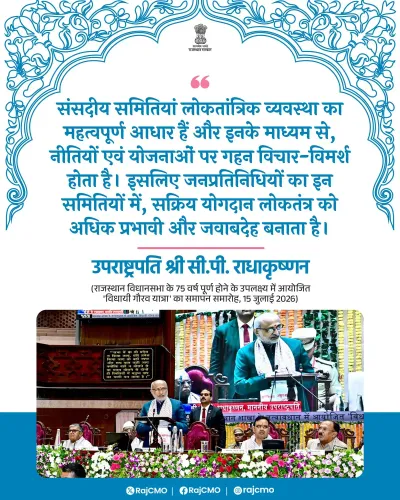
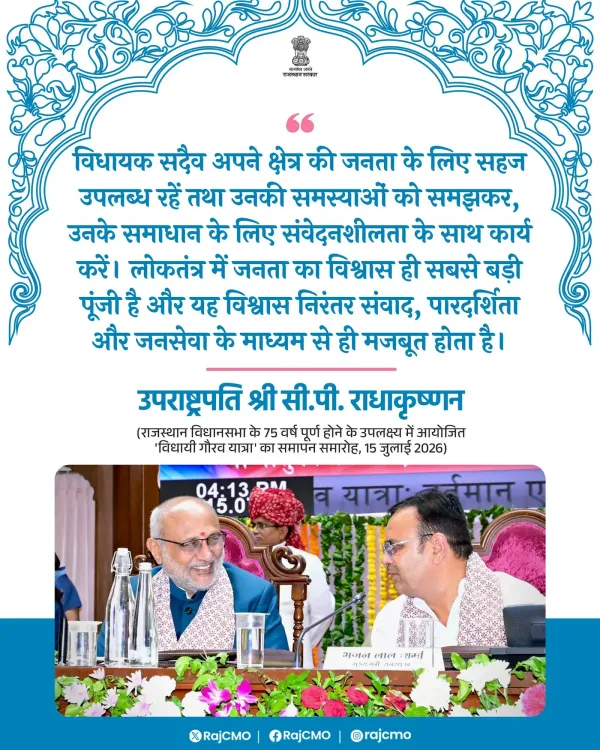
The Chief Minister's Office of Rajasthan on Thursday, 16 July 2026 issued a public directive urging all state legislators to remain readily accessible to the people of their constituencies and to address citizen grievances with sensitivity and purpose. The message, posted on the official CMO account on X, reflects a renewed emphasis on grassroots responsiveness within the state's governance framework.
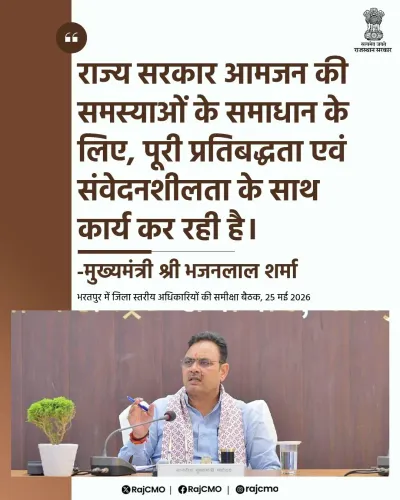
The post, written in Hindi, states: 'Vidhayak sadaiv apne kshetra ki janta ke liye sahaj uplabdh rahein tatha unki samasyaon ko samajhkar, unke samadhan ke liye samvedanshilta ke saath karya karein' — ('MLAs should always remain easily accessible to the people of their area and, by understanding their problems, work with sensitivity towards their resolution.')
Context
The directive was shared with a tag to @CPR_VP and accompanied by the hashtag #AapnoAgraniRajasthan (Aapno Agrani Rajasthan), a campaign phrase broadly translating to 'Our Leading Rajasthan.' The use of this hashtag signals alignment with the state government's broader branding around development and progressive governance.
The Rajasthan Legislative Assembly is a unicameral body whose elected members are constitutionally positioned as the primary interface between citizens and the government. Periodic reminders of this representative duty — particularly through high-visibility public channels — have been a recurring feature of governance communication in the state.
Policy Backdrop
Rajasthan governments across administrations have maintained mechanisms for citizen grievance redressal, including the Jan Sunwai portal framework that has been expanded and revised since the 2000s. MLA orientation programmes and CMO circulars on constituency responsiveness have historically accompanied such platforms, reinforcing the administrative expectation that legislators serve as active conduits for public concerns.
Across Indian states, chief ministers and their offices routinely issue such guidance to ruling-party legislators, particularly in the lead-up to assembly sessions or local body elections. The messaging typically aims to reinforce administrative accountability at the grassroots level and signal government attentiveness to voter concerns.
Stakeholders and Impact
The directive is directed at all Rajasthan MLAs, who collectively represent constituencies spanning the state's 200 assembly segments. For ordinary residents — especially in rural and semi-urban areas — the accessibility of their local legislator often determines how effectively they can navigate government schemes, infrastructure complaints, and welfare entitlements.
Civil society groups and citizen grievance forums in Rajasthan have long flagged inconsistent MLA availability as a barrier to effective constituency service. A public communication of this nature from the CMO carries institutional weight, signalling that the expectation of accessibility is not merely aspirational but is being actively monitored and promoted at the highest level of the state executive.
What's Next
Observers will watch for follow-up action from the Rajasthan CMO, including any circulars establishing performance metrics for MLA outreach, district-level review meetings, or integration with existing grievance redressal platforms. Proceedings of the Rajasthan Vidhan Sabha's forthcoming sessions may also reflect this emphasis on legislator accountability and constituent engagement.
Point of View
The office makes the expectation visible to voters, effectively creating a public benchmark against which MLA performance can be judged. This aligns with a wider pattern seen across Indian states where ruling establishments use social media to demonstrate executive attentiveness ahead of electoral cycles. The invocation of the #AapnoAgraniRajasthan hashtag further ties routine governance messaging into a cohesive state-branding effort, suggesting the communication is as much about political optics as administrative instruction.
NationPress
16 Jul 2026
Frequently Asked Questions
What did the Rajasthan CMO say to MLAs on 16 July 2026?
The Rajasthan Chief Minister's Office directed all state legislators to remain easily accessible to their constituents and to work with sensitivity in resolving public grievances.
What does #AapnoAgraniRajasthan mean?
'Aapno Agrani Rajasthan' is a Hindi-Rajasthani phrase meaning 'Our Leading Rajasthan,' used as a campaign hashtag by the state government to brand its governance and development initiatives.
How many MLAs does the Rajasthan Legislative Assembly have?
The Rajasthan Vidhan Sabha is a unicameral legislature with 200 elected members, each representing a separate assembly constituency across the state.
Does the Rajasthan government have a formal grievance redressal system for citizens?
Yes. Rajasthan has maintained grievance redressal platforms including the Jan Sunwai framework, which has been expanded since the 2000s to allow citizens to register complaints and track their resolution.
Why do chief ministers issue public directives to MLAs about accessibility?
Such directives reinforce the constitutional role of legislators as the primary link between citizens and government. Public messaging on X also signals accountability to voters and is common across Indian states, often intensifying before assembly sessions or elections.