Rajasthan CMO: Yamuna Water Pact Realised Under Modi's Double-Engine Govt
Synopsis
The Chief Minister's Office of Rajasthan announced on 21 July 2026 that the Yamuna water agreement has been realised under PM Narendra Modi's leadership, citing the BJP's double-engine government model as the enabling factor for the long-pending inter-state water accord.
Key Takeaways
The Chief Minister's Office of Rajasthan announced on 21 July 2026 that the Yamuna water agreement has been realised.
The announcement credits PM Narendra Modi and the 'double-engine government' model for delivering the pact.
Chief Minister Bhajan Lal Sharma was tagged in the post, signalling state-level ownership of the achievement.
The Yamuna water framework traces back to the 1994 MoU among riparian states and the Upper Yamuna River Board .
Farmers and residents in Rajasthan's eastern districts are the primary intended beneficiaries of the agreement.
Key implementation milestones to watch include release schedules from Hathni Kund barrage and Rajasthan-Haryana canal coordination meetings.
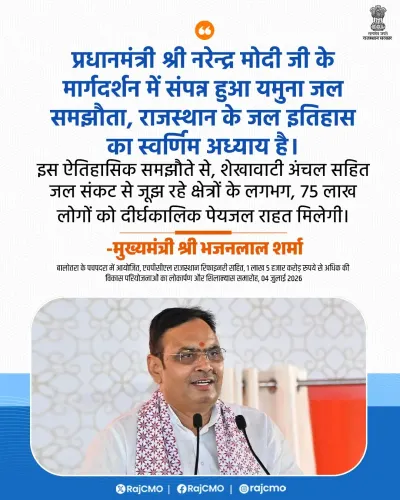
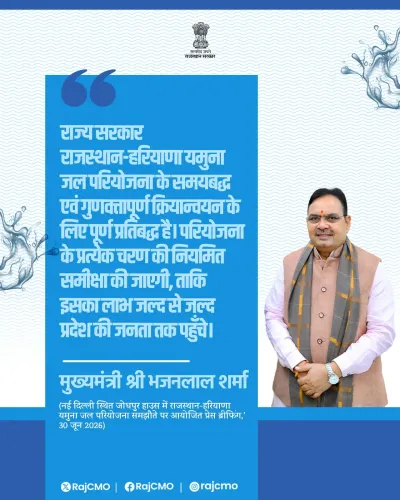
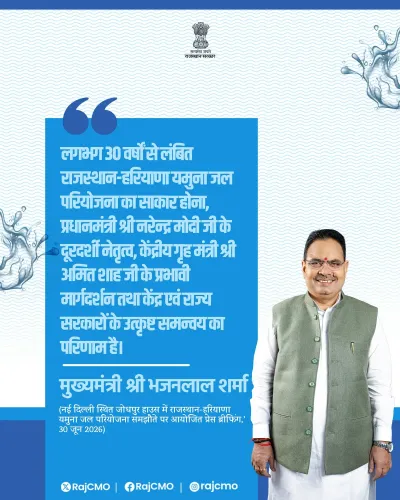
The Chief Minister's Office of Rajasthan announced on Tuesday, 21 July 2026 that the Yamuna water agreement has been realised under the leadership of Prime Minister Narendra Modi, crediting the BJP's 'double-engine government' framework for delivering the long-pending inter-state water accord.
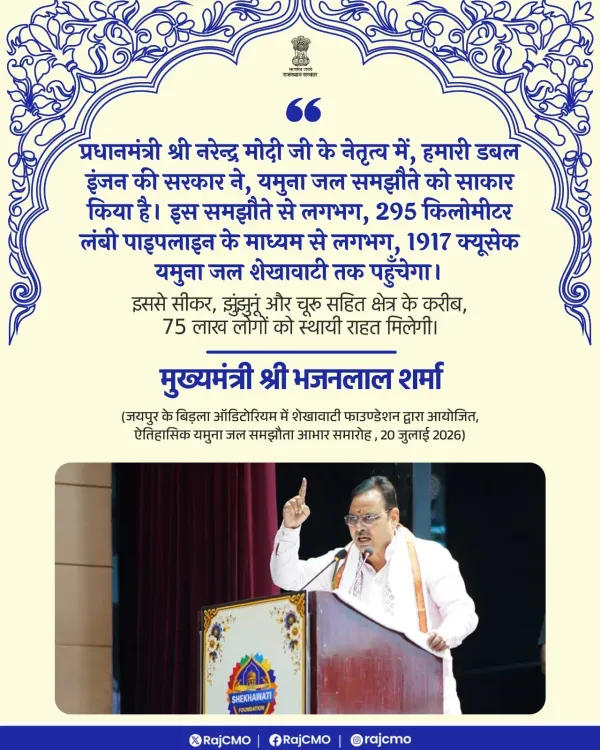
The post, attributed to the CMO and tagging Chief Minister Bhajan Lal Sharma (@BhajanlalBjp), read: 'Pradhan Mantri Shri Narendra Modi ji ke netritva mein, hamari double engine ki sarkar ne, Yamuna jal samjhaute ko sakar kiya hai' — meaning, 'Under the leadership of Prime Minister Shri Narendra Modi ji, our double-engine government has realised the Yamuna water agreement.' The post was accompanied by the hashtag #आपणो_अग्रणी_राजस्थान ('Our Pioneering Rajasthan'), a campaign phrase associated with the current state government.
Context
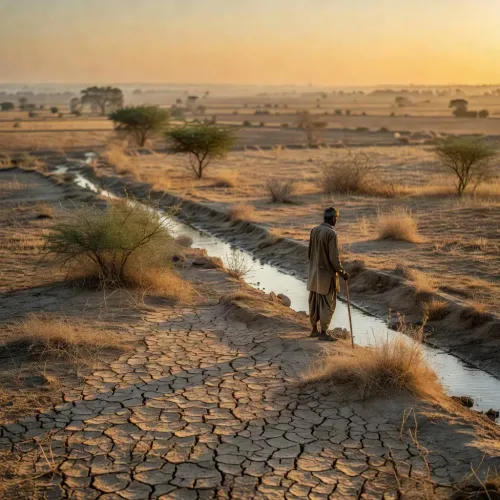
The Yamuna river is a shared resource among several north Indian states, including Uttar Pradesh, Haryana, Delhi, and Rajasthan. Rajasthan's share of Yamuna waters is critical for its eastern districts, which depend on canal-fed irrigation and drinking water supply. The CMO's announcement frames the agreement's realisation as a direct outcome of political alignment between the central and state governments — both governed by the BJP.
Policy Backdrop
The foundational framework for Yamuna water sharing dates to the 1994 Memorandum of Understanding signed by the riparian states, which also established the Upper Yamuna River Board to regulate distribution. In 2015, the central government reconstituted the Board to expedite pending projects and resolve long-standing allocation disputes. The current announcement suggests a further milestone in operationalising commitments under that framework, though the precise signing date or new quantitative allocations of the referenced agreement have not been independently confirmed.
The 'double-engine government' concept — a recurring BJP formulation — argues that states governed by the same party as the Centre receive faster policy delivery and resource allocation. The Rajasthan CMO's framing positions the Yamuna accord as evidence of this model working in practice, mirroring similar claims made around earlier river agreements including those concerning the Mahadayi and Ravi-Beas river systems.
Stakeholders and Impact
The primary beneficiaries of any enhanced Yamuna water allocation for Rajasthan would be farmers in the state's eastern belt, where agriculture is heavily dependent on surface water availability. Drinking water supply to towns and cities in that region also stands to improve if release schedules from key barrages are regularised. Coordination between Rajasthan and Haryana — the upstream state through which Yamuna waters flow — will be central to translating the agreement into ground-level delivery.
Other riparian stakeholders, including Delhi and Uttar Pradesh, have their own allocation interests under the 1994 MoU, meaning any revision or operationalisation of the pact carries implications across multiple state governments and millions of water users.
What's Next
Observers will watch for concrete release schedules from the Hathni Kund barrage — the primary control point for Yamuna water distribution — as well as any formal Rajasthan-Haryana coordination meetings on canal lining and utilisation certificates. The Upper Yamuna River Board is expected to play a central role in monitoring compliance and seasonal water releases. The CMO's announcement is likely to be followed by state-level communications detailing specific infrastructure timelines and district-level beneficiary data.
Point of View
The state government is seeking to convert an administrative milestone into a visible governance win ahead of any future electoral cycle. The move also signals Rajasthan's intent to assert its water rights more confidently within the Upper Yamuna River Board framework, where the state has historically been a less dominant voice compared to Haryana and Delhi. Whether the announcement translates into measurable increases in water availability for eastern Rajasthan's farmers will be the real test of its substance.
NationPress
20 Oct 2026
Frequently Asked Questions
What is the Yamuna water agreement for Rajasthan?
The Yamuna water agreement is an inter-state pact, rooted in the 1994 MoU among riparian states, that allocates a share of Yamuna river flows to Rajasthan for irrigation and drinking water supply, particularly for its eastern districts.
What is the double-engine government model?
The 'double-engine government' is a BJP political framework arguing that states governed by the same party as the central government receive faster policy implementation and resource allocation, as both engines — Centre and state — work in the same direction.
Who is the Chief Minister of Rajasthan in 2026?
Bhajan Lal Sharma has been the BJP Chief Minister of Rajasthan since December 2023 and was tagged in the CMO's announcement regarding the Yamuna water agreement.
What is the Upper Yamuna River Board?
The Upper Yamuna River Board is a central body established under the 1994 MoU among riparian states — Haryana, Uttar Pradesh, Rajasthan, Delhi, and Himachal Pradesh — to regulate the distribution of Yamuna waters and oversee related infrastructure.
Which districts of Rajasthan benefit from Yamuna water?
The eastern districts of Rajasthan are the primary beneficiaries of Yamuna water allocations, relying on canal networks fed by Yamuna flows for both agricultural irrigation and urban drinking water supply.