Rajasthan CMO: Yamuna water pact a foundation for prosperity
Synopsis
The Rajasthan CMO on 1 July 2026 framed the Rajasthan-Haryana Yamuna Water Project Agreement as a foundation for water security and prosperity for crores of residents, going beyond a routine water-sharing arrangement, as both BJP-governed states push cooperative infrastructure.
Key Takeaways
The Chief Minister's Office of Rajasthan on 1 July 2026 publicly characterised the Rajasthan-Haryana Yamuna Water Project Agreement as a development compact, not merely a water-sharing deal.
Chief Minister Bhajan Lal Sharma , in office since December 2023 , is the named political face of the announcement.
The agreement builds on the framework established by the 1994 MoU among five northern states and the Upper Yamuna River Board .
Both Rajasthan and Haryana are currently governed by the BJP , facilitating bilateral cooperation on water infrastructure.
Rajasthan farmers, urban water users, and semi-arid district communities are the primary intended beneficiaries.
Detailed project reports, central funding approvals, and Upper Yamuna River Board review are the next critical steps.
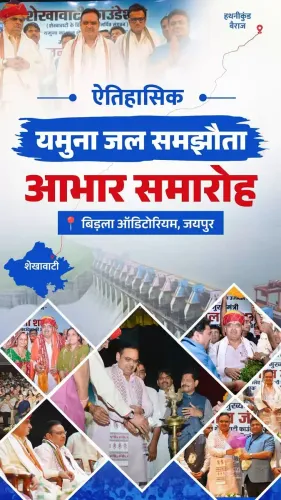
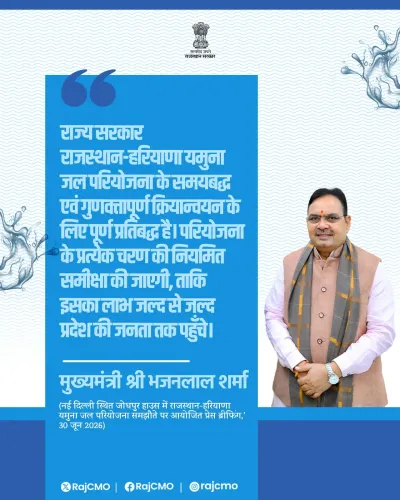
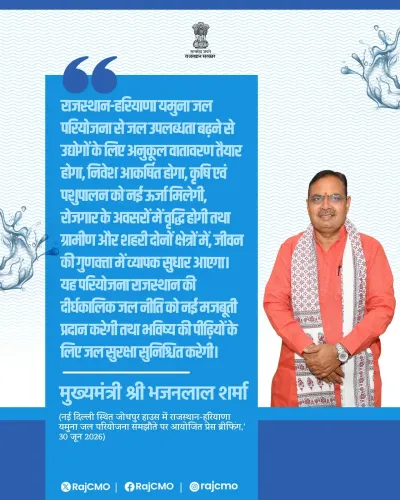
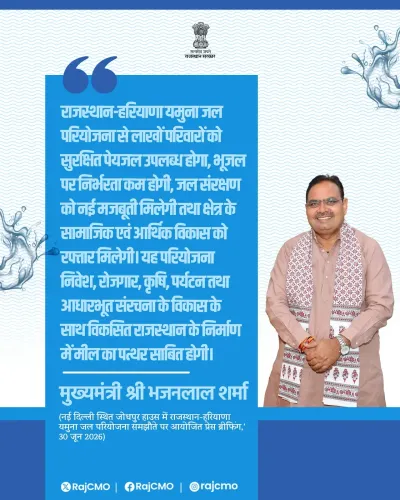
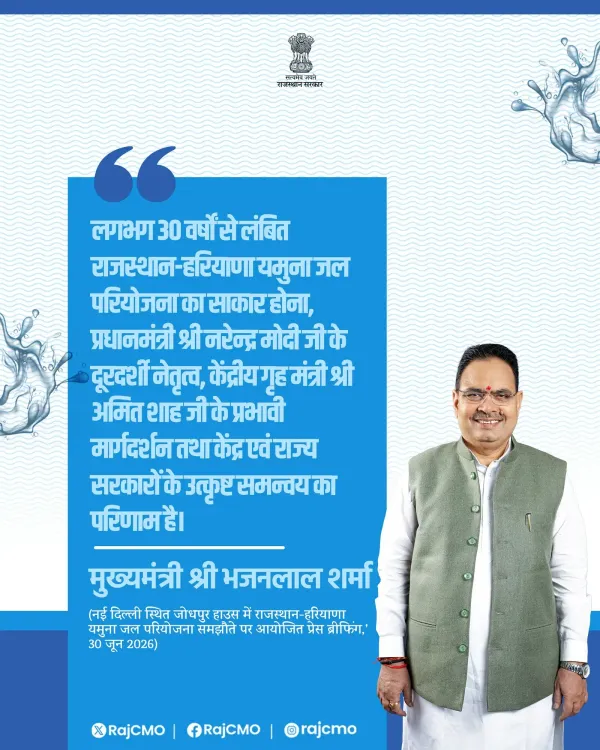
The Chief Minister's Office of Rajasthan on Wednesday, 1 July 2026 described the Rajasthan-Haryana Yamuna Water Project Agreement as far more than a water-sharing arrangement, calling it a powerful foundation for the bright future, water security, and prosperity of crores of residents of the state.
Context
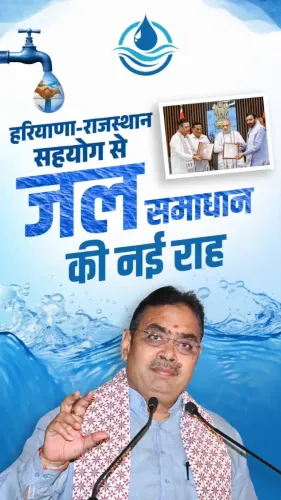
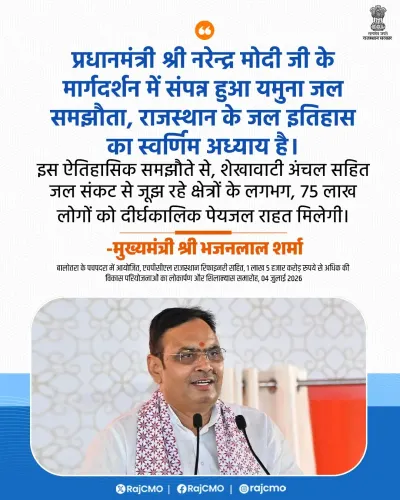
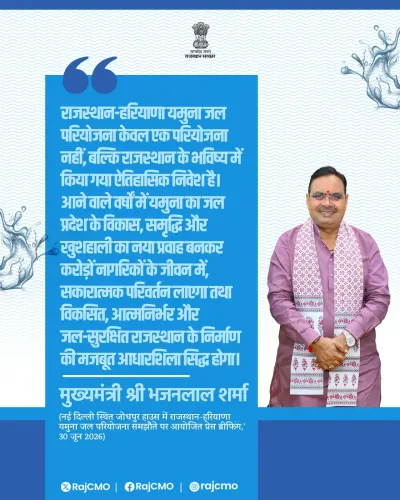
The official post, attributed to the office of Chief Minister Bhajan Lal Sharma, states in Hindi: 'राजस्थान-हरियाणा यमुना जल परियोजना समझौता जल बंटवारे का करार नहीं, बल्कि करोड़ों प्रदेशवासियों के उज्ज्वल भविष्य, जल सुरक्षा और समृद्धि का सशक्त आधार है।' ('The Rajasthan-Haryana Yamuna Water Project Agreement is not merely a water-sharing deal, but a strong foundation for the bright future, water security, and prosperity of crores of people of the state.') The framing deliberately elevates the agreement beyond a technical allocation exercise, positioning it as a development compact between two neighbouring states.
Policy Backdrop
Inter-state Yamuna water arrangements in India date back to the landmark 1994 Memorandum of Understanding signed among Uttar Pradesh, Haryana, Rajasthan, Delhi, and Himachal Pradesh, which also established the Upper Yamuna River Board as the nodal body for oversight. Rajasthan, a predominantly arid state, has long depended on river-water allocations from external basins to meet irrigation and drinking-water needs across its semi-arid districts. Haryana, sharing the Yamuna basin, has been a critical partner in canal infrastructure that channels water westward into Rajasthan.
With both states currently governed by the Bharatiya Janata Party (BJP), cooperative project announcements have gained momentum, contrasting with earlier periods when inter-state water disputes were adjudicated by tribunals rather than resolved through bilateral agreements. Groundwater depletion in several districts of both states has added urgency to surface-water infrastructure projects.
Stakeholders and Impact
The agreement's primary beneficiaries are expected to be Rajasthan's farming communities in districts that rely on canal irrigation, as well as urban and peri-urban populations facing seasonal drinking-water shortages. Haryana farmers and water users also stand to gain from coordinated infrastructure that can reduce wastage and improve distribution efficiency along shared canal networks.
The CMO's language — invoking 'water security' and 'prosperity' — signals that the state government intends to present this pact as a flagship achievement under CM Bhajan Lal Sharma's tenure, which began in December 2023. The hashtag #आपणो_अग्रणी_राजस्थान ('Our Leading Rajasthan') reinforces the political messaging around state-led development.
What's Next
Key milestones to watch include the preparation and approval of detailed project reports, clearances and funding from the central government, and the agreement's formal consideration by the Upper Yamuna River Board. Progress on these steps will determine whether the announcement translates into tangible infrastructure on the ground. Any joint review meeting between Rajasthan and Haryana officials will be a signal of implementation momentum.
Point of View
Designed to give the pact a development-narrative weight ahead of future electoral cycles. The fact that both Rajasthan and Haryana are BJP-governed states makes this kind of cooperative announcement structurally easier, echoing a broader pattern in Indian federal politics where same-party state governments fast-track bilateral infrastructure deals that cross-party configurations tend to stall. The invocation of 'water security' taps into a nationally resonant concern, particularly as groundwater tables fall across north India's semi-arid belt. Whether the announcement moves from political messaging to physical infrastructure will depend on the speed of detailed project reports and central government funding — the two pressure points that have historically delayed similar inter-state water projects.
NationPress
29 Sept 2026
Frequently Asked Questions
What is the Rajasthan-Haryana Yamuna Water Project Agreement?
It is a bilateral agreement between Rajasthan and Haryana aimed at jointly developing Yamuna water infrastructure, described by the Rajasthan CMO as a foundation for water security and prosperity rather than a simple water-sharing deal.
Who signed the Rajasthan-Haryana Yamuna water agreement?
The agreement involves the governments of Rajasthan and Haryana. Chief Minister Bhajan Lal Sharma is the named political face on the Rajasthan side, though specific signing details have not been independently verified.
What is the Upper Yamuna River Board?
The Upper Yamuna River Board is the nodal oversight body established under the 1994 MoU among Uttar Pradesh, Haryana, Rajasthan, Delhi, and Himachal Pradesh to manage Yamuna water sharing and related infrastructure.
How does this agreement benefit Rajasthan farmers?
Rajasthan's farming communities in canal-irrigated semi-arid districts are expected to benefit from improved water availability and distribution, reducing dependence on depleting groundwater sources.
What are the next steps after the Rajasthan-Haryana Yamuna water pact?
Key next steps include preparation of detailed project reports, approval of central government funding, and formal review by the Upper Yamuna River Board to move from announcement to implementation.