CM Bhajanlal's Rajasthan Govt Vows Last-Mile Development
Synopsis
The Chief Minister's Office of Rajasthan, citing CM Bhajanlal Sharma, declared on 21 June 2026 that the state government's core aim is last-mile development reaching the weakest sections of society, echoing the Antyodaya principle under the 'Aapno Agrani Rajasthan' campaign.
Key Takeaways
The Chief Minister's Office of Rajasthan posted on 21 June 2026 affirming last-mile development as the government's primary goal.
Chief Minister Bhajanlal Sharma has led a BJP government in Rajasthan since December 2023 .
The post invokes the Antyodaya principle — reaching the last and weakest person in society — used by governments across parties since the early 2000s.
The messaging aligns with the national 'Sabka Saath, Sabka Vikas' framework outlined in the BJP's 2023 Rajasthan election manifesto.
The hashtag #आपणो_अग्रणी_राजस्थान (Our Frontrunner Rajasthan) is the government's signature branding campaign.
Progress on flagship schemes targeting rural and marginalised communities in the next legislative session will be the practical test of this commitment.
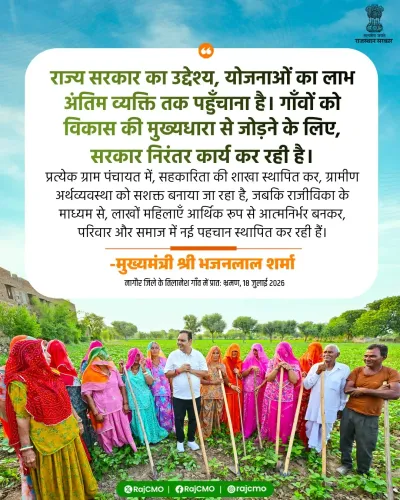
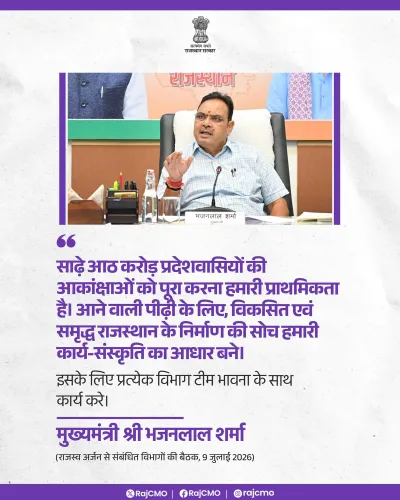
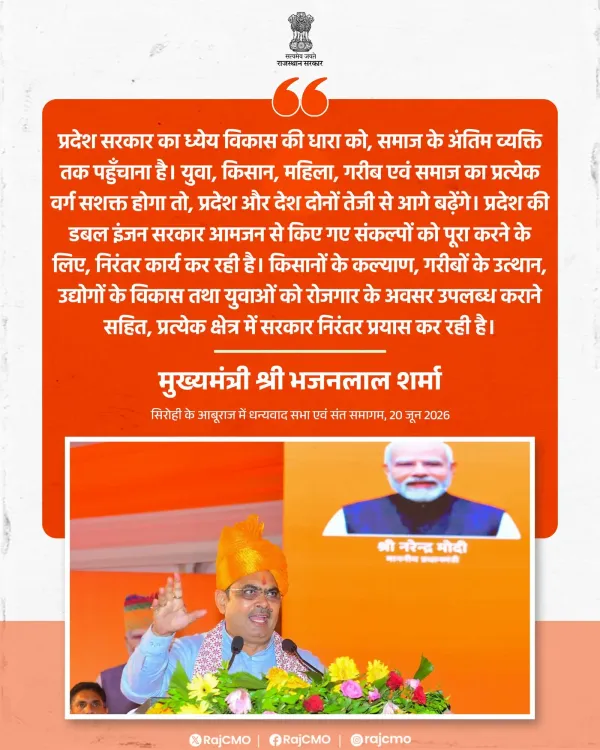
The Chief Minister's Office of Rajasthan reaffirmed on Sunday, 21 June 2026, that the state government's guiding aim is to carry the stream of development to the last person in society, invoking the Antyodaya principle that has anchored welfare policy in the state for decades. The post, attributed to Chief Minister Bhajanlal Sharma, was shared under the hashtag #आपणो_अग्रणी_राजस्थान (Our Frontrunner Rajasthan), the BJP-led government's signature campaign framing.
Context
The Hindi-language post carries a single, declarative line: 'प्रदेश सरकार का ध्येय विकास की धारा को समाज के अंतिम व्यक्ति तक पहुँचाना है' — 'The state government's goal is to carry the stream of development to the last person in society.' The phrasing draws directly on the Antyodaya vision, a concept first institutionalised by Pandit Deendayal Upadhyaya and later adopted by successive governments across the political spectrum as a shorthand for inclusive, bottom-up growth.
Chief Minister Bhajanlal Sharma has consistently used official communication channels to signal welfare intent since his government was sworn in during December 2023. The accompanying hashtag, translated as 'Our Frontrunner Rajasthan', positions the state as a model of progressive governance within the BJP's national narrative.
Policy Backdrop
The BJP's 2023 Rajasthan election manifesto placed inclusive, last-mile growth at the centre of its pitch to voters, aligning explicitly with the national 'Sabka Saath, Sabka Vikas' (Together with all, Development for all) framework championed by the central government. The Sharma administration inherited a state where rural households and marginalised communities have historically been the primary targets of flagship welfare schemes spanning agriculture, health, and social security.
Rajasthan governments of both major parties have periodically issued statements framing development in Antyodaya terms since the early 2000s. The current messaging continues that tradition while also serving as a branding exercise, projecting administrative intent ahead of budget sessions and scheme reviews in the state legislature.
Stakeholders and Impact
Rural households and marginalised communities across Rajasthan's 33 districts — spanning the Thar Desert belt, tribal regions of the south, and agrarian areas of the east — stand as the stated beneficiaries of this development philosophy. For these populations, last-mile delivery has historically meant access to subsidised food, drinking water infrastructure, health camps, and livelihood support under centrally and state-sponsored schemes.
The post's reach is amplified by the official @RajCMO handle, which functions as a primary communication vehicle for the Sharma government, ensuring the message lands with party workers, civil servants, and the broader public simultaneously. Official social-media statements of this kind also serve as public benchmarks against which future policy delivery is measured.
What's Next
Observers will watch the next Rajasthan legislative session for concrete budget allocations and progress reports on flagship schemes targeting rural and marginalised beneficiaries — the clearest test of whether the stated development philosophy translates into measurable last-mile outcomes. Scheme-specific data on coverage, fund utilisation, and beneficiary counts will determine how the government's Antyodaya rhetoric is ultimately judged.
As Rajasthan approaches the mid-point of the Sharma government's term, the consistency between such public commitments and on-ground delivery in underserved districts will shape both the administration's credibility and the BJP's standing ahead of the next electoral cycle in the state.
Point of View
The post serves a dual purpose: reinforcing the government's ideological lineage to Deendayal Upadhyaya and projecting administrative seriousness to a rural voter base. Such statements carry weight only when followed by verifiable last-mile delivery data, making the next budget session a critical credibility test. The broader pattern suggests this is as much about narrative management ahead of the government's mid-term phase as it is about any immediate policy action.
NationPress
19 Sept 2026
Frequently Asked Questions
What did the Rajasthan Chief Minister's Office post on 21 June 2026?
The Rajasthan CMO posted that the state government's goal is to carry the stream of development to the last person in society, attributing the message to Chief Minister Bhajanlal Sharma under the hashtag #आपणो_अग्रणी_राजस्थान.
Who is the Chief Minister of Rajasthan in 2026?
Bhajanlal Sharma of the BJP is the Chief Minister of Rajasthan, having taken office in December 2023 after the party won the state assembly elections.
What does Antyodaya mean in Indian governance?
Antyodaya, meaning 'upliftment of the last person,' is a principle associated with Pandit Deendayal Upadhyaya and refers to prioritising the welfare of the weakest and most marginalised sections of society in government policy.
What is the 'Aapno Agrani Rajasthan' campaign?
'Aapno Agrani Rajasthan,' meaning 'Our Frontrunner Rajasthan,' is the BJP-led Rajasthan government's branding campaign used to project the state as a model of progressive and inclusive governance.
How does the Rajasthan government plan to achieve last-mile development?
The government has aligned its approach with the national 'Sabka Saath, Sabka Vikas' framework, with flagship schemes targeting rural households and marginalised communities; specific allocations and progress reports are expected in upcoming legislative sessions.