Rajasthan CM Bhajanlal hails welfare reach to last-mile poor
Synopsis
The Chief Minister's Office of Rajasthan on 11 June 2026 credited CM Bhajanlal Sharma with delivering notable welfare gains to the state's poor and marginalised citizens, invoking the 'last person in the queue' governance ideal under the hashtag 'Our Pioneering Rajasthan'.
Key Takeaways
The Chief Minister's Office of Rajasthan posted on 11 June 2026 praising CM Bhajanlal Sharma 's welfare delivery record.
The post credits his leadership with reaching 'the poor, deprived, and the last person in the queue' through public-welfare schemes.
The hashtag #आपणो_अग्रणी_राजस्थान ('Our Pioneering Rajasthan') frames the messaging as part of a broader state branding campaign.
Key central schemes cited in the policy backdrop include Pradhan Mantri Awas Yojana (2015) and Ayushman Bharat (2018).
Rajasthan has been under BJP rule since December 2023 , aligning state welfare machinery with central direct-benefit-transfer platforms.
State budget allocations for 2025–26 and central review meetings on scheme delivery are the next milestones to watch.
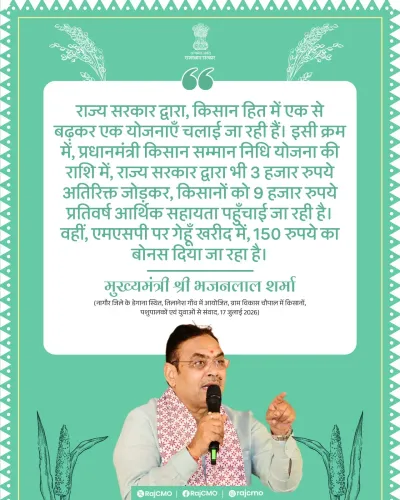
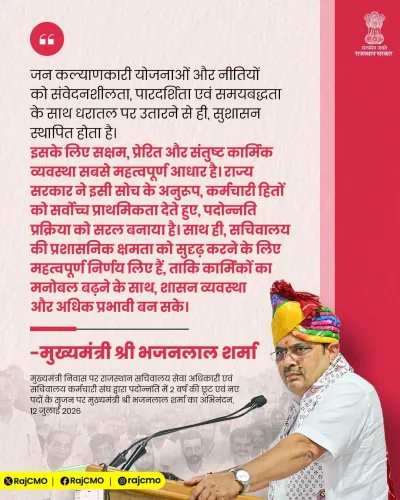
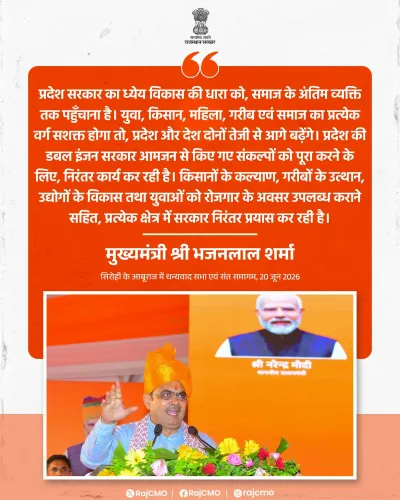
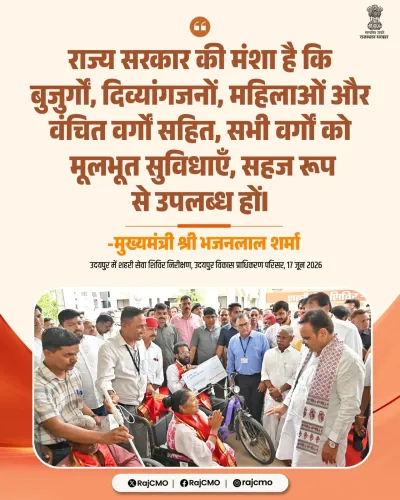
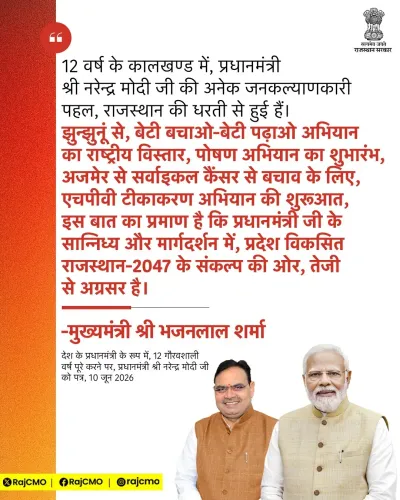
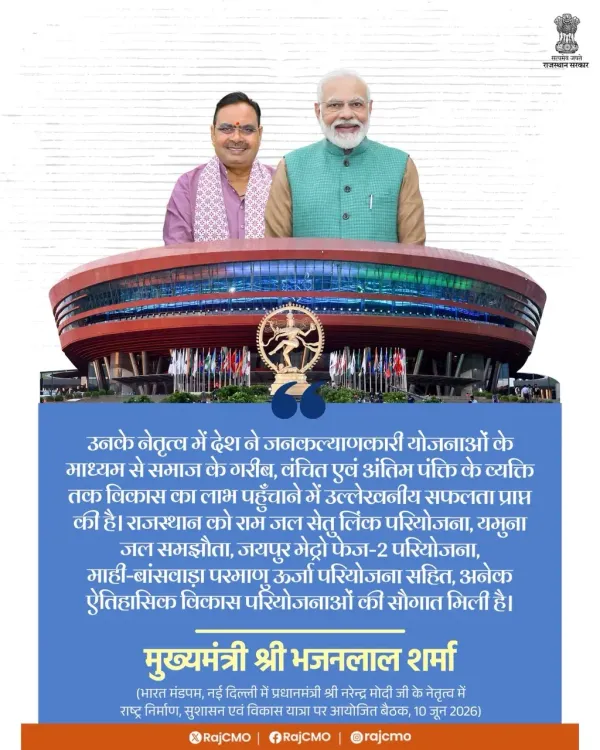
The Chief Minister's Office of Rajasthan on Thursday, 11 June 2026 praised Chief Minister Bhajanlal Sharma's leadership, stating that under his stewardship the state has achieved 'remarkable success' in delivering the benefits of welfare schemes to the poor, deprived, and the last person in the queue.
Context
The post, shared under the hashtag #आपणो_अग्रणी_राजस्थान ('Our Pioneering Rajasthan'), credits Bhajanlal Sharma with channelling welfare gains to society's most marginalised sections. The original Hindi text reads: 'उनके नेतृत्व में देश ने जनकल्याणकारी योजनाओं के माध्यम से समाज के गरीब, वंचित एवं अंतिम पंक्ति के व्यक्ति तक विकास का लाभ पहुँचाने में उल्लेखनीय सफलता प्राप्त की है।' — translated: 'Under his leadership, the country has achieved notable success in reaching the benefits of development to the poor, deprived, and the last person in the queue through public-welfare schemes.'
The reference to 'the last person in the queue' is a recurring motif in BJP's governance vocabulary, echoing the Gandhian concept of Antyodaya — upliftment of the most marginalised — which the party has adopted as a framing device for direct-benefit programmes.
Policy Backdrop
Rajasthan, under BJP rule since December 2023, has aligned its state machinery closely with central welfare programmes. National schemes such as Pradhan Mantri Awas Yojana (launched 2015), which targets housing for economically weaker sections, and Ayushman Bharat (introduced 2018), which extends health insurance to poor families, form the backbone of this last-mile delivery push.
Across BJP-governed states, the strategy has centred on Aadhaar-linked direct benefit transfers and digital platforms to reduce leakage and ensure targeted delivery to rural and urban poor households. Rajasthan's administration has sought to demonstrate convergence between state and central implementation pipelines.
Stakeholders and Impact
The primary beneficiaries of the welfare push cited in the post are poor and marginalised households across Rajasthan, particularly in rural belts where access to housing, healthcare, and income-support schemes has historically lagged. State officials and district-level administrators serve as the implementation machinery translating policy announcements into on-ground delivery.
Civil society groups monitoring welfare delivery have noted that last-mile access remains uneven across the state's vast geography, with remote districts in western Rajasthan and tribal pockets in the south presenting persistent challenges. The government's public messaging positions ongoing scheme implementation as a response to these gaps.
What's Next
Attention will turn to Rajasthan's state budget allocations for the 2025–26 fiscal cycle and any central review meetings assessing welfare delivery outcomes in the state. The #आपणो_अग्रणी_राजस्थान campaign framing suggests the Chief Minister's Office intends to sustain a visible public narrative around scheme delivery as a marker of governance performance. How the administration translates this messaging into measurable beneficiary numbers will determine its political and policy credibility in the months ahead.
Point of View
A frame that has been central to the party's electoral messaging since 2014. By tagging Bhajanlal Sharma directly and invoking the Antyodaya ideal, the communication team is building a personalised welfare brand around the Chief Minister ahead of future electoral cycles. The hashtag 'Our Pioneering Rajasthan' signals an effort to project Rajasthan as a model BJP state, inviting comparison with other party-governed states. The absence of specific scheme statistics, however, keeps the claim aspirational rather than accountable — a pattern common in government social-media messaging across party lines.
NationPress
26 Oct 2026
Frequently Asked Questions
Who is Bhajanlal Sharma and what is his role in Rajasthan?
Bhajanlal Sharma is the BJP Chief Minister of Rajasthan , in office since December 2023 . He oversees state governance including the implementation of central and state welfare schemes targeting poor and marginalised households.
What does 'last person in the queue' mean in Indian welfare policy?
The phrase refers to the Antyodaya ideal of prioritising the most marginalised citizens — the poorest of the poor — in welfare delivery. It is a key framing device used by the BJP to describe targeted, last-mile benefit distribution through schemes like Pradhan Mantri Awas Yojana and Ayushman Bharat .
What welfare schemes are being implemented in Rajasthan?
Rajasthan is implementing major central schemes including Pradhan Mantri Awas Yojana , which provides housing to economically weaker sections, and Ayushman Bharat , which extends health insurance to poor families, alongside state-level programmes aligned with central direct-benefit-transfer platforms.
What is the hashtag #आपणो_अग्रणी_राजस्थान about?
The hashtag translates to 'Our Pioneering Rajasthan' and is used by the Chief Minister's Office of Rajasthan as part of a state branding campaign to highlight governance achievements and welfare delivery under CM Bhajanlal Sharma .
What comes next for welfare delivery in Rajasthan?
Key milestones include Rajasthan's state budget allocations for 2025–26 and central government review meetings assessing on-ground welfare delivery outcomes across the state's districts.