Rajasthan Panchayat polls: Congress leads BJP by 13 lakh votes in rural blow
Synopsis
Rajasthan's Panchayat polls have handed the Congress a 13-lakh-vote lead over the ruling BJP in rural India's most electorally volatile state — and the rise of regional parties like RLP and BAP, who collectively drew 25 lakh votes, adds a third-force wildcard that neither national party can afford to ignore ahead of the Assembly elections.
Key Takeaways
The Congress secured approximately 12.97 lakh more votes than the BJP in combined Panchayat and urban local body elections in Rajasthan .
The Congress led by 13.30 lakh votes in Panchayat elections; the BJP held a narrower 98,000-vote lead in urban local body contests.
Congress won 747 Zila Parishad seats against BJP's 349 , and 3,758 Panchayat Samiti seats against BJP's 2,213 .
Regional parties — including RLP and BAP — collectively attracted approximately 25 lakh votes , exceeding the Congress-BJP vote margin.
All 41 Zila Parishads were polled simultaneously for the first time under a 'One State, One Election' model.
Panchayat results have historically not reliably predicted Rajasthan Assembly election outcomes, analysts caution.
The Rajasthan Panchayat and urban local body election results, declared on 21 November 2026, have delivered a significant political jolt to the ruling Bharatiya Janata Party (BJP), with the Indian National Congress securing an overall vote lead of approximately 12.97 lakh across both sets of polls. Widely regarded as a political 'semifinal' ahead of the next Rajasthan Assembly elections, the results have sharpened questions about the BJP's grassroots connect, particularly in the state's vast rural belt.
Rural Verdict: Congress Commands a 13-Lakh Lead
The Congress established a commanding lead of approximately 13.30 lakh votes in the Panchayat elections alone. The BJP partially clawed back in urban local body contests, securing a lead of more than 98,000 votes there — but that margin was insufficient to offset the rural deficit. Combined, the Congress polled approximately 3.5% more votes than the BJP across both election types.
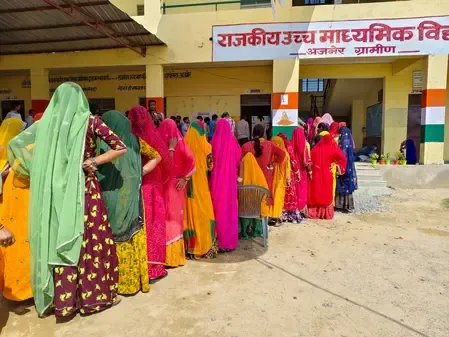
A total of approximately 2.73 crore votes were cast in the Panchayat elections, with 2,48,63,783 voters participating across 37 districts. Urban local body elections recorded 1,06,82,294 votes separately. The scale of participation underscores how closely watched these contests were as a barometer of public mood ahead of the Assembly polls.
Seat Tally: Congress Dominates Zila Parishads and Panchayat Samitis
Results declared for 37 Zila Parishads showed the Congress leading in more than two dozen, while the BJP was ahead in just six. In terms of seats, the Congress secured 747 Zila Parishad seats against the BJP's 349, out of a total of 1,275 wards.
The pattern was mirrored in Panchayat Samiti elections: Congress won 3,758 seats to the BJP's 2,213, out of 7,543 total wards. The remaining seats were shared between regional parties and independent candidates. Notably, the Congress also registered a decisive victory in Hanumangarh's Zila Parishad elections, where the BJP managed to win only seven seats.
For the first time in the state's history, elections for all 41 Zila Parishads were conducted simultaneously under the 'One State, One Election' model — making this round more directly comparable than previous cycles.
Regional Parties Emerge as Critical Force
One of the most consequential features of this election cycle is the consolidation of regional political forces. The Rashtriya Loktantrik Party (RLP) and the Bharat Adivasi Party (BAP), along with other regional players, collectively attracted approximately 25 lakh voters — a figure that significantly exceeds the entire vote margin between the Congress and the BJP.
This underlines a structural shift in Rajasthan's electoral landscape: neither major national party commands the field outright. Regional parties have demonstrated the capacity to tilt future contests, particularly in tribal and agrarian constituencies where both RLP and BAP have deepened their organisational presence.
Historical Context: A Pattern Revisited
Rajasthan's Panchayat election history has long reflected shifting rural preferences. The Congress held a strong position in Zila Parishad elections until 2010. The BJP then gained the upper hand over the subsequent two election cycles. Over the past four cycles, the positions of Zila Pramukh and Panchayat Samiti Pradhan have alternated between the two parties — a rhythm that analysts say reflects rural Rajasthan's tradition of voting against incumbency at different tiers.
Crucially, however, Panchayat results have not consistently predicted Assembly election outcomes in the state. Critics argue that treating local body results as a direct template for state-level performance misreads the distinct issues that drive each contest — local governance versus state policy versus national leadership.
What It Means Going Forward
For the BJP, the results raise pointed questions about rural outreach, the effectiveness of local leadership, and the party's connection with grassroots voters. For the Congress, the outcome provides political momentum and an opportunity to consolidate its base ahead of the Assembly election cycle. Whether this rural advantage translates into legislative seats will depend substantially on how both parties respond to the shifting dynamics — and whether regional parties continue to expand their footprint or align with either national formation.
Point of View
But the more structurally significant number is the 25 lakh votes that bypassed both national parties entirely and went to RLP, BAP, and regional independents. Rajasthan has a well-documented tradition of Panchayat results that do not replay at the Assembly level — but that cuts both ways: it offers the BJP no comfort, and it means the Congress cannot bank on this momentum automatically converting to seats. The real story here is fragmentation: a state where neither party commands a majority of rural opinion, and where regional players are accumulating enough vote share to decide who forms the next government.
NationPress
21 Nov 2026
Frequently Asked Questions
What were the key results of the Rajasthan Panchayat elections 2026?
The Congress secured approximately 12.97 lakh more votes than the BJP across combined Panchayat and urban local body elections in Rajasthan. In Panchayat elections specifically, the Congress led by around 13.30 lakh votes, while the BJP posted a smaller lead of over 98,000 votes in urban local body contests.
How did seat counts compare between Congress and BJP?
In Zila Parishad elections, Congress won 747 seats against the BJP's 349 out of 1,275 total wards. In Panchayat Samiti elections, Congress secured 3,758 seats to the BJP's 2,213 out of 7,543 wards. The Congress also led in more than two dozen of the 37 Zila Parishads for which results were declared.
What role did regional parties play in these elections?
The Rashtriya Loktantrik Party (RLP), Bharat Adivasi Party (BAP), and other regional players together drew approximately 25 lakh votes — a figure higher than the entire Congress-BJP vote margin. This signals that regional parties have become a critical third force in Rajasthan's electoral landscape.
Do Panchayat election results predict Rajasthan Assembly election outcomes?
Not reliably. Analysts caution that Rajasthan's Panchayat results have historically not consistently mirrored Assembly election outcomes, as local governance concerns differ from state-level issues. The results are considered an important political indicator, but not a definitive forecast.
What was the 'One State, One Election' model used in these polls?
For the first time in Rajasthan, elections for all 41 Zila Parishads were conducted simultaneously under a 'One State, One Election' model. This made the results more directly comparable across districts and election cycles than previous staggered rounds.