Rajasthan Railway Budget Rises 15x to Rs 10,228 Cr in 2026-27
Synopsis
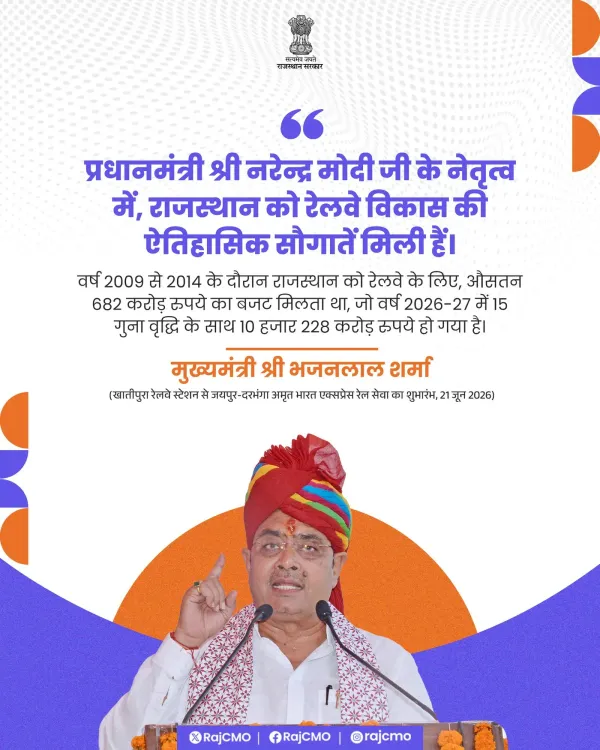
The Chief Minister's Office of Rajasthan announced on 22 June 2026 that the state's railway budget for 2026-27 has risen 15-fold to Rs 10,228 crore. CM Bhajanlal Sharma's office shared the figure, framing it as a landmark boost to the state's rail infrastructure under the current central and state governments.
Key Takeaways
Rajasthan's railway budget allocation for 2026-27 has been announced at Rs 10,228 crore , a 15-fold increase over previous levels.
The announcement was made by the Chief Minister's Office of Rajasthan on 22 June 2026 , attributed to CM Bhajanlal Sharma .
Rajasthan is a key rail corridor state, linking Delhi to Mumbai and Delhi to Ahmedabad .
Beneficiaries include the industrial sector, freight operators, and rail passengers across the state.
Actual impact will depend on project utilisation rates and physical execution progress reported in subsequent budget documents.
The announcement continues a pattern of BJP-governed states highlighting central railway allocations as development milestones.
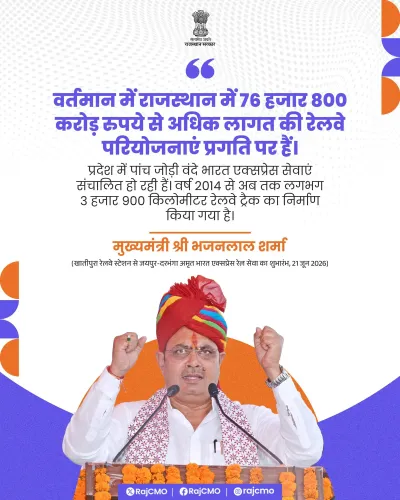
The Chief Minister's Office of Rajasthan announced on Monday, 22 June 2026 that the state's railway budget allocation for fiscal year 2026-27 has risen to Rs 10,228 crore, marking a 15-fold increase over previous levels. The announcement, attributed to Chief Minister Bhajanlal Sharma, was shared under the hashtag #आपणो_अग्रणी_राजस्थान ('Our Leading Rajasthan').
Context
The post states in Hindi: 'राजस्थान को रेलवे के लिए, मिलने वाला बजट वर्ष 2026-27 में 15 गुना वृद्धि के साथ 10 हजार 228 करोड़ रुपये हो गया है' — meaning, 'The railway budget to be received by Rajasthan for the year 2026-27 has increased 15 times to Rs 10,228 crore.' The figure represents the Union government's capital allocation directed toward railway projects within Rajasthan, a western Indian state that spans major freight and passenger corridors.
CM Bhajanlal Sharma, who took office in December 2023 following the BJP's assembly election victory, has consistently highlighted central infrastructure outlays as evidence of accelerated development under the current administration. The CMO's tagging of @BhajanlalBjp underscores the political ownership the state government is placing on this announcement.
Policy Backdrop
Union Budgets since 2014 have recorded successive increases in national railway capital expenditure, with dedicated projects covering track doubling, electrification, and freight corridor development — all of which touch Rajasthan. The state sits along critical rail arteries connecting Delhi to Mumbai and Delhi to Ahmedabad, making it a key node in both passenger and freight logistics.
The broader national pattern has seen the central government's railway capital expenditure grow substantially over the past decade as part of a sustained infrastructure push. States governed by the BJP have frequently highlighted state-specific rail outlays in official communications, framing them as outcomes of cooperative federalism between state and central leadership.
Stakeholders and Impact
A 15-fold increase in railway allocation — if fully utilised — would have significant implications for Rajasthan's industrial sector, which depends on rail for movement of minerals, cement, and agricultural produce. Passenger connectivity to smaller towns and tourist destinations such as Jaisalmer, Jodhpur, and Udaipur could also benefit from expanded track and rolling stock investments.
Rail passengers across the state stand to gain from new lines, station upgrades, and faster services that typically accompany higher capital outlays. The industrial belt in districts like Bhilwara, Alwar, and Kota could see improved freight evacuation capacity, potentially lowering logistics costs for manufacturers and exporters.
What's Next
The key test will be the pace of actual project execution. Utilisation certificates and physical progress reports — typically published in subsequent railway budget documents and parliamentary committee reviews — will indicate how much of the Rs 10,228 crore is converted into completed infrastructure on the ground.
Observers will watch whether project sanctions, land acquisition, and contractor mobilisation keep pace with the scale of the allocation. A large headline figure translates into tangible benefit only when spending is matched by timely delivery of tracks, bridges, and station facilities across Rajasthan.
Point of View
High-visibility infrastructure numbers serve as tangible proof-points for a government seeking to build a development narrative. The scale of the claimed increase — 15 times — is politically significant, but the real measure of success will come from utilisation data and project completion rates, which historically lag behind allocation headlines in Indian railway budgeting. If even a substantial fraction of Rs 10,228 crore is deployed effectively, it could materially reshape Rajasthan's freight logistics and passenger connectivity over the next three to five years.
NationPress
22 Jun 2026
Frequently Asked Questions
How much is Rajasthan's railway budget for 2026-27?
Rajasthan's railway budget allocation for 2026-27 has been announced at Rs 10,228 crore, representing a 15-fold increase over earlier levels, according to the Chief Minister's Office.
Who announced Rajasthan's railway budget increase?
The Chief Minister's Office of Rajasthan announced the figure on 22 June 2026, attributing it to Chief Minister Bhajanlal Sharma via the official CMO account on X.
What does the 15-fold railway budget rise mean for Rajasthan?
A 15-fold rise to Rs 10,228 crore could fund track doubling, new lines, station upgrades, and freight capacity expansion across Rajasthan, benefiting industries and passengers alike — provided the funds are fully utilised.
Which areas of Rajasthan will benefit from higher railway investment?
Industrial districts such as Bhilwara, Alwar, and Kota stand to gain from better freight connectivity, while tourist destinations like Jaisalmer, Jodhpur, and Udaipur could see improved passenger services.
Is Rajasthan's railway budget increase confirmed in the Union Budget?
The figure was stated by the Rajasthan CMO; verification against official Union Budget documents and railway budget annexures would confirm the exact allocation and project-wise breakdown.