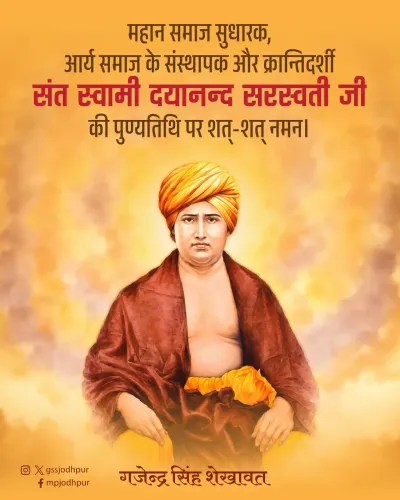
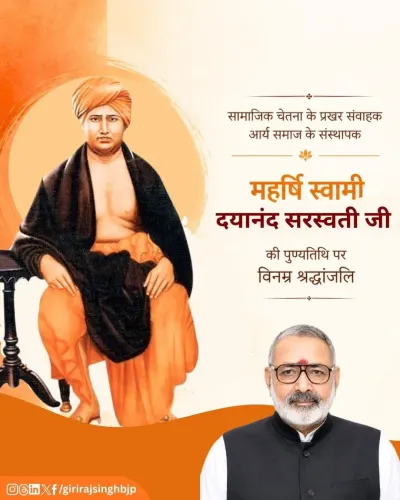
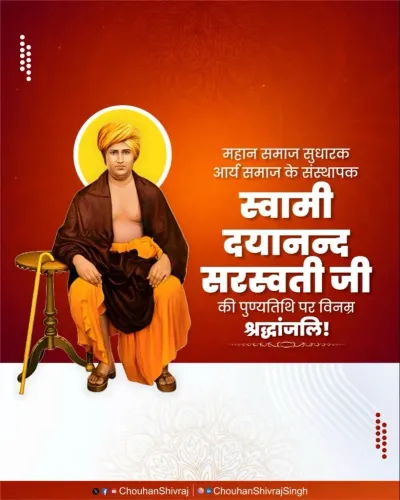
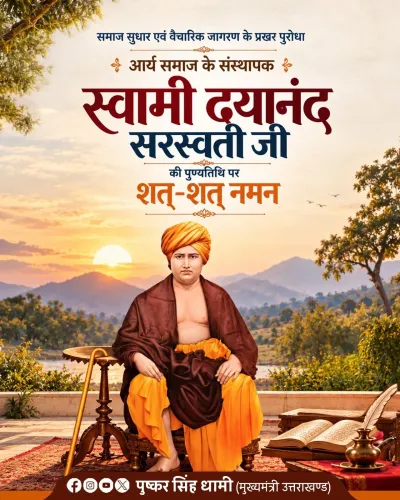
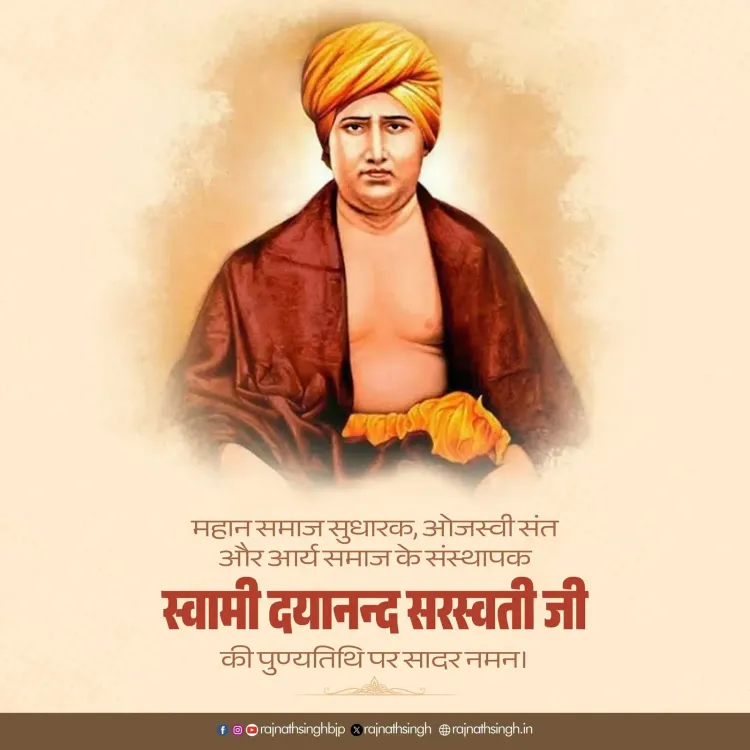
Rajnath Singh pays tribute to Maharshi Dayanand Saraswati
Synopsis
Union Defence Minister Rajnath Singh marked the death anniversary of Maharshi Dayanand Saraswati on October 30, 2026, paying tribute to the 19th-century reformer's legacy — the founding of Arya Samaj, the authorship of 'Satyarth Prakash', and his advocacy for women's empowerment and social equality.
Key Takeaways
Union Defence Minister Rajnath Singh paid tribute to Maharshi Dayanand Saraswati on his death anniversary, October 30, 2026 .
Dayanand Saraswati, born in 1824 , championed a return to Vedic principles and openly challenged idolatry, caste rigidity, and gender inequality.
He founded the Arya Samaj in 1875 , a reform movement promoting education, social equality, and Vedic monotheism.
His landmark text 'Satyarth Prakash' (The Light of Truth) is regarded as a foundational work of the Indian Renaissance.
Singh highlighted the reformer's contributions to women's empowerment and social equality as enduring guides for modern India.
October 30 tributes to Dayanand Saraswati are a consistent cross-party tradition in Indian political life.
On the death anniversary of one of India's most transformative 19th-century reformers, Union Defence Minister Rajnath Singh offered his homage to Maharshi Dayanand Saraswati on Friday, October 30, 2026, remembering him as a voice against social evils and a torchbearer of Vedic revival.
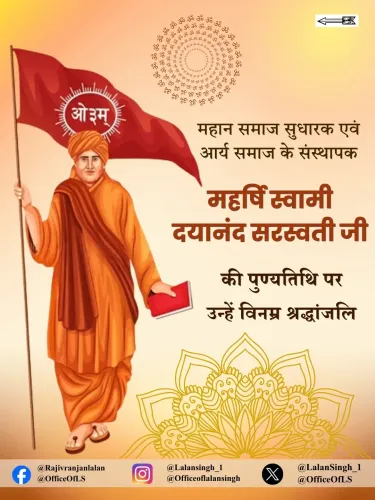
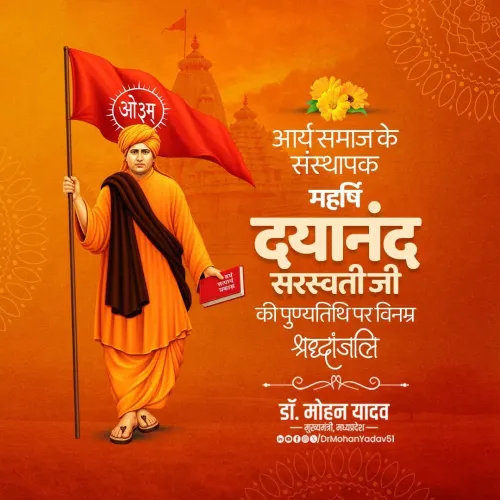
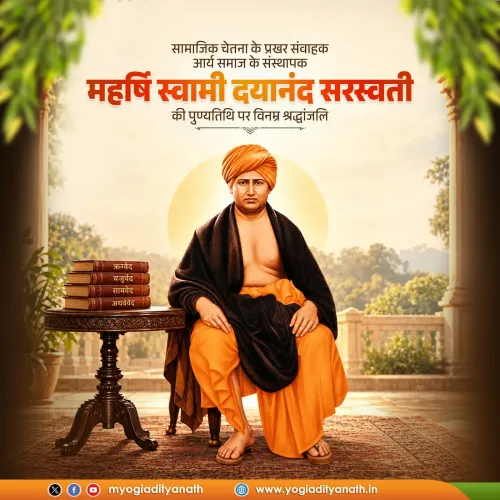
In his post, Singh wrote: 'महर्षि दयानंद सरस्वती जी की पुण्यतिथि पर उन्हें विनम्र श्रद्धांजलि' — 'Humble tribute to Maharshi Dayanand Saraswati on his death anniversary.' He recalled the reformer's role in taking the knowledge of the Vedas to the common people, his stand against social evils, and his contributions to women's empowerment and social equality. Singh also specifically saluted the founding of the Arya Samaj and the creation of the landmark text 'Satyarth Prakash' as works that ignited a renaissance.
Who was Maharshi Dayanand Saraswati?
Born in 1824, Dayanand Saraswati became one of the most consequential religious and social reformers of colonial India. He preached a return to the monotheistic roots of Vedic scripture, openly challenging idolatry, caste rigidity, and the marginalisation of women — positions that were radical for his era. His philosophy was not one of passive spirituality but of active, reasoned reform.
In 1875, he founded the Arya Samaj, a reform movement that promoted education, social equality, and a rational engagement with Vedic texts. The organisation went on to establish schools, support widow remarriage, and champion access to education for women — ideas that fed directly into India's broader nationalist and social awakening. His seminal work, 'Satyarth Prakash' (The Light of Truth), laid out his reformist vision in plain, accessible language, making it one of the enduring texts of the Indian Renaissance.
October 30 and India's tradition of reform commemoration
Dayanand Saraswati's death anniversary on October 30 draws tributes from political leaders across the spectrum every year. The commemorations reflect a wider pattern of acknowledging the 19th-century reform tradition — a period that shaped later Hindu organisational life and the currents that ran into the independence movement. Singh's tribute fits squarely within this annual civic ritual, though no immediate policy or legislative follow-up is attached to such statements.
The Arya Samaj's influence on Indian public life — from its early advocacy of Hindi as a national language to its founding of the Dayanand Anglo-Vedic (DAV) chain of schools — continues to be felt across education and civil society. Honouring its founder remains an act of recognising a living institutional legacy, not merely a historical footnote.
A reformer who died in 1883 still prompts a sitting Defence Minister to pause on a Friday morning. That, in itself, is the measure of how deep Dayanand Saraswati's roots run in India's modern story.
Point of View
Singh frames the reformer's legacy in terms resonant with contemporary welfare messaging. The Arya Samaj's institutional footprint — especially through the DAV school network — gives such commemorations a practical civic dimension beyond ritual rhetoric. Ultimately, the tribute reinforces a broader BJP political project of anchoring modern governance claims in the intellectual and moral authority of 19th-century reform.
NationPress
30 Oct 2026
Frequently Asked Questions
When is Maharshi Dayanand Saraswati's death anniversary?
Maharshi Dayanand Saraswati's death anniversary falls on October 30 each year. He passed away in 1883 .
What is the Arya Samaj and who founded it?
The Arya Samaj is a Hindu reform movement founded by Maharshi Dayanand Saraswati in 1875 . It promotes Vedic monotheism, education, and social equality, and went on to establish institutions including the widespread DAV school network.
What is 'Satyarth Prakash'?
' Satyarth Prakash ' (The Light of Truth) is a seminal text authored by Dayanand Saraswati that articulates his reformist vision based on Vedic principles. It remains one of the foundational works of the Indian Renaissance.
What did Rajnath Singh say about Dayanand Saraswati?
Rajnath Singh offered a humble tribute on Dayanand Saraswati's death anniversary, praising his role in spreading Vedic knowledge, opposing social evils, championing women's empowerment and social equality, and igniting a renaissance through the Arya Samaj and 'Satyarth Prakash'.
Why is Dayanand Saraswati important in Indian history?
Maharshi Dayanand Saraswati is regarded as a pivotal figure of 19th-century India for challenging idolatry, caste discrimination, and the marginalisation of women at a time when such positions were deeply radical. His Arya Samaj and writings fed into the intellectual currents that shaped India's nationalist movement.