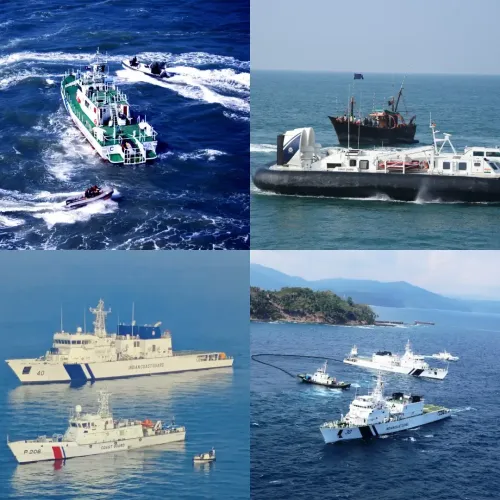
Rajnath Singh unveils gender-neutral framework for Coast Guard women officers
Synopsis
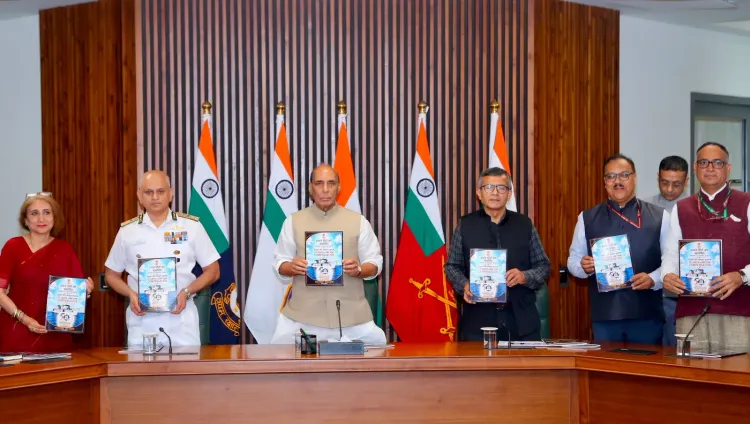
Defence Minister Rajnath Singh on July 28, 2026 announced a gender-neutral framework giving women officers equal induction, training, and permanent appointment rights in the Indian Coast Guard, and simplified ex-gratia procedures for Next of Kin of personnel missing at sea — both timed ahead of the ICG's 2027 Golden Jubilee.
Key Takeaways
Union Defence Minister Rajnath Singh announced two landmark policy reforms for the Indian Coast Guard on July 28, 2026 .
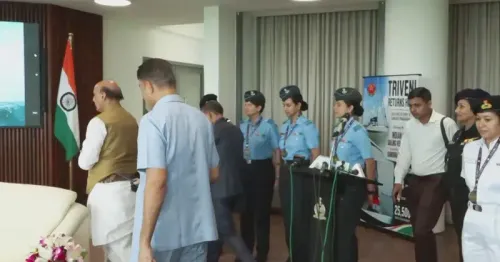
A new gender-neutral framework ensures equal opportunities for women officers at the induction, training, and Permanent Appointment stages in the ICG.
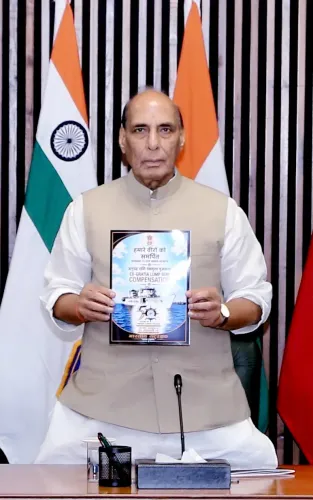
Ex-gratia and support procedures for the Next of Kin of Coast Guard personnel who go missing at sea on duty have been simplified and fast-tracked.
The reforms are part of the run-up to the ICG's Swarnim Jayanti (Golden Jubilee) in 2027 .
The move extends a policy arc that began in 2020 , when permanent commission was granted to women officers across the Army, Navy, and Air Force.
Two reforms that could reshape careers and protect families — Union Defence Minister Rajnath Singh on Tuesday, July 28, 2026, unveiled a gender-neutral policy framework for the Indian Coast Guard (ICG) and fast-tracked welfare procedures for families of personnel who go missing at sea. The announcements, made as the ICG marches toward its Swarnim Jayanti (Golden Jubilee) in 2027, mark the most significant administrative overhaul for the maritime force in recent years.
Equal footing at sea: what the gender-neutral framework changes
The new policy dismantles gender-based distinctions across three critical stages — induction, training, and Permanent Appointment — ensuring women officers compete and serve on the same terms as their male counterparts. Singh framed it explicitly as a #NariShakti commitment: 'equal opportunities in the induction, training, and Permanent Appointment of Women Officers in the ICG.'
The move follows a well-established policy arc. In 2020, the Ministry of Defence extended permanent commission to women officers across the Army, Navy, and Air Force, opening command roles that had been closed for decades. The Coast Guard — India's frontline maritime law-enforcement and search-and-rescue agency — now joins that progression. For women who have served in short-service roles without a path to permanence, the reform closes a long-standing structural gap.
Faster relief for families of personnel lost at sea
The second reform addresses one of the most painful bureaucratic failures in maritime service: the delay in ex-gratia payments and support for the Next of Kin of Coast Guard personnel who go missing while on duty at sea. Singh announced that these procedures have been 'simplified and fast-tracked,' reducing the administrative burden on grieving families at their most vulnerable moment.
The Coast Guard's operational theatre — open ocean, cyclone corridors, piracy-prone waters — carries risks that land-based forces do not face in the same way. A missing-at-sea case can remain legally unresolved for years, leaving families in financial and emotional limbo. The reform directly targets that gap. As Singh put it: 'A grateful nation stands firmly with the families of those who protect our maritime borders.'
The 2027 Swarnim Jayanti and the reform calendar
Both announcements are timed against the ICG's approaching Golden Jubilee. Organisational anniversaries in India's defence establishment have historically served as catalysts for structural upgrades — and the Coast Guard's 2027 milestone appears to be driving a concentrated reform push. What remains to watch: official notifications spelling out revised selection criteria, any changes to ex-gratia amounts, and whether further announcements follow on Coast Guard Day or in the 2026-27 Union Budget cycle.
For a force that guards 7,516 kilometres of Indian coastline and has been steadily expanding its fleet and mandate, these two reforms signal that the institutional upgrade runs deeper than ships and aircraft — it reaches the people who crew them, and the families who wait ashore.
Point of View
Navy, and Air Force on permanent commission. The ex-gratia reform, less visible but arguably more consequential, addresses a welfare deficit specific to maritime risk — a domain where 'missing' can mean years of legal uncertainty for families. Together, the reforms signal that the 2027 Swarnim Jayanti is being used as a forcing function for institutional modernisation, a pattern seen with other defence-anniversary milestones. Whether implementation keeps pace with the announcement will be the real test of intent.
NationPress
26 Oct 2026
Frequently Asked Questions
What is the new gender-neutral policy for Indian Coast Guard women officers?
The policy removes gender-based distinctions at the induction, training, and Permanent Appointment stages, giving women officers equal footing with male counterparts throughout their Coast Guard careers. It was announced by Defence Minister Rajnath Singh on July 28, 2026.
What changes have been made for families of Coast Guard personnel missing at sea?
The government has simplified and fast-tracked ex-gratia payments and support procedures for the Next of Kin of Coast Guard personnel who go missing at sea while on duty, reducing the bureaucratic burden on grieving families.
What is the Swarnim Jayanti of the Indian Coast Guard?
Swarnim Jayanti refers to the Golden Jubilee — the 50th anniversary — of the Indian Coast Guard, which is scheduled to be celebrated in 2027. Several policy reforms are being introduced in the lead-up to this milestone.
How does this Coast Guard reform relate to earlier women-in-defence policies?
In 2020, the Ministry of Defence extended permanent commission to women officers in the Army, Navy, and Air Force. The new Coast Guard framework brings the maritime force in line with that broader policy direction.
What is Nari Shakti in the context of India's defence forces?
Nari Shakti is a government-wide initiative promoting women's empowerment and equal participation across public institutions, including the armed and paramilitary forces. The Coast Guard gender-neutral policy is framed as part of this commitment.