Rajnath Singh: Future wars won by tech, not troop numbers

Synopsis
Rajnath Singh's Shirdi inauguration was more than a ribbon-cutting — it was a doctrine statement. With India's largest private artillery plant now live, a 20,000-tonne ordnance complex underway, and a target to push private-sector defence output to 50%, India is making its most concentrated bet yet that sovereign weapons production is the only credible deterrent in a world reshaped by Ukraine and West Asia.
Key Takeaways
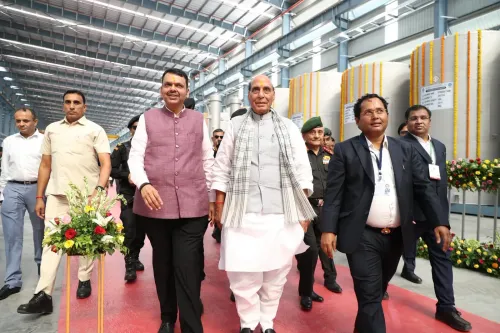
Defence Minister Rajnath Singh inaugurated a defence and aerospace manufacturing grid near Shirdi, Maharashtra on 23 May 2025 .
The centrepiece is a ₹1,000-crore , 200-acre facility in Savali Vihir — India's largest private-sector artillery plant.
A parallel ordnance complex at Belwandi, Shrigonda taluka targets 20,000 tonnes of annual explosive output.
Private sector share in defence production has reached 25–30% ; the government aims to take it to 50% .
Singh cited Operation Sindoor and global conflicts in Ukraine and West Asia as strategic imperatives for indigenous weapons development.
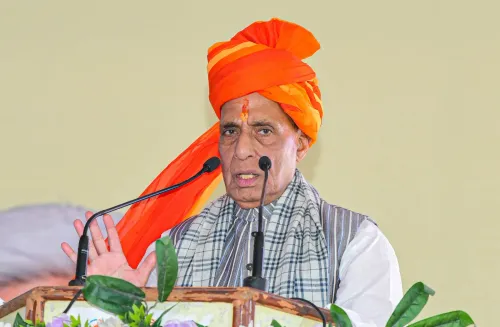
Defence Minister Rajnath Singh on Saturday, 23 May declared that the nature of modern warfare has fundamentally changed, asserting that future conflicts will be decided not by soldier counts but by a nation's command over advanced munitions and automated systems. Speaking at the inauguration of a defence and aerospace manufacturing grid near Shirdi, Maharashtra, Singh called indigenous weapons production the cornerstone of national sovereignty.
What Rajnath Singh Said
'The biggest difference in future wars will not depend on how many soldiers you have, but on how advanced and capable your country is from the perspective of munition volumes and automated systems,' Singh said. He added that 'the country that manufactures its own weapons is the one that writes its own destiny.'
Singh invoked Operation Sindoor as proof of India's tactical sharpness and lethal localised response capability, framing it as validation for the country's accelerating push toward self-reliance in defence production.
The Shirdi Facility: India's Largest Private Artillery Plant
The centrepiece of the inauguration is a ₹1,000-crore mega-facility spread over 200 acres in the Savali Vihir industrial estate near Shirdi. Developed by a private defence firm, it is described as India's largest private-sector artillery plant. The facility is part of a broader manufacturing grid that signals a structural shift in how India sources its defence hardware.
Running parallel to the Shirdi hub is a major ordnance development project at Belwandi in Shrigonda taluka, targeting an annual explosive output of 20,000 tonnes. Together, the two installations represent India's most concentrated private-sector defence buildout to date.
Private Sector's Growing Role in Defence
Singh acknowledged historical gaps in India's defence industrial base, noting that for decades after Independence, the sector remained confined to public-sector units and ordnance factories that struggled to keep pace with evolving technological demands. 'Today, that barrier has fallen,' he said. 'The private sector is no longer just a supplier of nuts and bolts — it is designing, innovating, and producing state-of-the-art weapon systems.'
He revealed that the private sector's share in defence production has risen to 25–30%, up from near-negligible levels in earlier years. The government has set a target of raising that share to 50% in the coming years, with the Make in India mandate being extended aggressively across critical technologies, including missiles, artillery, and space systems.
Strategic Context: Global Conflicts Reshaping India's Calculus
Singh's remarks came against the backdrop of two active conflict zones — the Russia-Ukraine war and the West Asia conflict — both of which have underscored the decisive role of precision munitions, drone warfare, and industrial-scale weapons production in determining battlefield outcomes. This comes amid India's broader effort to reduce its dependence on imported defence equipment, a vulnerability that has drawn scrutiny given the country's status as one of the world's largest arms importers.
Notably, the government is now treating private defence firms as core strategic partners rather than peripheral vendors — a philosophical shift that industry bodies have welcomed, even as execution timelines remain a watch point.
What Comes Next
With the Shirdi facility now operational and the Belwandi ordnance complex ramping up, India's private defence manufacturing corridor in Maharashtra is taking shape. The government has signalled it is prepared to take 'every necessary step' to ensure the country emerges as a frontrunner in munitions and automated systems. The trajectory of foreign direct investment into the aerospace ecosystem and the pace of technology transfer agreements will be key indicators of whether the ambition translates into durable industrial capacity.
Point of View
But the harder question is whether India's private defence sector can sustain the pace. Raising private-sector contribution from 25–30% to 50% requires not just new plants but a steady pipeline of domestic orders, credible technology transfer, and a procurement system that doesn't default to legacy public-sector suppliers. India remains among the world's largest arms importers — a structural contradiction that no single facility, however large, resolves. The real test is whether the government's willingness to 'take every necessary step' extends to reforming acquisition timelines and export facilitation, where progress has been slower than the rhetoric.
NationPress
19 Sept 2026
Frequently Asked Questions
What did Rajnath Singh inaugurate near Shirdi on 23 May 2025?
Rajnath Singh inaugurated a defence and aerospace manufacturing grid anchored by a ₹1,000-crore, 200-acre facility in the Savali Vihir industrial estate near Shirdi — described as India's largest private-sector artillery plant. The event marked a significant expansion of India's indigenous defence manufacturing capacity.
What is the private sector's current share in India's defence production?
According to Rajnath Singh, the private sector's share in India's defence production has reached 25–30%, up from near-negligible levels in earlier years. The government has set a target of raising this to 50% in the coming years through the expanded Make in India mandate.
What is the Belwandi ordnance complex and how does it connect to the Shirdi facility?
The Belwandi ordnance complex, located in Shrigonda taluka, is a parallel defence project targeting an annual explosive output of 20,000 tonnes. Together with the Shirdi artillery plant, it forms part of Maharashtra's emerging private-sector defence manufacturing corridor.
Why did Rajnath Singh reference Operation Sindoor at the Shirdi event?
Singh cited Operation Sindoor as evidence of India's tactical sharpness and capacity for lethal localised response, using it to argue that indigenous weapons production is essential for strategic autonomy. The reference framed the Shirdi facility as part of a broader national security doctrine, not merely an industrial project.
How do global conflicts influence India's defence manufacturing push?
Singh pointed to the Russia-Ukraine war and the West Asia conflict as proof that future wars will be determined by munitions volumes and automated systems rather than troop numbers. These conflicts have accelerated India's urgency to reduce dependence on imported defence equipment and build sovereign production capacity.