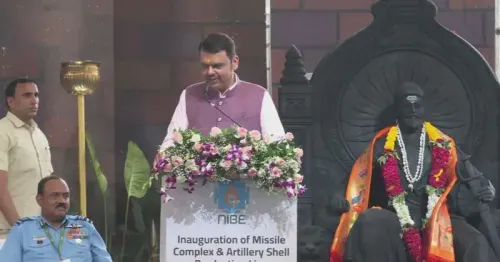
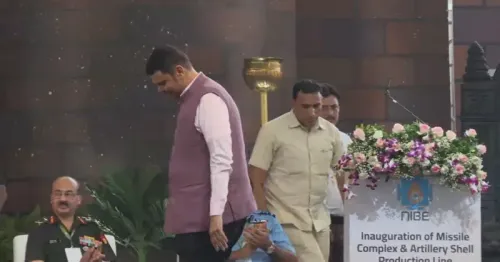
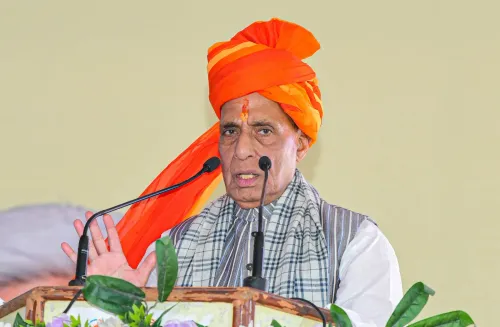
CM Fadnavis, Rajnath Singh Visit Shirdi Defence Plant
Synopsis
Union Defence Minister Rajnath Singh and Maharashtra CM Devendra Fadnavis on 23 May 2026 inspected Nibe Group's defence complex at Shirdi, reviewing indigenous artillery shell, TNT, and RDX technology plants alongside rocket launchers, drones, and advanced missile systems.
Key Takeaways
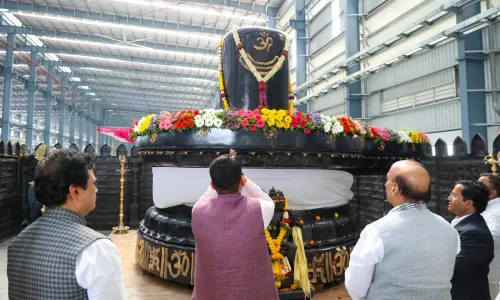
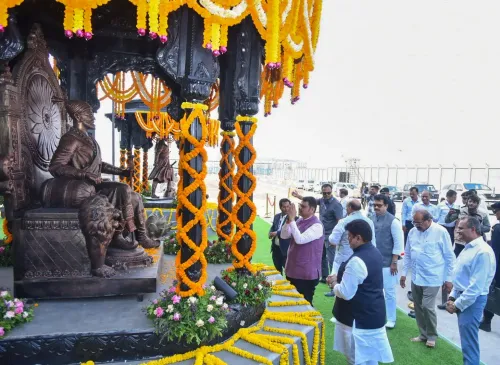
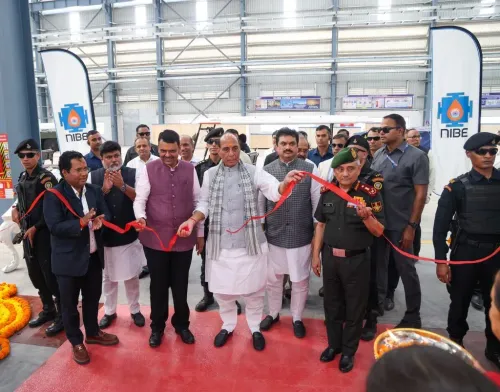
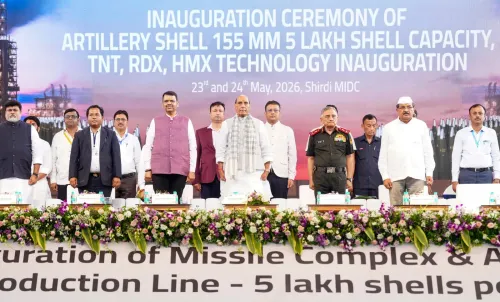
Rajnath Singh and CM Devendra Fadnavis jointly visited the Nibe Group Defence Manufacturing Complex at Shirdi, Ahilyanagar on 23 May 2026 .
The delegation inspected an Artillery Shell Line , an Indigenous TNT Technology Plant , and an Indigenous RDX Technology Plant .
Systems reviewed included rocket launcher systems , drones, advanced missiles, and cutting-edge weaponry.
Ganesh Nibe , Chairman and MD of Nibe Group, hosted the visit; Prof.
Ram Shinde and Minister Uday Samant were also present.
The facility is part of India's broader Atmanirbhar Bharat push to indigenise defence production, particularly in ammunition and explosives.
Maharashtra has been positioning Ahilyanagar as an emerging private-sector defence manufacturing hub.
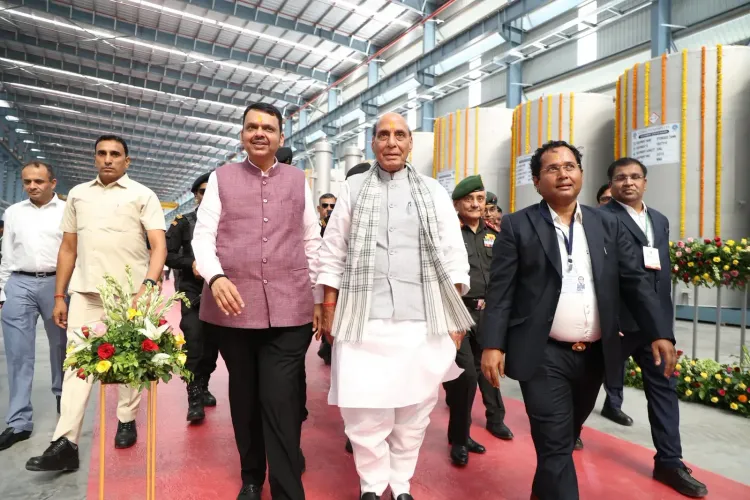
Chief Minister Devendra Fadnavis and Union Defence Minister Rajnath Singh on Saturday, 23 May 2026 jointly inspected the Nibe Group Defence Manufacturing Complex at Shirdi, Ahilyanagar in Maharashtra, reviewing indigenous artillery, explosives, and advanced weapons systems produced at the facility. The Chief Minister's Office of Maharashtra confirmed the visit, sharing images from the inspection on its official social media account.
What Was Inspected
The two leaders toured three key installations within the complex: an Artillery Shell Line, a Display of Indigenous TNT Technology Plant, and a Display of Indigenous RDX Technology Plant. During the visit, Rajnath Singh and Fadnavis received detailed briefings on a range of defence systems, including rocket launcher systems, drones, advanced defence technologies, and cutting-edge missiles and weaponry.
The Marathi-language post from the CMO stated that the delegation 'रॉकेट लॉन्चर प्रणाली, ड्रोन, प्रगत संरक्षण तंत्रज्ञान, अत्याधुनिक क्षेपणास्त्रे व शस्त्रे' ('rocket launcher systems, drones, advanced defence technology, state-of-the-art missiles and weapons') were reviewed in detail.
Context
Nibe Limited, a Maharashtra-based company, has been expanding aggressively into defence manufacturing with a focus on ammunition, explosives, and associated technologies. Ganesh Nibe, Chairman and Managing Director of the Nibe Group, was present at the facility to host the delegation. The complex at Shirdi represents one of the more prominent private-sector entries into India's domestic ammunition supply chain.
Also in attendance were Maharashtra Legislative Council Chairman Prof. Ram Shinde and Cabinet Minister Uday Samant, signalling the state government's institutional backing for the venture.
Policy Backdrop
The visit sits squarely within the Atmanirbhar Bharat framework launched in May 2020, which set ambitious targets for reducing India's dependence on imported defence equipment, particularly in ammunition and explosives. The liberalisation of foreign direct investment norms in defence to 74 per cent under the automatic route in 2020 opened the door for private companies such as Nibe to set up facilities for sensitive products including TNT and RDX-based systems.
Maharashtra has actively positioned itself as a defence manufacturing hub, offering land and industrial incentives under its industrial policies. High-level visits by the Union Defence Minister alongside state chief ministers are a recurring feature of India's indigenisation drive, used to publicly validate private-sector progress on the government's defence production targets.
Stakeholders and Impact
For the Indian armed forces, domestic production of artillery shells and explosive compounds reduces supply-chain vulnerability and foreign exchange outgo. For Maharashtra's industrial clusters, a functional private defence complex at Ahilyanagar signals potential for downstream employment and ancillary industry growth in a region not traditionally associated with defence manufacturing.
Private defence manufacturers across India are watching the Nibe facility closely, as it tests whether state-level support and central policy liberalisation can translate into certified, scaled production of high-specification military-grade products.
What's Next
The Defence Ministry's successive indigenisation lists continue to identify categories where private producers can qualify as suppliers to the armed forces; artillery ammunition and explosives figure prominently on those lists. Any formal procurement approvals or capacity-expansion announcements following this inspection would mark a significant step for the facility. Maharashtra's next state budget is also being watched for further incentives targeting defence cluster development in the region.
Point of View
Such visits publicly reinforce the indigenisation narrative ahead of the next Defence Production and Export Promotion Policy review cycle. For Fadnavis, anchoring a high-profile defence investment in Ahilyanagar — a region without a legacy defence-industrial base — carries both economic and political dividends. The broader pattern suggests India is moving from policy announcements on private-sector defence participation to on-ground validation, with states competing to host the next generation of dual-use manufacturing clusters.
NationPress
24 Sept 2026
Frequently Asked Questions
Why did Rajnath Singh visit Shirdi in May 2026?
Rajnath Singh visited Shirdi on 23 May 2026 to inspect the Nibe Group Defence Manufacturing Complex alongside Maharashtra CM Devendra Fadnavis, reviewing indigenous artillery shell, TNT, and RDX technology plants as part of India's defence indigenisation push.
What does Nibe Group manufacture at Shirdi?
Nibe Group's Shirdi complex houses an artillery shell production line and display plants for indigenous TNT and RDX technology, alongside capabilities in rocket launcher systems, drones, and advanced missile systems.
What is India's Atmanirbhar Bharat defence policy?
Launched in May 2020, Atmanirbhar Bharat in defence aims to reduce India's dependence on imported military equipment by encouraging private and public sector companies to manufacture weapons, ammunition, and platforms domestically.
Is Maharashtra becoming a defence manufacturing hub?
Maharashtra has been actively positioning itself as a defence manufacturing hub through industrial incentives and policy support, with facilities such as the Nibe Group complex at Shirdi representing the state's push to attract private defence investment.