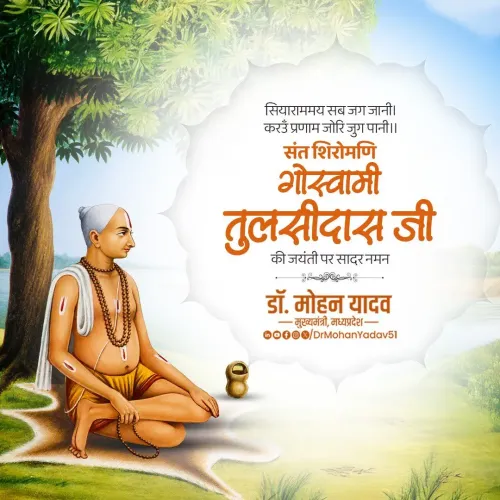
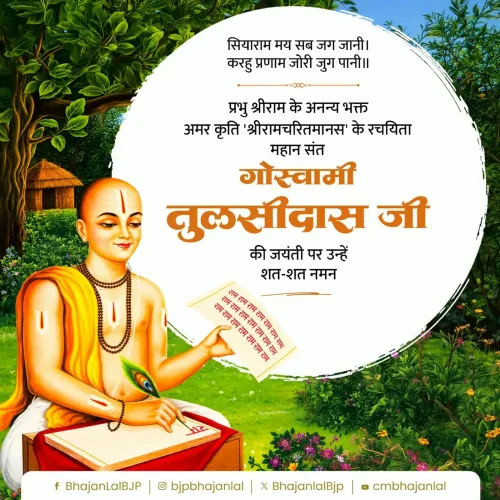
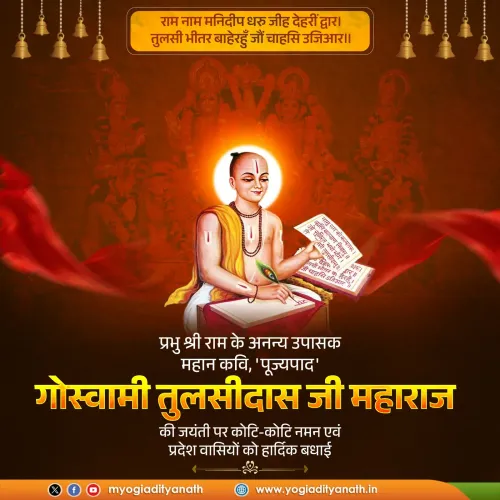
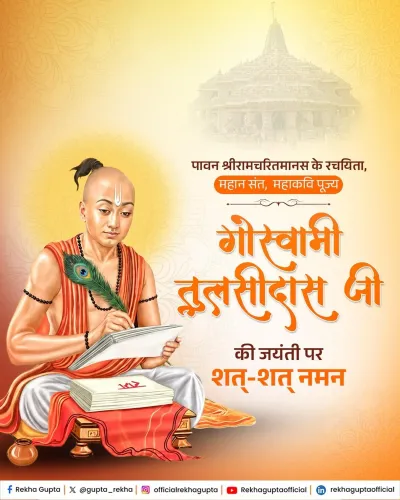
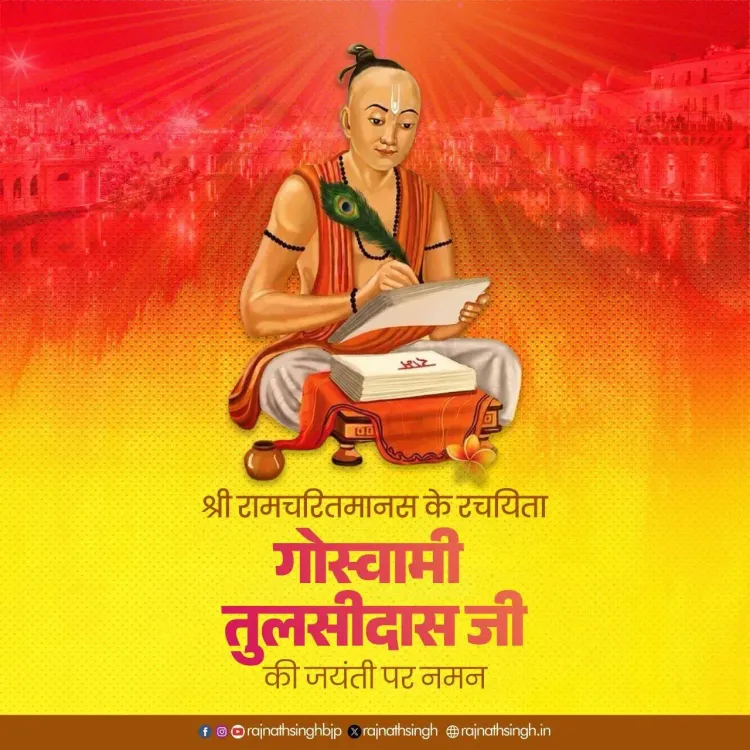
Rajnath Singh pays tribute to Goswami Tulsidas on Jayanti
Synopsis
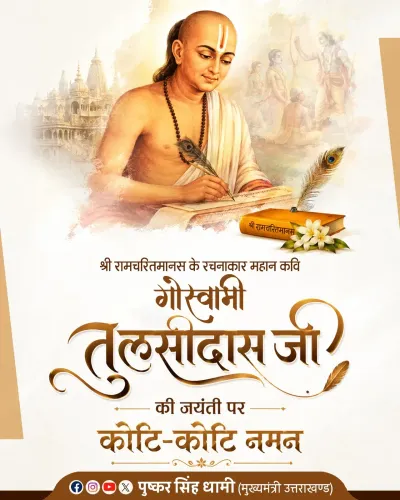
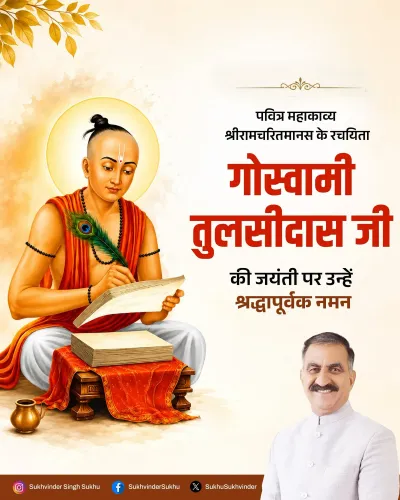
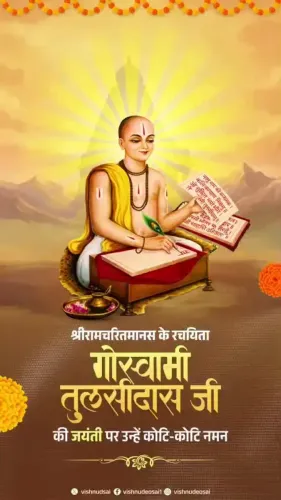
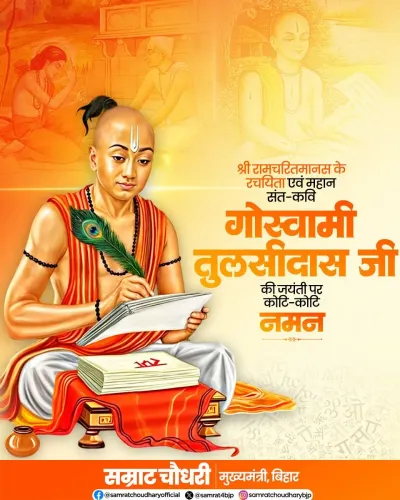
Union Defence Minister Rajnath Singh marked Tulsidas Jayanti on 19 August 2026 with a Hindi tribute, quoting the Ramcharitmanas and calling the 16th-century saint-poet's works an enduring light of Indian life-values and cultural consciousness.
Key Takeaways
Union Defence Minister Rajnath Singh posted a tribute on 19 August 2026 marking Tulsidas Jayanti .
Singh opened with a couplet from the Ramcharitmanas : 'Ja par kripa Ram ki hoi, ta par kripa karahin sab koi.' He described Goswami Tulsidas as a 'great saint and mahakavi who linked devotion to public consciousness.' Singh called Tulsidas's works 'not merely devotion but an invaluable light of Indian life-values and cultural consciousness.' He said the Ramcharitmanas will continue to show the path of virtue and right conduct to future generations of India.
A verse from the Ramcharitmanas — 'Ja par kripa Ram ki hoi, ta par kripa karahin sab koi' ('On whom Ram's grace falls, all bestow their grace upon them') — opened a tribute that Union Defence Minister Rajnath Singh posted on Wednesday, 19 August 2026, honouring the birth anniversary of the 16th-century saint-poet Goswami Tulsidas.
Singh offered 'crores of salutations' (koti-koti naman) to Tulsidas, describing him as a 'great saint and mahakavi who linked devotion to public consciousness.' The minister said Tulsidas, through the timeless composition Shri Ramcharitmanas, connected the ideals of Lord Shri Ram to the lives of ordinary people and showed the path of truth, propriety (maryada), compassion, duty, and public welfare (lokkallyan).
Why Ramcharitmanas endures as a civilisational text
Singh went further than a conventional birthday tribute. He argued that Tulsidas's works are 'not merely an expression of devotion but an invaluable light of Indian life-values and cultural consciousness.' The Ramcharitmanas, he wrote, 'will continue to illuminate the path of virtue and right conduct for India's coming generations.'
Goswami Tulsidas composed the Ramcharitmanas in Awadhi — the vernacular of the common people — at a time when Sanskrit held a near-monopoly on religious literature. That choice was itself a democratic act: it brought the story of Ram's ideals directly to those who could not access the classical tongue, and the text has since become one of the most recited scriptures across North and Central India.
A ritual of public memory senior leaders observe every year
Singh's post follows a well-established pattern in Indian public life: leaders across the political spectrum mark the birth anniversaries of bhakti-era saints and medieval poets with formal tributes that link classical texts to present-day values. The gesture carries no new programme or policy announcement; its significance lies in the continuity of official recognition for a literary and spiritual legacy that cuts across caste and region.
State-level cultural discourses and recitation programmes are typically organised around Tulsidas Jayanti, giving the occasion an observance that extends well beyond social-media salutations.
For a Defence Minister who has consistently woven cultural nationalism into his public persona, the tribute is also a reminder that Ram-related literature occupies a central place in the BJP's civilisational vocabulary — and that Ramcharitmanas, five centuries on, remains very much a living text in Indian political and social discourse.
Point of View
Which is precisely what makes it effective as soft cultural messaging. For a Defence Minister whose portfolio is defined by hard power, the turn to a 16th-century poet is a deliberate signal about the BJP's broader identity politics. The emphasis on Ramcharitmanas as guidance for 'coming generations' also subtly frames the text not as heritage alone but as living civic instruction.
NationPress
19 Aug 2026
Frequently Asked Questions
Who was Goswami Tulsidas?
Goswami Tulsidas was a 16th-century Indian saint-poet best known for composing the Ramcharitmanas, a retelling of the Ramayana in Awadhi that made Ram's story accessible to ordinary people and emphasised values of dharma, compassion, and duty.
What is Tulsidas Jayanti?
Tulsidas Jayanti is the birth anniversary of Goswami Tulsidas, observed annually according to the Hindu calendar. It is marked by recitations of the Ramcharitmanas and cultural programmes across North and Central India.
What did Rajnath Singh say about Tulsidas?
Rajnath Singh called Tulsidas a 'great saint and mahakavi who linked devotion to public consciousness' and said his works are 'not merely devotion but an invaluable light of Indian life-values and cultural consciousness.'
What is the Ramcharitmanas?
The Ramcharitmanas is a 16th-century epic poem by Tulsidas that retells the story of Lord Ram in Awadhi. It is one of the most widely read and recited scriptures in North India and is regarded as a foundational text of the bhakti movement.
Why do Indian leaders tribute bhakti saints on their anniversaries?
Paying tribute to bhakti-era saints on their birth anniversaries is a long-standing practice among Indian political leaders across parties. It signals respect for classical cultural heritage and links timeless literary values to contemporary public life.