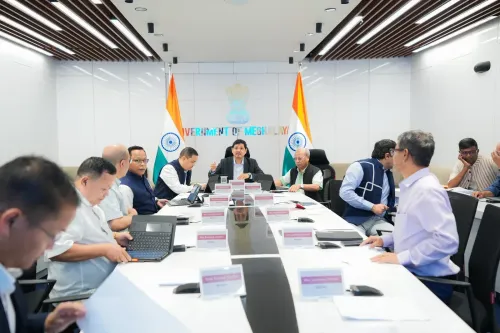
CM Conrad Sangma clears two university governance bills

Synopsis
Meghalaya's Cabinet cleared amendment bills for MIT Meghalaya and MGU on 19 August 2026, replacing the sponsoring body with the Governor as Visitor and boosting government representation on governing boards — aligning both universities with UGC norms.
Key Takeaways
Two bills approved: The Maharashtra Institute of Technology of Meghalaya (Amendment) Bill, 2026 and the Mahatma Gandhi University (Amendment) Bill, 2026 were cleared by Meghalaya Cabinet on 19 August 2026 .
Governor replaces sponsoring body as Visitor of both universities, matching the UGC-standard model used by other Indian universities.
Board of Management government representation increases from one to two members at both institutions.
Board of Governors government seats rise from two to three at both institutions.
The changes apply identically to both MIT Meghalaya and MGU, ensuring uniform governance structures.
The bills must now be passed by the Meghalaya Legislative Assembly before taking effect.
Meghalaya's Cabinet has moved to bring two of the state's private universities into line with national regulatory standards, approving amendments to the founding Acts of both the Maharashtra Institute of Technology of Meghalaya (MIT Meghalaya) and Mahatma Gandhi University (MGU) on Wednesday, 19 August 2026. The twin bills, cleared under the watch of Chief Minister Conrad Sangma, resolve a long-standing governance gap that had left these institutions out of step with University Grants Commission norms.
Governor steps in as Visitor, replacing sponsoring body
The most consequential change in both bills concerns who holds the role of Visitor — the apex constitutional authority over a university's governance. Under the earlier Acts, that role was assigned to the sponsoring body of each institution. The amendment replaces this with the Governor of Meghalaya, bringing the arrangement in line with the standard UGC-aligned model followed by virtually every other university in the country. It is a structural correction, not a ceremonial one: the Visitor holds powers of inspection, inquiry, and ultimately oversight of the university's direction.
The University Grants Commission, India's statutory higher-education regulator, has consistently pushed states to standardise the Visitor role under the Governor's office to ensure institutional accountability and uniformity across public and private universities alike. Meghalaya's Cabinet has now acted on that mandate for both MIT Meghalaya and MGU simultaneously.
Government seats on boards expand at MIT Meghalaya and MGU
The amendments also widen the state government's footprint on the governing bodies of both institutions. Representation on the Board of Management rises from one to two members, while seats on the Board of Governors increase from two to three. The change applies identically to both universities, signalling a deliberate push for parallel governance structures rather than institution-by-institution negotiation.
Across India's northeastern states, this kind of legislative synchronisation — amending multiple private university Acts in a single Cabinet sitting — has become a recognisable pattern as state governments respond to UGC pressure to tighten oversight. The expanded government presence on boards is designed to strengthen accountability without displacing the institutions' academic autonomy.
Bills now head to the Meghalaya Legislative Assembly
With Cabinet approval secured, the Maharashtra Institute of Technology of Meghalaya (Amendment) Bill, 2026 and the Mahatma Gandhi University (Amendment) Bill, 2026 must now pass through the Meghalaya Legislative Assembly before the revised governance structures can take effect. Once enacted, both universities will operate under board compositions and Visitor arrangements indistinguishable from those governing other state universities — a clean slate for regulatory compliance.
For students and faculty at MIT Meghalaya and MGU, the practical implication is straightforward: their institutions will now sit fully within the UGC's standardised governance framework, removing any ambiguity about accreditation, recognition, and oversight that the earlier Acts may have created.
Point of View
Particularly in the northeast where private institutions have proliferated rapidly. By vesting the Visitor role in the Governor, Meghalaya aligns with a constitutional convention that reinforces state oversight without directly interfering in academic affairs. The expansion of government board seats is a softer but equally significant lever — it gives the state a louder voice in institutional decisions without triggering the political friction of a full takeover. Conrad Sangma's Cabinet is essentially future-proofing these universities against accreditation risk, a move with direct consequences for student enrolment and institutional credibility.
NationPress
19 Aug 2026
Frequently Asked Questions
What did the Meghalaya Cabinet approve on 19 August 2026?
The Cabinet approved two amendment bills — the Maharashtra Institute of Technology of Meghalaya (Amendment) Bill, 2026 and the Mahatma Gandhi University (Amendment) Bill, 2026 — to bring both universities in line with UGC governance norms.
Why is the Governor being made the Visitor of MIT Meghalaya and MGU?
The UGC requires the Governor to serve as Visitor for universities to ensure uniform oversight. The earlier Acts had assigned this role to each institution's sponsoring body, which was out of step with national regulatory standards.
How does the amendment change board composition at MIT Meghalaya and MGU?
Government representation on the Board of Management rises from one to two members, and on the Board of Governors from two to three members, at both universities.
What happens next after Cabinet approval of these bills?
Both amendment bills must be introduced and passed in the Meghalaya Legislative Assembly before the new governance structures can come into force.
What is the UGC's role in university governance in India?
The University Grants Commission is India's statutory higher-education regulator. It sets governance norms — including the Visitor role and board composition — that all recognised universities are expected to follow for accreditation and compliance purposes.