Chhattisgarh CMO forms committee to draft, implement UCC
Synopsis
The Chief Minister's Office of Chhattisgarh announced on 25 June 2026 that the state government has constituted a committee to draft and implement the Uniform Civil Code, following Uttarakhand's landmark 2024 enactment and a broader push by BJP-governed states toward personal-law reform.
Key Takeaways
The Chief Minister's Office of Chhattisgarh announced on 25 June 2026 that a committee has been formed to draft and implement the Uniform Civil Code (UCC) in the state.
The UCC is a Directive Principle under Article 44 of the Indian Constitution, calling for a common set of personal laws for all citizens regardless of religion.
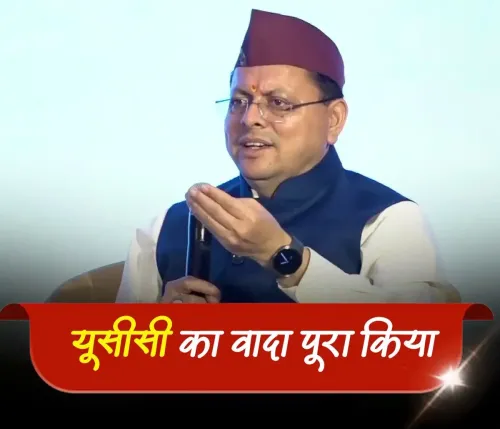
Uttarakhand enacted India's first state-level UCC in February 2024 , setting the precedent Chhattisgarh is now following.
Multiple BJP-governed states have constituted expert committees for state-specific UCC frameworks as a national code remains pending at the Union level.
The committee's mandate covers both drafting the code and planning its implementation , signalling an intent to move toward legislation.
If enacted, Chhattisgarh would become the second Indian state to have a legally operative Uniform Civil Code.
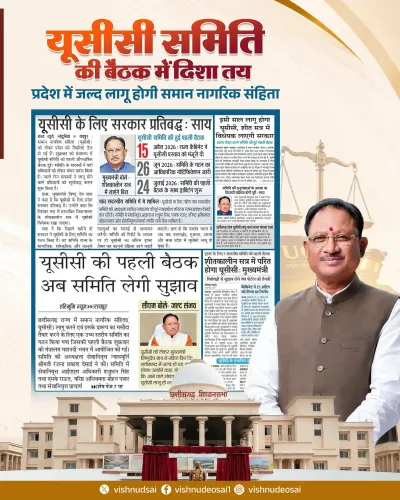
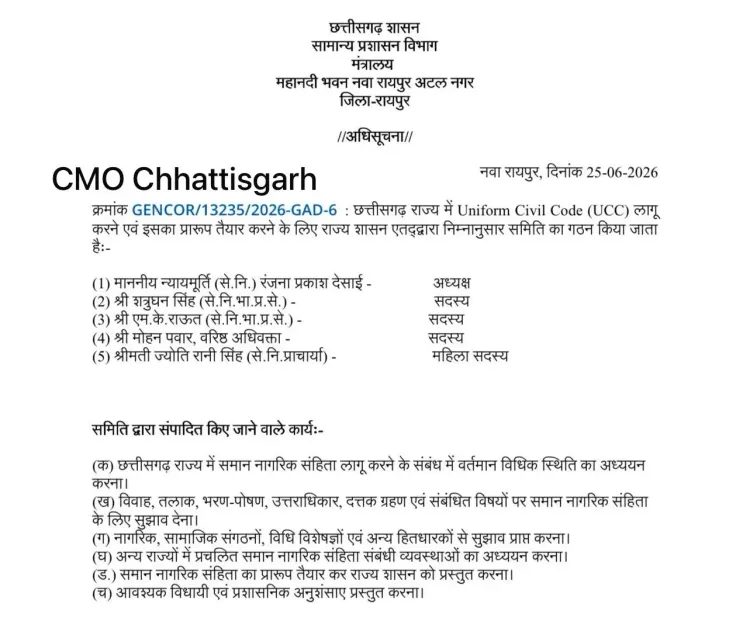
The Chief Minister's Office of Chhattisgarh announced on Thursday, 25 June 2026 that the state government has constituted a committee to draft and implement the Uniform Civil Code (UCC) in the state, marking a significant step in personal-law reform at the sub-national level.
The official post stated: 'छत्तीसगढ़ राज्य में Uniform Civil Code (UCC) लागू करने एवं इसका प्रारूप तैयार करने राज्य शासन द्वारा समिति का गठन' — translated as: 'The state government has constituted a committee to implement the Uniform Civil Code (UCC) in Chhattisgarh and to prepare its draft.' The announcement was tagged under the hashtags #UniformCivilCode and #SushasanSarkar (meaning 'Good Governance Government').
Context
The Uniform Civil Code refers to a common set of personal laws — covering marriage, divorce, inheritance, and adoption — applicable to all citizens regardless of their religion. It is enshrined as a Directive Principle of State Policy under Article 44 of the Indian Constitution, though it has remained aspirational rather than enforceable for decades.
India currently operates under religion-specific personal laws, with separate codes governing Hindus, Muslims, Christians, and other communities. The debate around a national UCC has persisted since the Constitution was adopted in 1950, with periodic legislative and judicial interventions keeping it in public discourse.
Policy Backdrop
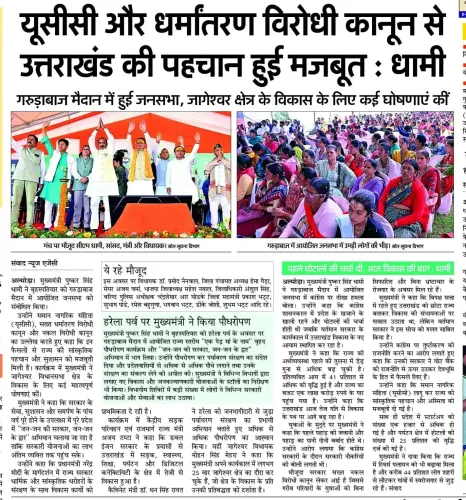
Uttarakhand became the first Indian state to enact a state-level Uniform Civil Code, passing its legislation in February 2024 following the work of an expert committee it had constituted. That move set a precedent for other states to pursue their own codification efforts without waiting for a national law.
Multiple BJP-governed states have since moved to constitute expert committees to draft state-specific UCC frameworks, reflecting a decentralised approach to personal-law reform. Chhattisgarh, governed by the BJP, now joins this wave with its own committee formation. A national UCC continues to be discussed at the Union level but no central legislation has been enacted as of this writing.
Stakeholders and Impact
The committee's mandate, as stated by the CMO, is both to prepare the draft code and to plan its implementation — a dual role that signals intent to move from policy design to ground-level rollout. The announcement directly affects all residents of Chhattisgarh, particularly communities whose personal affairs are currently governed by religion-specific statutes.
Religious communities, legal practitioners, civil society organisations, and women's rights groups are among the key stakeholders who are expected to engage with the committee's process. The drafting exercise will need to balance constitutional rights, personal freedoms, and the state's legislative competence in a domain that has historically been politically sensitive.
What's Next
The immediate milestone to watch is the release of the committee's draft report, which will outline the proposed provisions of Chhattisgarh's UCC. Following that, a bill would need to be introduced and passed in the Chhattisgarh Legislative Assembly for the code to acquire legal force — the same path Uttarakhand followed.
If Chhattisgarh advances its draft to legislation, it would become the second Indian state to enact a UCC, adding further momentum to a broader national conversation about uniform personal laws and potentially increasing pressure on the Union government to take up a central code.
Point of View
Creating legislative facts on the ground that could eventually compel a national reckoning. By tagging the announcement with 'SushasanSarkar', the CMO is explicitly linking personal-law reform to a good-governance identity — a positioning that serves both administrative and electoral narratives. The Uttarakhand model gives Chhattisgarh a legal and procedural template to follow, reducing the political risk of being first. The real test will come when the draft is made public and stakeholder consultations begin, at which point the breadth and balance of the proposed code will face sharper scrutiny.
NationPress
24 Sept 2026
Frequently Asked Questions
What is the Uniform Civil Code and why is Chhattisgarh forming a committee for it?
The Uniform Civil Code (UCC) is a proposed common set of personal laws — covering marriage, divorce, inheritance, and adoption — applicable to all citizens irrespective of religion. Chhattisgarh has formed a committee to draft and implement a state-level UCC, following the precedent set by Uttarakhand in 2024.
Which was the first Indian state to implement the Uniform Civil Code?
Uttarakhand was the first Indian state to enact a Uniform Civil Code, passing its legislation in February 2024 after an expert committee prepared the draft.
Does the Indian Constitution mandate a Uniform Civil Code?
The UCC is listed under Article 44 of the Indian Constitution as a Directive Principle of State Policy. Directive Principles are not enforceable by courts but are meant to guide the state in governance and lawmaking.
What will the Chhattisgarh UCC committee do?
According to the Chief Minister's Office, the committee has been tasked with preparing a draft of the Uniform Civil Code for Chhattisgarh and planning its implementation in the state.
Will the Chhattisgarh UCC apply to all religions?
A Uniform Civil Code by definition is intended to apply to all citizens regardless of their religion, replacing separate religion-specific personal laws. The exact provisions will depend on the draft the committee produces and any legislation the state assembly subsequently passes.