Maharashtra forms 7-member panel to implement Uniform Civil Code
Synopsis
Maharashtra has constituted a seven-member committee to implement the Uniform Civil Code, the Chief Minister's Office announced on 9 July 2026. The move follows Uttarakhand's landmark UCC legislation and aligns with the BJP's long-standing national manifesto commitment to legal uniformity across communities.
Key Takeaways
The Chief Minister's Office of Maharashtra announced the formation of a seven-member committee for UCC implementation on 9 July 2026 .
The Uniform Civil Code is a Directive Principle under Article 44 of the Indian Constitution, directing uniform civil laws for all citizens regardless of religion.
Uttarakhand was the first Indian state to enact UCC legislation, after constituting a committee in 2022 and passing a law in 2024 .
The BJP has committed to UCC implementation in its national manifestos since 2014 , and CM Devendra Fadnavis has been tagged in the announcement.
Key stakeholders include women's groups supporting uniform protections and religious minority communities with concerns about personal law changes.
Legal challenges before higher courts are anticipated once any draft Maharashtra UCC bill is tabled.
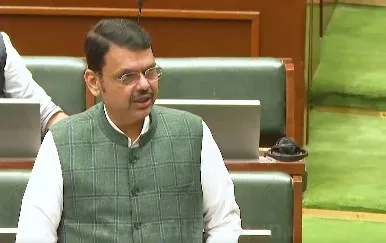
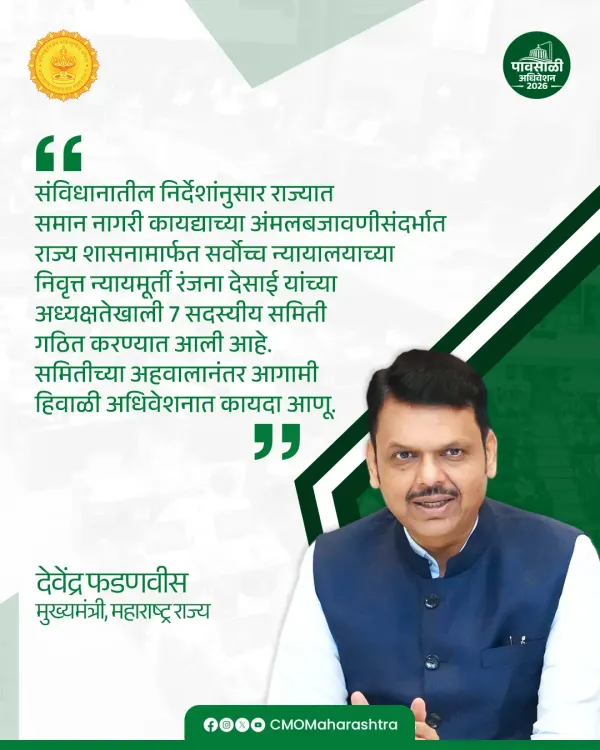
The Chief Minister's Office of Maharashtra announced on Thursday, 9 July 2026 that the state government has constituted a seven-member committee to oversee the implementation of the Uniform Civil Code (UCC) in Maharashtra, tagging Chief Minister Devendra Fadnavis in the official post.
The post, shared on the CMO's official X account, read: 'महाराष्ट्रात समान नागरी कायद्याच्या अंमलबजावणीसाठी सात सदस्यीय समिती गठित' — ('A seven-member committee has been constituted for the implementation of the Uniform Civil Code in Maharashtra.')
Context
The Uniform Civil Code envisions a single set of civil laws — governing marriage, divorce, inheritance, and adoption — applicable to all citizens regardless of religion. The concept is rooted in Article 44 of the Indian Constitution (1950), which lists it as a Directive Principle of State Policy, directing the State to endeavour to secure a UCC for all citizens.
Maharashtra's move follows Uttarakhand, which became the first Indian state to enact UCC legislation after constituting a five-member expert committee in 2022 and passing a law in 2024. Goa has historically operated under a common civil code inherited from Portuguese-era laws, serving as a long-standing domestic precedent.
Policy Backdrop
The Bharatiya Janata Party (BJP) included UCC implementation in its national election manifestos in both 2014 and 2019, framing it as a matter of gender equality and legal uniformity across communities. The Law Commission of India examined the issue and released a consultation paper in 2018, noting the complexity of reconciling diverse personal laws.
Chief Minister Devendra Fadnavis, a senior BJP leader who has served multiple terms at the helm of Maharashtra, has positioned the state as an active participant in the party's broader governance agenda. The formation of this committee signals Maharashtra's intent to move from policy commitment to structured implementation.
Stakeholders and Impact
The UCC debate directly concerns women's groups, who have long argued that uniform personal laws would strengthen protections against discriminatory practices in marriage and inheritance. Religious minority communities have raised concerns about the potential erosion of faith-based personal laws, making the committee's composition and mandate particularly significant.
Maharashtra is one of India's most populous and economically significant states, home to a diverse mix of religious and cultural communities. Any legislation emerging from this committee's work would set a major precedent and is likely to face scrutiny in higher courts.
What's Next
The immediate focus will be on the seven-member committee's terms of reference, its timeline for delivering recommendations, and whether the state government introduces a bill in the Maharashtra Legislative Assembly. Legal challenges before the Bombay High Court or the Supreme Court of India are widely anticipated once any draft legislation is tabled.
Maharashtra's initiative adds momentum to a national conversation on UCC that has intensified since Uttarakhand's legislation, and its outcome could influence the pace at which other BJP-governed states move toward similar frameworks.
Point of View
Particularly given the state's large and diverse minority populations. The committee's eventual report will be a bellwether for how far BJP-governed states are willing to push UCC implementation ahead of any central legislation.
NationPress
8 Oct 2026
Frequently Asked Questions
What is the Uniform Civil Code and why is Maharashtra forming a committee for it?
The Uniform Civil Code is a proposed set of common civil laws on marriage, divorce, inheritance, and adoption applicable to all citizens regardless of religion. Maharashtra has formed a seven-member committee to work out the framework for implementing it in the state, following a similar approach taken by Uttarakhand.
Which states have already implemented the Uniform Civil Code in India?
Uttarakhand became the first Indian state to enact UCC legislation, passing a law in 2024 after forming an expert committee in 2022. Goa has historically operated under a common civil code inherited from Portuguese rule.
Who announced the UCC committee in Maharashtra?
The Chief Minister's Office of Maharashtra made the announcement on 9 July 2026 via its official X account, tagging Chief Minister Devendra Fadnavis.
What does Article 44 of the Indian Constitution say about the Uniform Civil Code?
Article 44, listed under the Directive Principles of State Policy, directs the State to endeavour to secure a Uniform Civil Code for all citizens across India. It is not a justiciable right but a policy goal the government is expected to pursue.
Will the Maharashtra UCC committee decision face legal challenges?
Legal challenges before the Bombay High Court or the Supreme Court of India are widely anticipated once any draft legislation emerges from the committee's recommendations, as UCC laws directly affect personal religious laws of various communities.