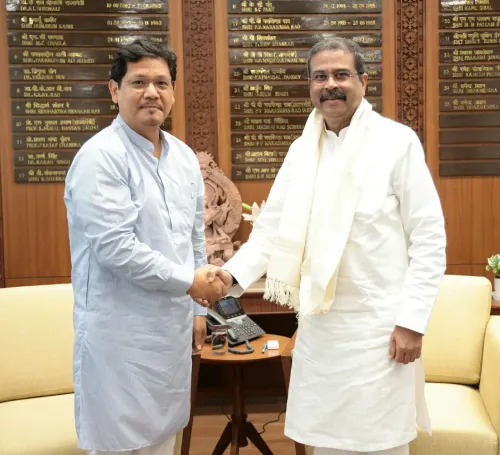
CM Conrad Sangma orders strategy to lift Meghalaya PGI ranking
Synopsis
Meghalaya Chief Minister Conrad Sangma has directed the state Education Department to draft a focused strategy and stronger mechanisms to improve Meghalaya's Performance Grading Index ranking, citing reporting gaps, weak learning outcomes and the need for school infrastructure upgrades after a detailed review of the state's low score.
Key Takeaways
CM Conrad Sangma chaired a review on improving Meghalaya's Performance Grading Index ranking.
Reporting challenges were identified as a key factor behind the state's low score.
The state Education Department has been directed to put in place a focused strategy.
Focus areas include learning outcomes and school infrastructure improvements.
The PGI was launched by the Union Ministry of Education in 2019 to grade states on school education.
The post tagged Union Education Minister Dharmendra Pradhan and the Education Ministry.
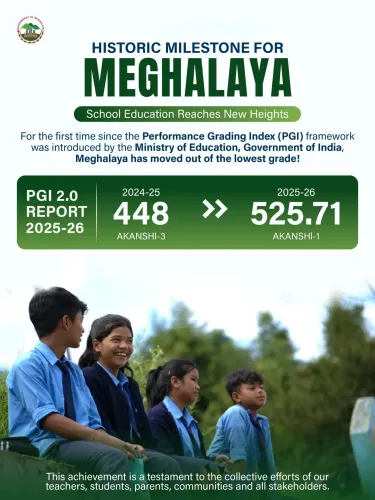
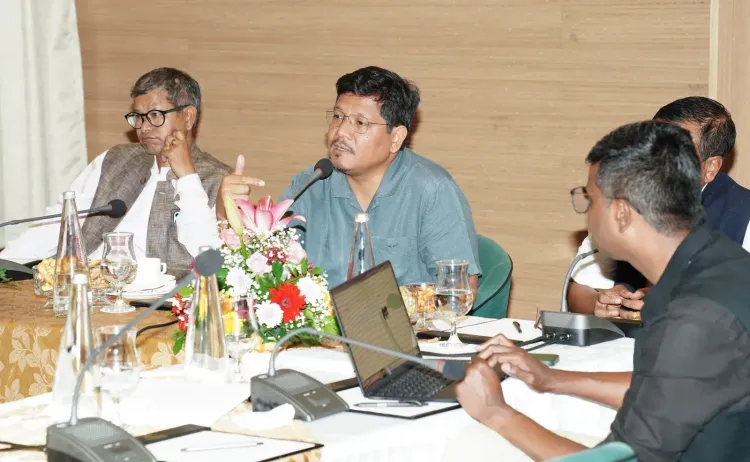
Meghalaya Chief Minister Conrad Sangma on Wednesday said he had chaired a detailed review meeting to chart a course for improving the state's standing on the Performance Grading Index (PGI), the Union Ministry of Education's annual evaluation of school systems. Sangma said the review examined the reasons behind Meghalaya's low score and flagged reporting gaps as a key drag on the overall rating. He has directed the state Education Department to draw up a focused strategy and stronger delivery mechanisms.
In his post on X, Sangma wrote that he 'carefully assessed the factors behind the low score and identified key gaps, including reporting challenges that impacted our overall rating.' He added that directions had been issued to the Education Department 'to put in place a focused strategy and stronger mechanisms to improve performance, learning outcomes and build on our commitment for infrastructure improvements in Schools.' The Chief Minister tagged Union Education Minister Dharmendra Pradhan, the Union Ministry of Education and state Education Minister Rakkam A. Sangma's ministerial colleague handle in the post.
Context
The Performance Grading Index was introduced by the Ministry of Education in 2019 as a structured tool to benchmark states and Union Territories on school education. It scores systems across domains including learning outcomes, access, equity, infrastructure and governance processes, with the aim of nudging states toward measurable, time-bound reforms.
Meghalaya, like several northeastern states, has historically grappled with challenges of geography, dispersed habitations and teacher deployment that complicate both delivery and data reporting. Sangma's acknowledgement that 'reporting challenges' weighed on the rating points to a long-recognised issue: PGI scoring depends heavily on how comprehensively states upload verifiable data into central dashboards.
Policy backdrop
The PGI sits alongside the centrally sponsored Samagra Shiksha programme and the National Education Policy (NEP) 2020 framework, under which states are expected to align reforms with measurable outcomes. Federal-state coordination on education metrics has become a recurring theme, with chief ministers periodically convening reviews to close gaps flagged in central assessments.
For Meghalaya, improving on the index is tied not only to reputational standing but also to the state's ability to demonstrate absorptive capacity for central funds linked to school infrastructure, teacher training and digital learning.
Stakeholders and impact
The immediate stakeholders are school students across Meghalaya's eleven districts, teachers, district education officers and the state Education Department's planning wing. Sharper data reporting protocols typically translate into more accurate identification of under-resourced schools, which in turn shapes where new classrooms, drinking water facilities, toilets and laboratories are built.
The Chief Minister's emphasis on 'learning outcomes' alongside infrastructure signals an attempt to balance brick-and-mortar spending with measurable improvements in foundational literacy and numeracy, areas the NEP has prioritised through the NIPUN Bharat mission.
What's next
The state Education Department is now expected to translate the Chief Minister's directions into a written action plan, including timelines for data submission to central portals and a roadmap for school infrastructure upgrades. The next annual PGI release by the Union Ministry of Education will be the first public test of whether the corrective steps move Meghalaya up the grading ladder.
Budget allocations in the next state financial cycle, along with any assembly discussion on school infrastructure, will indicate the scale of resources the Sangma government is willing to commit to the reset.
Point of View
A dynamic the PGI was designed to encourage. Sangma's candid flag on 'reporting challenges' is notable, as it reframes part of the problem as administrative capacity rather than pure outcome failure — easier to fix in the short term. The political optics also matter: tagging the Union Education Minister signals a cooperative federal posture from an NPP-led NDA-allied government. The real test will be whether the next PGI cycle reflects genuine learning-outcome gains or only cleaner data submission.
NationPress
25 Sept 2026
Frequently Asked Questions
What is the Performance Grading Index?
The Performance Grading Index (PGI) is an annual evaluation released by the Union Ministry of Education that grades states and Union Territories on their school education systems. It scores them across domains such as learning outcomes, access, equity, infrastructure and governance processes.
Why is Meghalaya's PGI ranking low?
Chief Minister Conrad Sangma has said the state's low score was driven by multiple gaps, including reporting challenges that affected the overall rating. A detailed review has been undertaken to identify and address these issues.
What has Conrad Sangma directed the Education Department to do?
He has directed the state Education Department to put in place a focused strategy and stronger mechanisms to improve performance, learning outcomes and school infrastructure. The aim is to ensure Meghalaya achieves a better PGI ranking in the coming years.
When was the PGI launched?
The Performance Grading Index was launched by the Union Ministry of Education in 2019. It is intended as a structured benchmarking tool to push states toward measurable, time-bound school education reforms.
Who is the Union Education Minister tagged in the post?
Dharmendra Pradhan is the Union Minister of Education in the Government of India. He was tagged along with the Education Ministry's handle in Conrad Sangma's post.