Conrad Sangma reviews Meghalaya PGI score, flags 3,198 school mergers

Synopsis
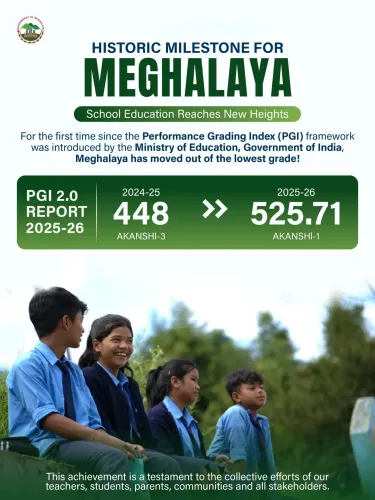
Meghalaya has quietly merged 3,198 of its 14,582 schools — over a fifth of its network — as Chief Minister Conrad K. Sangma pushes a data-led overhaul to lift the state's Performance Grading Index score. Officials concede the PGI rank reflects structural and reporting gaps, not student potential, signalling that the next reform battle is administrative, not pedagogical.
Key Takeaways
Sangma chaired a high-level Education Department review on 3 June in Shillong .
Meghalaya has nearly 14,600 schools serving a population of around 30 lakh .
3,198 of 14,582 schools have been merged or consolidated under the school rationalisation programme. 'Learning Outcomes' carries the highest weightage in the PGI framework and was the meeting's central focus.
Vocational learning is being scaled via the Community Skill Integrated Curriculum from primary to secondary levels.
Deputy Commissioners directed to adopt a mission-mode approach for district-level accountability.
Meghalaya Chief Minister Conrad K. Sangma on Wednesday, 3 June chaired a high-level review with the state Education Department in Shillong to assess Meghalaya's performance in the Performance Grading Index (PGI) and lay out a road map for accelerating education reforms. The review covered learning outcomes, school infrastructure, vocational training and digital governance across nearly 14,600 schools serving a population of around 30 lakh.
Key focus on learning outcomes
The meeting centred on 'Learning Outcomes', the indicator carrying the highest weightage in the PGI framework. Officials briefed the Chief Minister on interventions to strengthen foundational literacy and numeracy, raise classroom teaching standards and roll out targeted support for students lagging behind.
Sangma reiterated the government's commitment to ensuring access to quality education for every child in the state, particularly in remote and rural areas where Meghalaya's school network is most extensive.
School rationalisation progress
A key highlight was the school rationalisation programme. Officials informed the meeting that out of 14,582 schools in Meghalaya, 3,198 schools have already been merged or consolidated to improve teacher deployment, resource allocation and service delivery.
The phased infrastructure upgrade covers science laboratories, ICT facilities, smart classrooms, libraries, kitchen gardens, rainwater harvesting systems, drinking water and solar-powered infrastructure.
District-level accountability push
Sangma directed Deputy Commissioners and district administrations to work in a mission-mode approach with the Education Department to close implementation gaps. He stressed continuous monitoring of performance indicators and assured full government support for schools targeting measurable improvements.
Vocational learning is being expanded through the Community Skill Integrated Curriculum, which introduces students from primary to secondary levels to practical, skill-oriented modules. Student welfare measures reviewed included the Mid-Day Meal programme and the installation of sanitary pad vending machines and incinerators in girls' schools.
What the Chief Minister said
“We are aware where Meghalaya stands, and we are equally aware of the progress we are making. Education is a long-term investment, and the reforms we have undertaken over the last few years are laying the foundation for lasting change,” Sangma said. He added that with access largely secured, the next priority is quality learning outcomes in every institution.
An official present at the meeting said Meghalaya's PGI score largely reflects “structural, administrative and data reporting challenges” and does not represent “the talent or potential of our children, which is second to none.”
Data systems and what's next
The review also examined steps to strengthen digital governance, including improved data reporting, digital compliance, Aadhaar integration and institutional record management — all aimed at ensuring accurate representation of Meghalaya's progress in national assessments. Sangma called for a strategic, scientific and data-driven approach, with regular assessments and stronger coordination between schools, districts and the state government.
Point of View
But it is not entirely wrong. The rationalisation of 3,198 schools is the more consequential story: in a hill state with thin populations per village, consolidation can either lift teacher-pupil ratios or quietly raise dropout risk if transport and access aren't addressed. The real test isn't the next PGI cycle; it's whether merged-school catchments retain their students. Until district-level retention data is published alongside the rationalisation numbers, the reform remains half-evaluated.
NationPress
26 Sept 2026
Frequently Asked Questions
What is the Performance Grading Index (PGI)?
The Performance Grading Index is a national framework used to assess states' school education performance across indicators such as learning outcomes, access, infrastructure, equity and governance. Learning Outcomes carry the highest weightage in the framework.
How many schools has Meghalaya merged under the rationalisation programme?
Officials informed the review meeting that 3,198 schools out of 14,582 in Meghalaya have already been merged or consolidated. The goal is better teacher deployment, improved resource allocation and stronger service delivery.
What did Conrad Sangma say about Meghalaya's education reforms?
Sangma said education is a long-term investment and that reforms undertaken over the last few years are laying the foundation for lasting change. He added that with school access largely ensured, the government's next priority is quality learning outcomes in every institution.
What student welfare initiatives were reviewed?
The review covered the Mid-Day Meal programme and the installation of sanitary pad vending machines and incinerators in girls' schools. Infrastructure upgrades including drinking water, solar power and rainwater harvesting were also assessed.
Why does Meghalaya's PGI score lag?
An official at the meeting said the score largely reflects structural, administrative and data reporting challenges rather than the capability of students. The government is now strengthening digital governance, Aadhaar integration and institutional record management to improve representation in national assessments.