Conrad Sangma: Meghalaya exits PGI lowest category
Synopsis
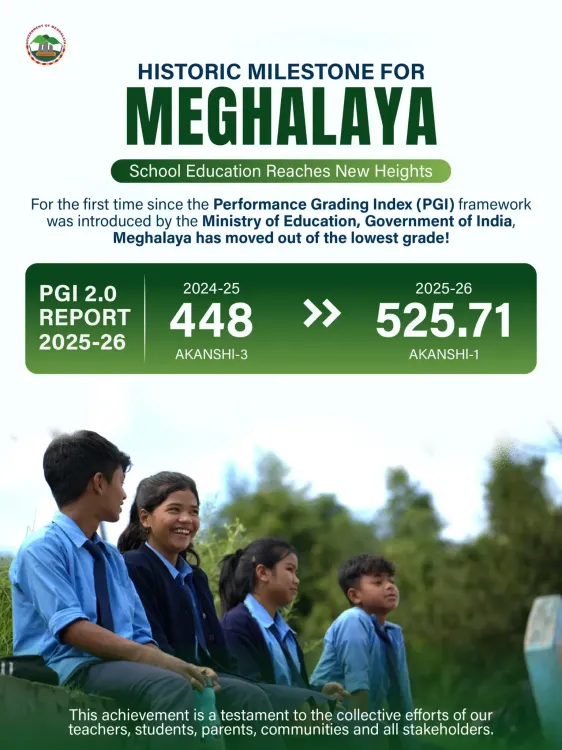
Meghalaya has exited the PGI's lowest Akankshi-3 category for the first time, with its score jumping over 124 points in three years to 525.71 in 2025-26. Chief Minister Conrad Sangma credited teachers, communities, and systemic reforms for making Meghalaya one of India's fastest-improving states in school education.
Key Takeaways
Meghalaya has moved from Akankshi-3 to Akankshi-1 in the Performance Grading Index (PGI) — the first time the state has exited the lowest PGI category since the index was introduced.
The state's PGI score rose from 401.62 in 2022–23 to 525.71 in 2025–26 , an improvement of over 124 points in three years .
Chief Minister Conrad Sangma credited reforms across teacher quality, school infrastructure, curriculum, governance, digital systems, and learning outcomes.
The improvement makes Meghalaya one of the fastest-improving states in the country on the PGI metric.
Sangma tagged the Union Education Minister , PMO India , and the Ministry of Education , signalling central-state coordination on the achievement.
The CM emphasised the journey continues, with a stated goal of a 'world-class, inclusive, and future-ready education system' for every child in Meghalaya .
Meghalaya Chief Minister Conrad Sangma on Wednesday, 8 July 2026 announced that Meghalaya has for the first time exited the lowest category of the Performance Grading Index (PGI), a school education ranking framework introduced by the Ministry of Education, Government of India, moving from the Akankshi-3 grade to Akankshi-1 and recording one of the fastest score improvements among all Indian states.
Context
The Performance Grading Index was introduced by the Union Ministry of Education to assess and rank states and union territories on school education quality across parameters including learning outcomes, teacher quality, infrastructure, governance, and equity. States are graded across ascending categories — with Akankshi being the lower rungs and higher grades reflecting stronger systemic performance.
Meghalaya's PGI score has risen from 401.62 in 2022–23 to 525.71 in 2025–26, an improvement of over 124 points in three years. Chief Minister Sangma described this as a result of 'sustained reforms in teacher quality, school infrastructure, curriculum, governance, digital systems, and learning outcomes.'
Policy Backdrop
The PGI framework grades states on a scale that encompasses over 70 indicators grouped under domains such as outcomes, effective classroom transactions, infrastructure and facilities, equity, and governance. States in the Akankshi category — the lowest tier — have historically faced systemic gaps in teacher deployment, digital access, and learning assessment infrastructure.
Meghalaya, a small northeastern state with a largely rural and tribal population, has faced structural challenges in school education, including difficult terrain, dispersed habitation, and teacher vacancies. The state government's push under the National Education Policy (NEP) 2020 framework, alongside central schemes such as PM POSHAN and Samagra Shiksha Abhiyan, has been credited with driving incremental improvements. Chief Minister Sangma's post tagged Union Education Minister Dharmendra Pradhan (@dpradhanbjp), the Prime Minister's Office (@PMOIndia), and the Ministry of Education (@EduMinOfIndia), signalling coordinated acknowledgement of the milestone.
Stakeholders and Impact
The Chief Minister specifically credited 'teachers, students, parents, School Management Committees, education officials, and communities across the State' for the achievement, underscoring a decentralised, community-driven reform model. School Management Committees (SMCs), mandated under the Right to Education Act, play a key role in local school governance and accountability.
For Meghalaya's approximately 11 lakh school-going children, improved PGI scores translate into tangible gains: better-trained teachers, upgraded classrooms, stronger learning assessment systems, and improved digital infrastructure. The state's movement to Akankshi-1 also positions it to access higher tranches of performance-linked grants under Samagra Shiksha, potentially unlocking additional central funding.
What's Next
Chief Minister Sangma was explicit that the milestone is not a destination, stating the state's commitment to 'building a world-class, inclusive, and future-ready education system that empowers every child in Meghalaya to realise their full potential.' The next PGI cycle will test whether the momentum is sustained and whether Meghalaya can graduate beyond the Akankshi tier entirely into higher performance bands.
The announcement adds political weight to the National People's Party (NPP)-led government's governance narrative ahead of future electoral cycles, with education reform joining infrastructure and connectivity as key planks of CM Sangma's development agenda for the state.
Point of View
And the CM's public tagging of central education authorities suggests a deliberate effort to align the achievement with the broader national education reform narrative under NEP 2020. For the NPP government, this milestone serves a dual purpose: it reinforces Conrad Sangma's development-first positioning and strengthens the party's case for continued central support and political relevance in a region where coalition arithmetic is always in flux. Whether the gains are sustained will depend on whether systemic reforms in teacher deployment and learning outcomes outlast the political cycle.
NationPress
7 Oct 2026
Frequently Asked Questions
What is the Performance Grading Index (PGI) in India?
The Performance Grading Index (PGI) is a framework introduced by India's Ministry of Education to grade states and union territories on school education quality across parameters like learning outcomes, teacher quality, infrastructure, and governance. States are ranked in ascending categories, with Akankshi being the lower tier.
What is Meghalaya's new PGI score in 2025-26?
Meghalaya's PGI score in 2025-26 is 525.71, up from 401.62 in 2022-23 — an improvement of over 124 points in three years.
What does Akankshi-1 mean in the PGI grading system?
Akankshi-1 is a category within the lower performance band of the PGI grading system. Moving from Akankshi-3 to Akankshi-1 means Meghalaya has improved significantly within the tier, though further progress is needed to exit the Akankshi band entirely.
Who is Conrad Sangma and which party does he belong to?
Conrad Sangma is the Chief Minister of Meghalaya and the national president of the National People's Party (NPP), a regional political party based in the northeast of India.
What reforms helped Meghalaya improve its PGI ranking?
According to Chief Minister Conrad Sangma, improvements came from sustained reforms in teacher quality, school infrastructure, curriculum development, governance, digital systems, and learning outcomes, driven by teachers, students, parents, School Management Committees, and communities across the state.