Rajnath Singh Salutes Indian Infantry on Shaurya Diwas
Synopsis
On Shaurya Diwas, 27 October 2026, Union Defence Minister Rajnath Singh paid tribute to the Indian Army's infantry, honouring their courage from the historic 1947 Srinagar airlift to today's most demanding frontiers, calling their sacrifice the finest tradition of India's armed forces.
Key Takeaways
Shaurya Diwas is observed annually on 27 October to honour the Indian Army's infantry, rooted in the 1947 airborne landing in Srinagar .
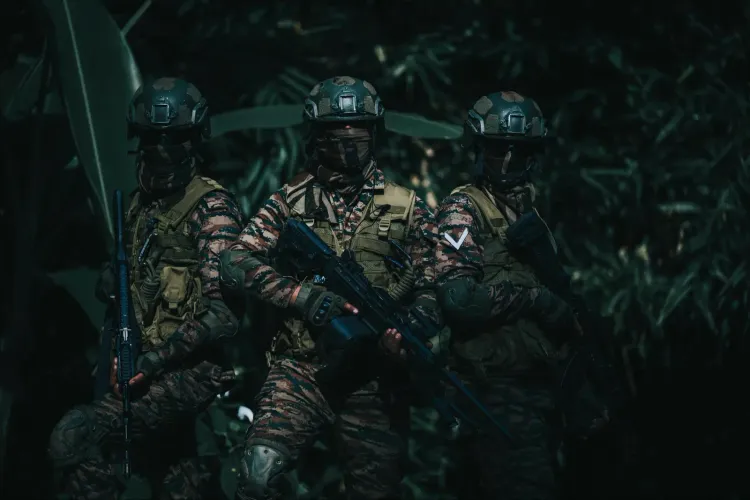
Defence Minister Rajnath Singh saluted infantrymen for courage 'from the historic battlefields of 1947 to the most challenging frontiers of today.' Singh described the infantry's devotion, courage and willingness to sacrifice as 'the finest traditions of our Armed Forces.' The Indian Infantry is the most combat-exposed arm of the Indian Army, serving across every terrain from glaciers to jungles.
The annual tribute is part of the government's broader calendar of armed forces commemorations, reinforcing civilian-military continuity.
Seventy-nine years after Indian troops were airlifted into Srinagar to hold the line against a tribal invasion, Union Defence Minister Rajnath Singh invoked that founding act of courage on Shaurya Diwas, 27 October 2026, paying tribute to every infantryman who has since carried that legacy forward.
The 1947 Airlift That Gave Shaurya Diwas Its Meaning
The date is not arbitrary. On 27 October 1947, Indian Army troops were rushed by air to Srinagar as Pakistani tribal militias advanced on the Kashmir Valley — a mission mounted within hours of the Maharaja signing the Instrument of Accession. That airborne intervention is widely credited with saving the city and, with it, India's claim to the region. It is the act of soldiering that Shaurya Diwas commemorates every year.
Singh's post drew a direct line from that moment to the present, honouring infantrymen who have 'held the line when the odds were overwhelming' across every major conflict since independence — from the 1965 and 1971 wars to the glacial altitudes of Siachen and the most recent frontier standoffs.
Infantry: The Arm That Bears the Heaviest Cost
The Indian Infantry is the largest and most combat-exposed arm of the Indian Army. It fights on every terrain — jungle, desert, high-altitude glacier, urban sprawl — and historically accounts for the highest share of battle casualties. When Singh writes of soldiers who 'made the ultimate sacrifice so that India may stand tall,' he is speaking to a numerical and human reality that underpins every formal tribute.
His message named three qualities — 'unwavering devotion to duty, remarkable courage and willingness to make the supreme sacrifice' — framing them not as rhetoric but as 'the finest traditions of our Armed Forces.' The phrasing is deliberate: it places the infantry within a living institutional culture, not merely a historical record.
An Annual Ritual With Enduring Weight
Tributes on 27 October have become a fixed point on the government's calendar, with the Defence Minister and senior military leadership marking the day each year. But the ritual carries weight that repetition does not diminish. Each observance reconnects the political executive — the civilian authority over the armed forces — with the soldiers who operate at the sharpest end of national security. In a year when India's frontier posture continues to demand active deployment, the salute lands with particular resonance.
The nation's infantry, Singh wrote, shall be 'forever remembered and remain grateful for their service and sacrifice.' For the families of those who never came home from those battlefields, that permanence is the only answer that counts.
Point of View
In years of active frontier pressure, signal political resolve to the armed forces and the public simultaneously. Rajnath Singh's framing — linking 1947's founding moment to 'the most challenging frontiers of today' — deliberately collapses the distance between historical sacrifice and present deployment, reinforcing continuity of national purpose. For a government that has made military honour a visible policy theme, these observances are part of a consistent messaging architecture around sovereignty and sacrifice. The infantry, bearing the heaviest human cost of that architecture, is its most powerful symbol.
NationPress
27 Oct 2026
Frequently Asked Questions
What is Shaurya Diwas and why is it celebrated on 27 October?
Shaurya Diwas is observed on 27 October each year to honour the Indian Army's infantry. The date marks the 1947 airborne landing in Srinagar , when Indian troops were airlifted to counter a tribal invasion during the first Indo-Pakistani war, a mission that secured the Kashmir Valley.
What did Rajnath Singh say on Shaurya Diwas 2026?
Defence Minister Rajnath Singh saluted the 'extraordinary courage, valour and sacrifice' of Indian infantrymen, honouring their service from the 1947 battlefields to today's frontiers and calling their devotion 'the finest traditions of our Armed Forces.'
What is the role of the Indian Infantry in the Indian Army?
The Indian Infantry is the largest and most combat-exposed arm of the Indian Army. It operates across all terrains — from high-altitude glaciers to jungles and deserts — and has participated in every major conflict since India's independence in 1947.
What happened on 27 October 1947 in Srinagar?
On 27 October 1947 , Indian Army troops were airlifted to Srinagar within hours of Jammu and Kashmir's Maharaja signing the Instrument of Accession, halting the advance of Pakistani tribal militias and securing the city.
Does India observe Infantry Day every year?
Yes. 27 October is marked annually as Shaurya Diwas (also associated with Infantry Day), with the Defence Minister and senior military leadership paying tribute to the Indian Army's infantry and its sacrifice across India's conflicts since independence.