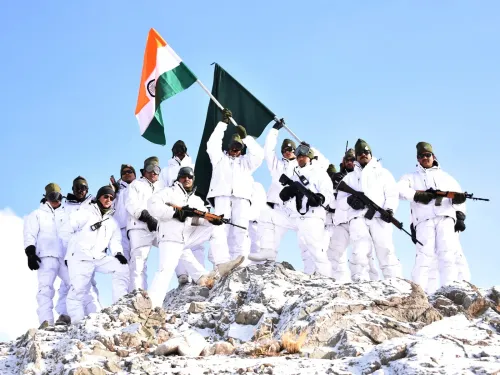
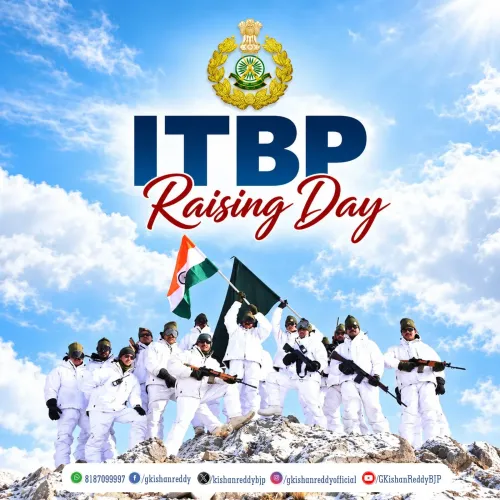
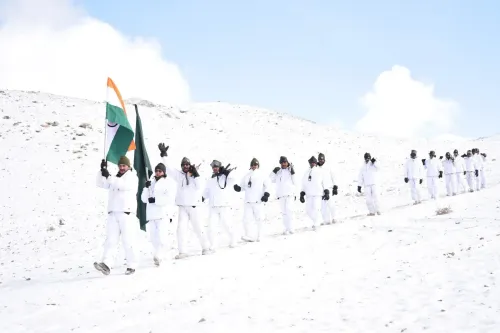
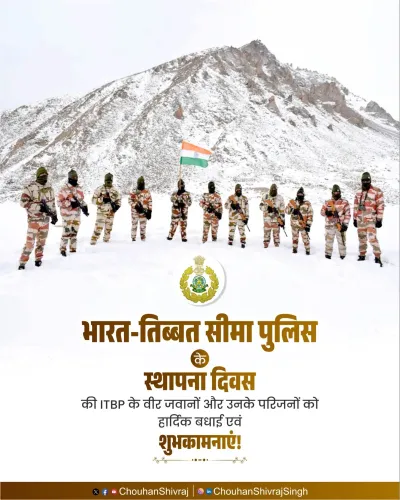
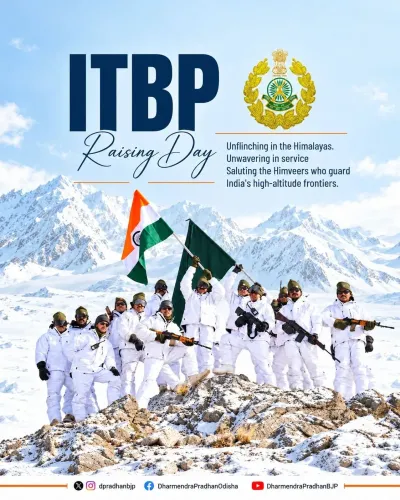
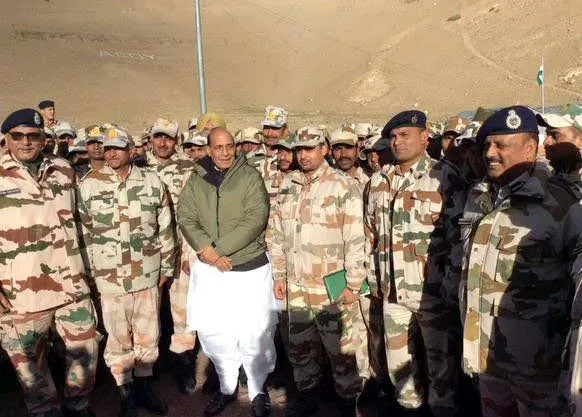
Rajnath Singh salutes ITBP on its 64th Raising Day
Synopsis
Union Defence Minister Rajnath Singh saluted ITBP on its 64th Raising Day, crediting Himveers for guarding India's Himalayan borders in extreme conditions and for contributions to Left Wing Extremism operations — honouring a force born from the 1962 Sino-Indian War.
Key Takeaways
ITBP Raising Day falls on 24 October every year, marking the force's founding in 1962 during the Sino-Indian War.
Union Defence Minister Rajnath Singh extended greetings to all ITBP personnel and their families on the 64th Raising Day .
Singh highlighted ITBP's role in guarding India's borders 'in the harshest climatic conditions' — a reference to high-altitude Himalayan postings along the India-China frontier.
The tribute specifically acknowledged ITBP's contributions to Left Wing Extremism counter-insurgency operations, alongside its primary border-guarding mandate.
ITBP is a Central Armed Police Force (CAPF) under the Union Home Ministry, operating in coordination with state police and other CAPFs.
Born in the crucible of the 1962 Sino-Indian War, the Indo-Tibetan Border Police turns 64 on Saturday, October 24, 2026 — and Union Defence Minister Rajnath Singh marked the occasion with a tribute to the force's Himveers, the men and women standing watch at India's highest, coldest frontiers.
Raised in war, tested by altitude
The ITBP was raised on 24 October 1962, weeks into the Sino-Indian War, specifically to guard the vast Himalayan frontier that runs along the border with China. The decision to create a dedicated high-altitude border force acknowledged a hard truth: conventional military deployments could not sustain permanent vigil across terrain where oxygen is thin and temperatures plunge to lethal lows. More than six decades later, that founding logic still holds.
Singh's post highlighted what sets the force apart — not just the geography, but the conditions. 'The Himveers of ITBP have played a vital role in safeguarding India's borders in the harshest climatic conditions,' he wrote, a nod to postings at altitudes exceeding 18,000 feet where glacier winds and whiteout snowstorms are operational realities, not exceptions.
Beyond the mountains: ITBP's role in fighting Left Wing Extremism
Singh's tribute also pointed to a less-discussed dimension of ITBP's mandate — internal security. The force has contributed to Left Wing Extremism (LWE) operations, the decades-long counter-insurgency effort against Maoist groups active across parts of central and eastern India. This dual role — high-altitude border guardian and internal security responder — places the ITBP in a category of its own among India's Central Armed Police Forces (CAPFs).
India's CAPF architecture assigns specialised roles to each force, but the geographic and operational stretch demanded of ITBP is singular. Deployment in coordination with state police forces for LWE operations means Himveers move between two entirely different threat environments — frozen passes in the north and forest corridors in Chhattisgarh or Jharkhand.
A salute from South Block on Raising Day
For a Defence Minister who previously served as Home Minister — the ministry that directly oversees all CAPFs including ITBP — Singh's acknowledgement carries an institutional weight beyond ceremonial courtesy. His message closed with a line that captures the force's ethos: 'Their courage, professionalism and unwavering commitment to duty reflect the finest traditions of service to the nation.'
Every October 24, Raising Day parades and commemorations remind a largely civilian audience that some of India's most demanding postings involve no combat headlines — just silent, sustained vigil on ridgelines the world rarely photographs. The Himveers carry that watch forward into year sixty-five.
Point of View
The explicit mention of Left Wing Extremism signals that Naxal-affected areas remain a live policy concern even as border infrastructure with China commands greater public attention. Raising Day messaging by the Defence Ministry also serves a morale function, periodically elevating a force that operates far from the media spotlight. The reiteration of 'professionalism and unwavering commitment' language aligns with the government's ongoing effort to build a distinct institutional identity and public pride around each CAPF.
NationPress
24 Oct 2026
Frequently Asked Questions
When was ITBP raised and why?
The Indo-Tibetan Border Police was raised on 24 October 1962 following the Sino-Indian War, specifically to guard India's northern Himalayan border with China.
What does ITBP stand for?
ITBP stands for Indo-Tibetan Border Police , a Central Armed Police Force primarily responsible for guarding the India-China border.
Why are ITBP personnel called Himveers?
ITBP personnel are called Himveers — meaning 'brave ones of the Himalayas' — a title that reflects their service in extreme high-altitude conditions along the Himalayan frontier.
What is ITBP's role in Left Wing Extremism operations?
Beyond border guarding, ITBP is deployed in coordination with state police for Left Wing Extremism (LWE) counter-insurgency operations in Maoist-affected areas of central and eastern India.
What did Rajnath Singh say on ITBP Raising Day 2026?
Defence Minister Rajnath Singh extended warm greetings to all ITBP personnel and families, praising their role in border security under harsh conditions and their contributions to combating Left Wing Extremism.