Rajnath Singh: India's Youth Now Defence Tech Partners

Synopsis
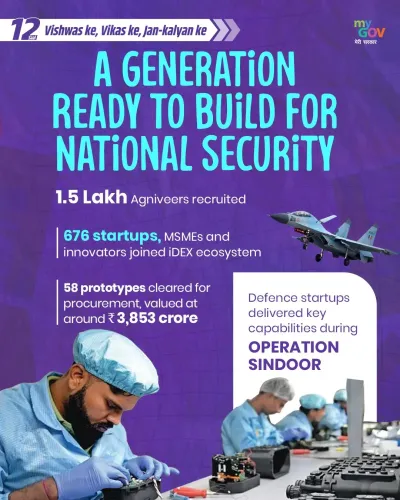
Union Defence Minister Rajnath Singh declared on 27 September 2026 that India's youth have evolved into national security technology partners, citing iDEX, iDEX-Prime and ADITI as platforms driving indigenous development of AI, drones, robotics, quantum and autonomous-systems capabilities.
Key Takeaways
Rajnath Singh stated on 27 September 2026 that India's youth are now 'technology partners for national security,' not merely job-seekers or job-creators. iDEX (launched April 2018 ) connects startups and MSMEs to the defence R&D pipeline via the Defence Innovation Organisation (est.
2017). iDEX-Prime provides larger-scale funding for high-potential defence tech projects that have matured beyond seed stage.
ADITI targets critical and emerging technologies — including AI, drones, robotics, quantum systems and autonomous platforms — for accelerated indigenous development.
Singh's framing places defence innovation firmly within the Atmanirbhar Bharat policy arc that has expanded positive indigenisation lists since 2020 .
Key future indicators include new iDEX and ADITI challenge rounds, the next Union Budget's defence innovation allocation, and startup showcases at DefExpo and Aero India .
India's young innovators are no longer waiting on the sidelines of national security — they are being handed the blueprint. On Sunday, 27 September 2026, Union Defence Minister Rajnath Singh declared that Indian youth had evolved beyond the roles of job-seeker or job-creator, stepping into a new identity: technology partner for national security.
Posting on X in Hindi, Singh wrote: 'Bharat ka yuva ab keval Job Seeker ya Job Creator nahin, balki National Security ka Technology Partner ban raha hai.' — 'India's youth is no longer merely a job-seeker or job-creator, but is becoming a technology partner for national security.' He pointed to three government schemes — iDEX, iDEX-Prime, and ADITI — as the platforms making this shift real, with young innovators building capabilities in AI, drones, robotics, quantum technologies, and autonomous systems.
What iDEX, iDEX-Prime and ADITI Actually Do
Innovations for Defence Excellence (iDEX) was launched by the Ministry of Defence in April 2018 to plug startups and MSMEs directly into the defence R&D pipeline — a model that most mature defence economies had adopted decades earlier. The Defence Innovation Organisation, set up in 2017 as the implementing backbone, administers the programme and connects innovators with the armed forces as early customers and co-developers.
iDEX-Prime is the high-octane tier of that framework — designed for projects that have outgrown seed-level support and need larger-scale funding to move from prototype to deployable product. ADITI (Acing Development of Innovative Technologies with iDEX) targets the sharpest edge of the agenda: critical and emerging technologies where India has historically depended on imports. Together, the three instruments form a layered pipeline — from first-time founders all the way to advanced-stage defence tech companies.
The Atmanirbhar Arc Behind the Statement
Singh's post is not a one-off announcement — it is a rhetorical milestone in a decade-long policy journey. Since 2014, successive policy measures have sought to dismantle India's deep import dependence in defence. The positive indigenisation lists, first notified in 2020 and expanded in subsequent years, banned imports of a growing catalogue of defence items, creating a captive domestic market that startups could actually sell into.
What has shifted in tone is the framing: where earlier communications emphasised industrial self-reliance in hardware, Singh's statement today pushes the frontier explicitly toward AI, quantum, and autonomous systems — technologies where the gap between civilian innovation and military application is at its narrowest, and where a young, software-literate generation has a genuine competitive edge.
Why the 'Technology Partner' Label Matters
The choice of words is deliberate. Calling India's youth a 'national security technology partner' — rather than a beneficiary of government contracts — signals a relationship of co-creation, not procurement. It repositions defence startups from vendors to stakeholders in India's strategic posture. For a country that has spent decades importing frontline platforms, that is a significant rhetorical — and, its architects would argue, operational — shift.
The sectors Singh named are not aspirational: drone technology has already seen significant domestic commercialisation, and Indian AI and robotics startups have attracted both private capital and armed-forces interest. The question is whether the institutional scaffolding — challenge grants, procurement fast-tracks, and testing infrastructure — can keep pace with the ambition the minister is projecting.
The next real measure will come at the forthcoming DefExpo or Aero India exhibitions, where the pipeline of iDEX and ADITI graduates will face their most public stress-test yet. If the platforms and prototypes on display reflect the breadth Singh is claiming, the 'technology partner' label will earn its weight.
Point of View
Quantum and autonomous systems under the iDEX umbrella, the minister is signalling that India intends to compete in next-generation warfare domains through domestic talent rather than imported platforms. The statement also serves a domestic political purpose: it ties the BJP's governance record on defence modernisation to aspirational youth constituencies ahead of any electoral cycle. Whether the institutional infrastructure — procurement fast-tracks, testing ranges, and sustained funding — can substantiate the ambition remains the central accountability question.
NationPress
27 Sept 2026
Frequently Asked Questions
What is iDEX and how does it help defence startups in India?
iDEX (Innovations for Defence Excellence) is a Ministry of Defence initiative launched in April 2018 that connects Indian startups and MSMEs with the defence R&D ecosystem through challenge grants and procurement pathways, administered by the Defence Innovation Organisation.
What is the ADITI scheme in Indian defence?
ADITI (Acing Development of Innovative Technologies with iDEX) is a government scheme designed to accelerate the indigenous development of critical and emerging defence technologies such as AI, drones, quantum systems and autonomous platforms.
What did Rajnath Singh say about India's youth and defence technology?
On 27 September 2026, Rajnath Singh posted that India's youth were no longer just job-seekers or job-creators, but were becoming technology partners for national security by developing AI, drones, robotics, quantum and autonomous systems through iDEX, iDEX-Prime and ADITI.
How does Atmanirbhar Bharat connect to defence innovation in India?
Atmanirbhar Bharat's defence component, pursued since 2014 and formalised through positive indigenisation lists from 2020 onwards, aims to replace imported defence equipment with domestically developed alternatives — with iDEX and ADITI as key instruments for engaging startups in that process.