Rajnath Singh: India's Youth Now a Tech Partner in Defence

Synopsis
Union Defence Minister Rajnath Singh has declared India's youth the technological partners of national security, highlighting iDEX, iDEX Prime and ADITI as engines of startup-led innovation in drones, AI, quantum technology and cybersecurity under the Atmanirbhar Bharat defence push.
Key Takeaways
Union Defence Minister Rajnath Singh declared on October 15, 2026 that India's youth are now technological partners in national defence.
Schemes iDEX , iDEX Prime , and ADITI are cited as key vehicles giving startups and MSMEs access to defence innovation opportunities. iDEX (Innovations for Defence Excellence) was launched by the Ministry of Defence in 2018 to fund and partner with private innovators on defence challenges.
Focus domains include drones, artificial intelligence, quantum technology, and cybersecurity — the core technologies of modern warfare.
The push is framed as central to Atmanirbhar Bharat in defence, moving India away from import dependence toward domestic capability.
The real measure of success lies in how many funded projects move from prototype to actual induction into the armed forces .
India's young innovators are no longer waiting on the sidelines of national security — Union Defence Minister Rajnath Singh declared on Thursday, October 15, 2026, that the country's youth have become full technological partners in its defence ecosystem, channelling talent across drones, artificial intelligence, quantum technology, and cybersecurity to power India's self-reliance push.
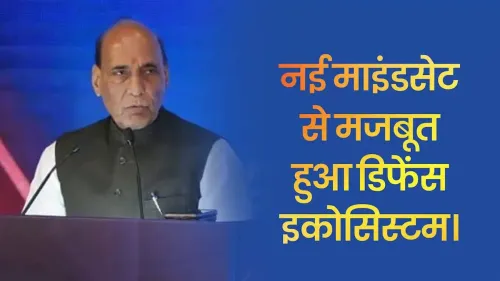
Posting in Hindi on X, Singh said: 'Aaj Bharat ka yuva desh ki suraksha ka technological partner ban chuka hai' — 'Today, India's youth have become the technological partner of the nation's security.' He specifically credited schemes like iDEX, iDEX Prime, and ADITI for opening new innovation opportunities for young people, startups, and MSMEs within the defence sector.
iDEX: The Scheme That Opened the Defence Door to Startups
iDEX — Innovations for Defence Excellence — was launched by the Ministry of Defence in 2018 as a landmark step to dismantle the long-standing dominance of legacy public-sector firms in India's defence supply chain. The scheme offers funding and procurement linkages to startups and small businesses willing to tackle real operational challenges posed by the armed forces. What began as a bet on private ingenuity has, over the years, grown into a broader ecosystem push.
Singh's reference to iDEX Prime and ADITI alongside the original programme signals the layering of that architecture — building higher-budget, deeper-technology tiers on top of the original startup sandbox. The combined thrust is aimed squarely at domains that define the next generation of warfare: autonomous systems, AI-driven decision-making, quantum communications, and cyber defence.
Drones, AI, Quantum — Where Young India Is Being Deployed
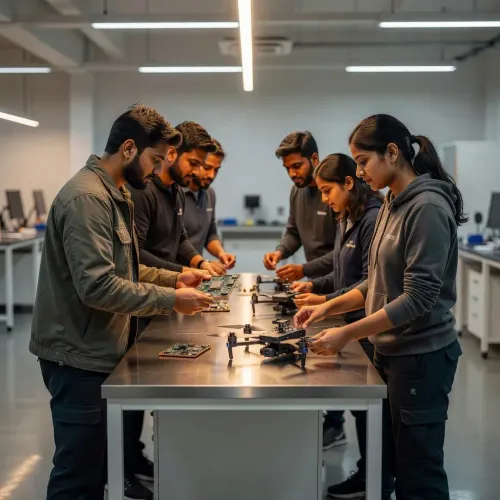
The domains Singh named are not incidental. Drones have already seen India move from near-total import dependence to a growing domestic industrial base, with indigenous UAV developers supplying both the armed forces and border-security agencies. Artificial intelligence is being woven into surveillance, logistics, and tactical platforms. Quantum technology — covering secure communications and next-generation sensing — and cybersecurity round out a portfolio that mirrors the priority lists of every major defence power on the planet.
The minister's framing is pointed: it is not the state alone, nor the traditional defence-industrial complex, that will deliver Atmanirbhar Bharat in defence. It is the startup founder, the MSME engineer, and the young researcher who are being cast as co-architects of national security.
Atmanirbhar Bharat's Deepest Bet Yet
India's shift from being one of the world's largest arms importers toward self-sufficiency in defence technology has been a defining policy arc since the late 2010s. Rajnath Singh, who has helmed the Defence Ministry through much of that transformation, has consistently used both budgetary levers — successive increases in the domestic procurement budget — and institutional ones, like iDEX, to accelerate the pivot. The real test, as defence observers have long noted, is how many iDEX-funded projects move from prototype to actual induction into the armed forces. That pipeline — proof-of-concept to battlefield deployment — remains the frontier to watch as upcoming defence budgets and expos approach.
If today's message lands as intended, India's next generation is not just the workforce of tomorrow's economy — it is the security architecture of a nation that has decided to build its own shield.
Point of View
Not just procurement lists. The layering of iDEX Prime and ADITI atop the original 2018 scheme suggests the ministry is institutionalising, not merely celebrating, private-sector defence innovation. The domains named — AI, quantum, cyber — mirror the strategic priorities of every peer and near-peer competitor India faces, indicating the framework is being calibrated to real threat assessments. The outstanding question, which every defence budget and expo will sharpen, is whether the procurement pipeline is converting startup talent into fielded capability fast enough to matter.
NationPress
15 Oct 2026
Frequently Asked Questions
What is iDEX and who can apply?
iDEX — Innovations for Defence Excellence — is a Ministry of Defence scheme launched in 2018 that funds and partners with startups, MSMEs, and individual innovators to develop technologies for the Indian armed forces. Eligible applicants include registered Indian startups and small businesses working on defence-relevant solutions.
What did Rajnath Singh say about youth and defence technology?
On October 15, 2026 , Union Defence Minister Rajnath Singh said India's youth have become the 'technological partner' of the nation's security, crediting iDEX, iDEX Prime, and ADITI schemes for channelling young talent into drones, AI, quantum technology, and cybersecurity.
What is the ADITI scheme in defence?
ADITI is a defence innovation scheme referenced by Rajnath Singh alongside iDEX and iDEX Prime as part of India's broader effort to involve startups and MSMEs in cutting-edge defence technology development under the Atmanirbhar Bharat framework.
How is India becoming self-reliant in defence technology?
India has pursued Atmanirbhar Bharat in defence through successive policy measures since the late 2010s, including mandatory domestic procurement quotas, private-sector participation, and innovation schemes like iDEX that fund startups working on drones, AI, quantum, and cyber capabilities.
What defence technologies are Indian startups working on?
Indian defence startups are active in drones (UAVs), artificial intelligence, quantum technology, and cybersecurity — domains highlighted by Defence Minister Rajnath Singh as central to India's push for technological self-reliance in national security.