Rajnath Singh Hails IITs as Engine of Atmanirbhar Innovation
Synopsis
Union Defence Minister Rajnath Singh called India's IIT ecosystem a 'powerful engine of innovation and entrepreneurship,' framing its rise as proof of the country's growing technological capabilities and commitment to Atmanirbhar Bharat — signalling deeper integration of premier academic institutions with national self-reliance goals.
Key Takeaways
Union Defence Minister Rajnath Singh on October 14, 2026 described India's IIT ecosystem as a 'powerful engine of innovation and entrepreneurship.' He linked the IITs' rise directly to India's Atmanirbhar Bharat self-reliance initiative launched by PM Modi in May 2020 .
The IIT network expanded significantly from 2008 onward , adding new campuses and scaling research and incubation capacity.
IIT-linked incubators support startups in deep-tech, defence components, semiconductors, and advanced materials — sectors central to indigenisation targets.
Singh's framing — from a minister overseeing India's defence procurement — signals accelerating integration of academic research with strategic industrial goals.
Potential follow-through includes deeper IIT-DRDO partnerships and new policy measures for academic-to-government technology transfer.
India's premier engineering institutions are no longer just classrooms — they are becoming launchpads for the country's strategic and economic future. Union Defence Minister Rajnath Singh on Wednesday, October 14, 2026, declared the IIT ecosystem a 'powerful engine of innovation and entrepreneurship,' linking its rise directly to India's self-reliance ambitions.
What Rajnath Singh said — and why it lands differently from a Defence Minister
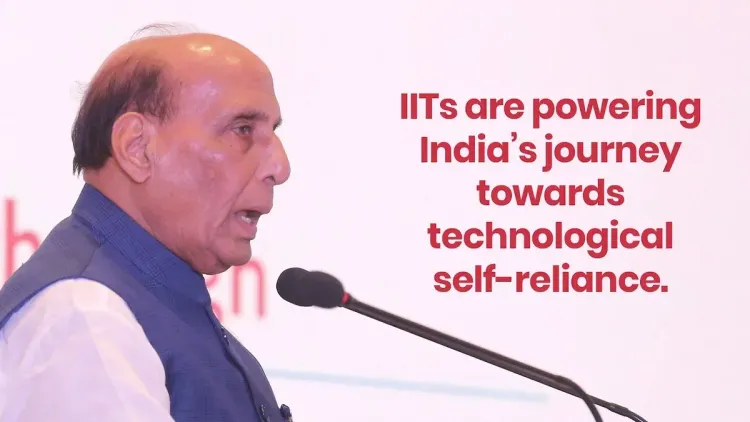
Singh's post was unambiguous: 'India's IIT ecosystem is emerging as a powerful engine of innovation and entrepreneurship. This is a testament to India's growing technological capabilities and our commitment to Atmanirbhar Bharat.' Coming from the minister who oversees one of India's largest public procurement budgets — and the sector most aggressively targeted by the indigenisation drive — the framing is deliberate. The Indian Institutes of Technology, once celebrated primarily as pipelines to global tech firms, are increasingly being positioned as anchors of domestic capability-building.
The IIT network's expanding footprint in research and startups
India's IIT system has grown significantly since the original five institutes were established in the 1950s and 60s. A fresh wave of expansion from 2008 onward added new campuses, scaling the network's research output and incubation capacity. Today, IIT-linked startup ecosystems span deep-tech, defence components, semiconductor design, and advanced materials — precisely the domains where India seeks to cut import dependence. The IITs' technology business incubators have collectively supported thousands of startups, several of which now supply to government and defence programmes.
Atmanirbhar Bharat's academic front
Prime Minister Narendra Modi announced the Atmanirbhar Bharat Abhiyan in May 2020 as a sweeping national self-reliance mission — reducing dependency on imports across manufacturing, technology, and strategic sectors. In the defence domain, this translated into positive indigenisation lists, higher foreign direct investment caps, and a push for domestic research. Integrating institutions like the IITs into that chain — connecting academic innovation with industrial and defence application — has been a stated policy goal. Singh's remarks signal that integration is visibly accelerating.
The road the IITs are now expected to walk
Observers watching this space will track whether Singh's endorsement is accompanied by concrete announcements: deeper IIT-DRDO research partnerships, new funding windows for academic-to-industry technology transfer, or policy measures that give IIT-incubated startups a clearer path into government procurement. The signal from the country's defence establishment is clear — India's academic crown jewels are being called upon to do more than produce talent. They are being asked to produce capability.
For a country that once imported the bulk of its advanced technology, an IIT ecosystem celebrated by the Defence Minister as an engine of self-reliance marks a meaningful shift in how India sees the line between the university and the national interest.
Point of View
And tying IIT output to that doctrine raises the stakes for how these institutions are funded, directed, and evaluated. For the BJP government, showcasing the IITs as proof of 'growing technological capabilities' also serves a broader narrative ahead of any policy announcements in the critical-technology space. The real test will be whether this rhetorical alignment translates into structural bridges — research grants, procurement preferences, or fast-track IP frameworks — that make IIT innovation commercially viable within India.
NationPress
14 Oct 2026
Frequently Asked Questions
What did Rajnath Singh say about IITs?
Rajnath Singh said India's IIT ecosystem is emerging as a 'powerful engine of innovation and entrepreneurship' and called it a testament to India's growing technological capabilities and commitment to Atmanirbhar Bharat.
What is Atmanirbhar Bharat and how does it relate to IITs?
Atmanirbhar Bharat is a national self-reliance initiative launched by PM Narendra Modi in May 2020 to reduce import dependence in manufacturing, technology, and strategic sectors. IITs are being positioned as key contributors to this goal through research, incubation, and applied innovation.
How many IITs are there in India?
India's IIT network expanded significantly from the original five institutes established in the 1950s-60s, with a fresh wave of new campuses added from 2008 onward, making it one of the largest networks of premier technical universities in the world.
What is the role of IITs in India's defence indigenisation?
IIT-linked incubators support startups in deep-tech, defence components, semiconductor design, and advanced materials — sectors central to India's defence indigenisation targets under Atmanirbhar Bharat.
What could follow Rajnath Singh's praise for the IIT ecosystem?
Analysts will watch for concrete policy follow-through such as deeper IIT-DRDO research partnerships, new funding for academic-to-industry technology transfer, or measures giving IIT-incubated startups a clearer path into government and defence procurement.