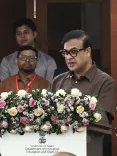
CM Revanth Reddy hails Manmohan Singh's legacy, backs Sonia's reassessment
Synopsis
Telangana Chief Minister A. Revanth Reddy backed a piece by Sonia Gandhi on August 11, 2026, calling the UPA's 2004–2014 governance 'far better than projected' and praising Dr. Manmohan Singh as a man of the 'highest integrity' whose legacy history will reassess kindly.
Key Takeaways
Revanth Reddy publicly endorsed a piece by Sonia Gandhi on August 11, 2026 , praising the UPA's governance record.
Revanth called the UPA's 2004–2014 decade 'far better than projected' and said public opinion is already shifting.
Manmohan Singh as 'unimpeachably one of the greats of modern public life' with 'highest integrity.' Dr.
Singh served as Prime Minister for ten years (2004–2014) and earlier drove India's 1991 economic liberalisation as Finance Minister.
The post reflects a broader Congress strategy of rehabilitating the UPA legacy as a political contrast narrative.
As both CM and Telangana Pradesh Congress Committee president , Revanth's endorsement carries institutional weight for the party.
A decade after leaving office, Dr. Manmohan Singh's legacy is finding fresh defenders — and Telangana Chief Minister A. Revanth Reddy is among the most vocal. On Tuesday, August 11, 2026, the CM took to X to endorse what he called a 'deeply insightful and heartfelt piece' by Congress leader Sonia Gandhi, arguing that the UPA's ten years in power (2004–2014) were 'far better than projected.'
Revanth's case for Singh: 'Finest of minds, greatest of hearts'
Revanth Reddy's post was unambiguous in its admiration. He described Dr. Singh as 'unimpeachably one of the greats of our modern public life' — a man of 'finest of minds, greatest of hearts,' soft-spoken yet firmly resolved, and above all, one of 'highest integrity.' The CM added that 'history will indeed be kinder' to Singh, and that 'the writing of such a new page of that chapter is already underway.'
The tribute tracks a broader Congress effort to rehabilitate the UPA record — particularly on economic governance and institutional integrity — as a contrast to the decade that followed. Revanth Reddy, who also heads the Telangana Pradesh Congress Committee, is one of the party's most prominent state-level voices, making his endorsement politically significant beyond the personal sentiment.
Singh's record and the UPA decade in focus
Dr. Manmohan Singh served as Prime Minister from 2004 to 2014 under two successive United Progressive Alliance governments, having first entered national consciousness as Finance Minister during the landmark 1991 economic liberalisation. His tenure as PM saw landmark social legislation — including the Right to Information Act and MGNREGA — alongside periods of strong GDP growth and, later, criticism over corruption scandals and policy paralysis.
Sonia Gandhi, who chaired the UPA throughout its decade in power, has periodically offered reflections on that period. The specific piece referenced by Revanth Reddy could not be independently verified, but the CM's framing of it as sharing 'poignant truths that most Indians have started realising already' signals a deliberate political message: that public opinion on the UPA era is shifting.
Opposition reassessments and the Congress narrative machine
Indian opposition parties have increasingly leaned into legacy politics — revisiting the 2004–2014 period to draw implicit and explicit contrasts with subsequent governance. For Congress, Singh remains a powerful symbol: a technocrat-statesman whose personal probity was rarely questioned even by opponents, and whose economic credentials are unmatched in the party's recent history.
Revanth Reddy's post, coming from a sitting Chief Minister and state party president, gives that narrative institutional weight. It is a reminder that the contest over India's political memory is as live as any current policy debate.
History's verdict on the UPA may still be contested — but Congress is clearly done waiting for it to arrive on its own.
Point of View
Amplifying a legacy-rehabilitation narrative the party has been building around the UPA era. The choice to centre Dr. Manmohan Singh's integrity and governance record implicitly frames a contrast with the BJP decade that followed, a rhetorical strategy Congress has deployed with increasing frequency ahead of electoral cycles. That a sitting Chief Minister and state party president is the messenger elevates the signal from sentiment to strategy. Watch for whether this triggers a coordinated Congress response across states, or a BJP counter-narrative on the UPA's economic controversies.
NationPress
25 Sept 2026
Frequently Asked Questions
What did Revanth Reddy say about Manmohan Singh?
Revanth Reddy called Dr. Manmohan Singh 'unimpeachably one of the greats of modern public life,' praising him as a man of the 'finest of minds, greatest of hearts' and 'highest integrity,' adding that history will be kinder to his legacy.
What is Sonia Gandhi's piece that Revanth Reddy endorsed?
Revanth Reddy referred to a piece by Sonia Gandhi that he described as 'deeply insightful and heartfelt,' in which she shares what he called 'poignant truths' about the UPA decade. The specific publication details of the piece have not been independently verified.
How long did Manmohan Singh serve as Prime Minister?
Dr. Manmohan Singh served as Prime Minister of India for ten years, from 2004 to 2014, leading two successive Congress-led UPA governments.
What is the UPA and what is its legacy?
The United Progressive Alliance (UPA) was a Congress-led coalition that governed India from 2004 to 2014. Its legacy includes landmark social legislation such as MGNREGA and the Right to Information Act, alongside periods of strong economic growth and later criticism over policy and corruption controversies.
Why is Congress revisiting the UPA record in 2026?
Congress leaders have increasingly used the UPA legacy — particularly Dr. Manmohan Singh's personal integrity and economic record — as a political contrast narrative against subsequent governance, a strategy that intensifies around electoral cycles and key political moments.