Revanth Reddy hails ATCs for placing youth in top firms
Synopsis
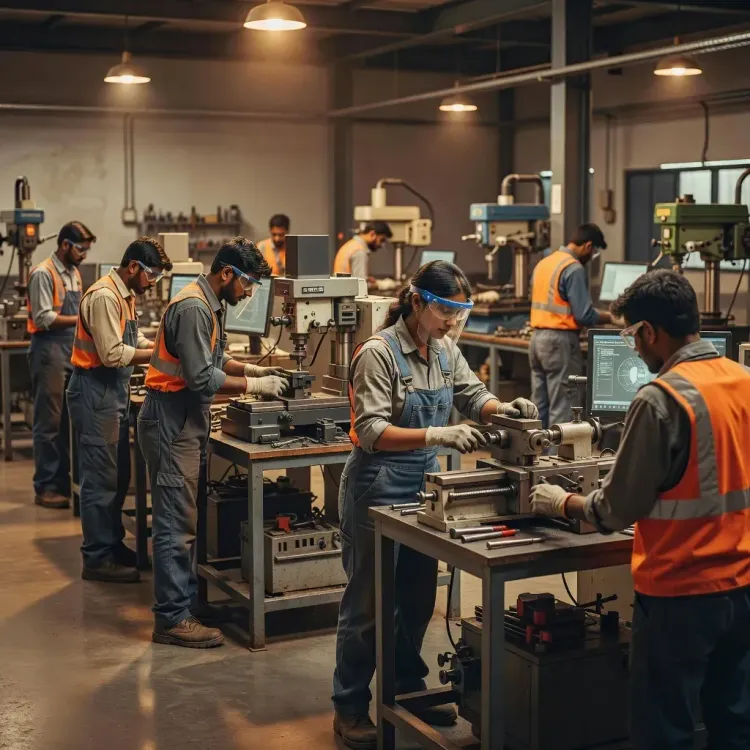
Telangana CM Revanth Reddy celebrates placements of ATC-trained youth at Apple, L&T, Tata Motors and other top firms, announcing expansion of the Tata Technologies-partnered ITI upgrade programme to skill lakhs more.
Key Takeaways
Advanced Technology Centres (ATCs) are upgraded versions of government ITIs, developed in partnership with Tata Technologies .
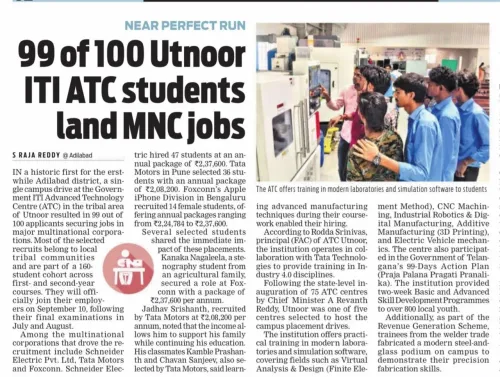
Trained students have received job offers from Apple, ITC, L&T, Bharat Dynamics, Eicher, Apollo , and Tata Motors .
The programme aims to align vocational curricula with industry skill demands in manufacturing, automotive, and technology sectors.
CM Revanth Reddy confirmed more ATCs are set to come online, targeting employment skills for lakhs of Telangana youth .
The ATC model contributes to the national Skill India Mission through a state-level public-private partnership framework.
Thousands of Telangana youth trained at Advanced Technology Centres (ATCs) are walking into jobs at some of India's most recognised companies — and Telangana Chief Minister A. Revanth Reddy wants the state to know it is just getting started. On Wednesday, 30 September 2026, the Chief Minister took to X to celebrate the early placement wins from the ATC programme and signal an even bigger expansion ahead.
From ITI classrooms to Apple, Tata Motors and L&T shop floors
The ATCs are not a new institution — they are a reimagination of an old one. Industrial Training Institutes (ITIs), the decades-old backbone of India's vocational ecosystem, are being upgraded into ATCs in partnership with Tata Technologies, the multinational engineering and IT services firm that has worked with multiple state governments on exactly this kind of transformation.
The upgrade is designed around a simple diagnosis: ITI curricula were lagging behind what industry actually needed. Tata Technologies brings updated course content, equipment, and industry linkages; the state provides the infrastructure and students. The result, according to Revanth Reddy, is placement offers from marquee employers — Apple, ITC, L&T, Bharat Dynamics, Eicher, Apollo, and Tata Motors among them — at competitive salaries.
A skilling bet aligned with national ambition
The ATC push sits squarely within the broader arc of India's Skill India Mission, launched in 2015, which called on states to forge public-private partnerships that could close the gap between vocational graduates and employer expectations — particularly in manufacturing, automotive, and technology sectors. Telangana's model, with Tata Technologies as anchor partner, is one of the more visible state-level bets on that national agenda.
What makes the current moment notable is the placement signal itself. Moving students from government ITI training into nationally and internationally recognised companies is the proof-of-concept that sceptics of the Skill India model have long demanded. The Chief Minister described the development as 'ఎంతో సంతోషకరం... గర్వకారణం' — 'immensely joyful and a matter of pride.'
More ATCs on the horizon — and a larger promise
Revanth Reddy's post looked ahead as much as it looked back. He stated that additional ATCs are set to come online in the coming period, with the ambition of turning these centres into powerful platforms that equip lakhs of young men and women with the skills needed to secure employment. The hashtags #PrajaPalana and #TelanganaRising anchored the announcement within the state government's flagship governance and development narrative.
The exact number of ATCs currently operational and precise placement counts have not been officially published, but the trajectory is clear: Telangana is betting that modernised vocational infrastructure, industry-partnered curriculum, and a pipeline to branded employers is the most direct route from a government training centre to a first salary.
For Telangana's youth, the proof will be in the placements — and if the early returns hold, the ATCs may become the state's most concrete answer to the question every young graduate is actually asking.
Point of View
Framed under #PrajaPalana and #TelanganaRising, signals that the Congress government intends to make youth employment a central pillar of its mid-term narrative rather than a routine welfare footnote. Whether placement numbers at scale validate that framing will be the real test as more ATCs come online.
NationPress
30 Sept 2026
Frequently Asked Questions
What are Advanced Technology Centres (ATCs) in Telangana?
ATCs are upgraded Industrial Training Institutes (ITIs) in Telangana, developed in partnership with Tata Technologies to provide industry-relevant skill training and improve job placement outcomes for students.
Which companies are hiring students from Telangana ATCs?
Companies including Apple, ITC, L&T, Bharat Dynamics, Eicher, Apollo, and Tata Motors have offered employment opportunities to ATC-trained students, according to CM Revanth Reddy.
What is Tata Technologies' role in the Telangana ATC programme?
Tata Technologies is the industry partner responsible for upgrading ITI curricula and infrastructure, aligning training content with current manufacturing, automotive, and technology sector requirements.
How does the ATC model relate to Skill India Mission?
The ATC programme is a state-level implementation of the national Skill India Mission's public-private partnership model, which was launched in 2015 to bridge skill gaps and boost employability through industry-linked vocational training.
Will more ATCs be opened in Telangana?
Yes. CM Revanth Reddy has confirmed that additional ATCs are planned to come online, with the goal of providing skill development opportunities to lakhs of young people across the state.