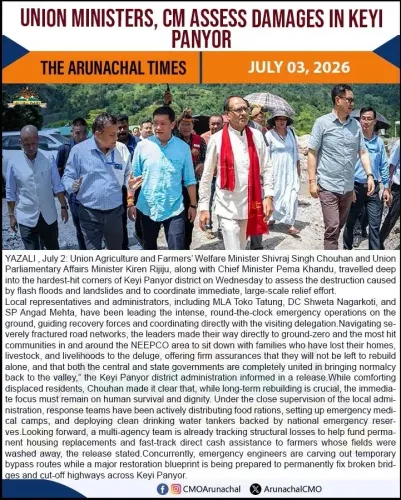
Rijiju condoles flood, landslide deaths in Arunachal's Keyi Panyor

Synopsis
Union Minister Kiren Rijiju on June 25, 2026, mourned lives lost in floods and landslides in Arunachal Pradesh's Keyi Panyor District, pledging full government support as rescue and relief operations continue on the ground.
Key Takeaways
Union Parliamentary Affairs Minister Kiren Rijiju expressed condolences over flood and landslide deaths in Keyi Panyor District, Arunachal Pradesh on June 25, 2026 .
Rijiju confirmed that rescue, relief and restoration efforts are actively underway for affected families.
The disaster occurred against the backdrop of recurring monsoon-season flooding in Arunachal Pradesh's steep, hilly terrain.
India's disaster response is governed by the Disaster Management Act, 2005 , with the NDRF and SDRF as primary operational mechanisms.
Formal damage assessments and central assistance details are expected to follow in the coming days.
The situation may draw attention during Parliament's upcoming monsoon session , with potential discussions on Northeast disaster infrastructure funding.
Union Parliamentary Affairs Minister Kiren Rijiju on Thursday, June 25, 2026, expressed deep condolences over the loss of lives and widespread devastation caused by floods and landslides in Keyi Panyor District of Arunachal Pradesh, assuring that rescue, relief and restoration efforts are actively underway.
Context
Rijiju, who represents Arunachal Pradesh as a senior BJP leader and serves as a Union Cabinet minister, posted on X that he was 'deeply saddened by the loss of lives and the devastation caused by the floods and landslides in Keyi Panyor District.' He extended 'heartfelt condolences to the bereaved families' and prayers for the 'speedy recovery of those injured,' adding that 'every possible assistance is being extended to those affected.'
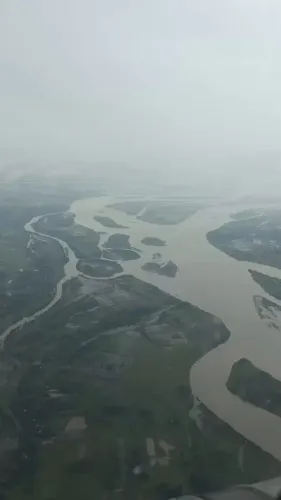
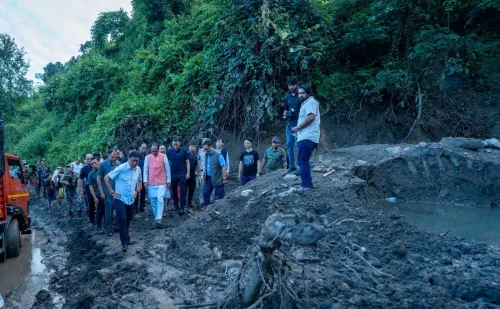
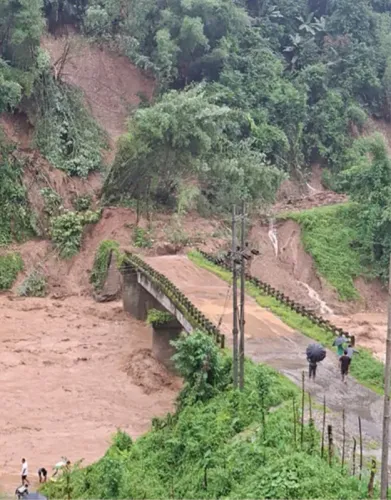
Keyi Panyor is an administrative district in Arunachal Pradesh, a state characterised by steep Himalayan terrain and river valleys that make it acutely vulnerable to monsoon-season disasters. Floods and landslides in the region can cut off remote communities, damage roads and bridges, and cause significant loss of life and property.
Policy Backdrop
India's disaster response framework rests on the Disaster Management Act of 2005, which established the National Disaster Management Authority (NDMA) to coordinate preparedness and relief across central and state agencies. The National Disaster Response Force (NDRF), raised in 2006, provides specialised rescue and relief teams that are routinely deployed during monsoon emergencies in the Northeast.
States also draw on the State Disaster Response Fund (SDRF), which receives central contributions, to finance immediate relief operations. Successive Union governments have used these mechanisms to channel assistance to Arunachal Pradesh during recurring monsoon crises, with Union ministers from the region often serving as key interlocutors between state administrations and New Delhi.
Stakeholders and Impact
The most immediate stakeholders are the flood-affected families of Keyi Panyor District, along with local district administration officials and state government teams coordinating on-ground relief. Rijiju's statement that 'the safety and well-being of our people remain our highest priority' signals that the Union government is closely monitoring the situation.
Given the mountainous geography of Arunachal Pradesh, landslides frequently damage road connectivity, isolating villages and hampering the movement of relief material. Restoration of transport links and communication infrastructure typically forms a critical part of post-disaster recovery in the state.
What's Next
Authorities are expected to release formal damage assessments and details of central assistance, including any NDRF team deployments and SDRF disbursements, in the coming days. With Parliament's monsoon session approaching, the disaster in Arunachal Pradesh could draw legislative attention, particularly around funding for disaster-resilient infrastructure in the Northeast. Rijiju's public commitment that 'we stand firmly with every affected family' also signals that follow-up announcements on relief packages are likely.
Point of View
His public assurance of government support is as much an act of constituent outreach as it is crisis communication. The post fits a well-established pattern where Northeast-origin ministers serve as visible bridges between New Delhi's disaster machinery and remote, vulnerable communities. The emphasis on 'rescue, relief and restoration' in a single breath also signals awareness that in hilly terrain, restoration of connectivity is as urgent as immediate relief. With the monsoon session of Parliament ahead, the government will be under pressure to translate condolences into verifiable central assistance figures.
NationPress
24 Sept 2026
Frequently Asked Questions
What happened in Keyi Panyor District Arunachal Pradesh?
Keyi Panyor District in Arunachal Pradesh was hit by severe floods and landslides, causing loss of lives and widespread devastation, prompting Union Minister Kiren Rijiju to offer condolences and confirm that relief operations are underway.
Who is Kiren Rijiju and why did he comment on the Arunachal floods?
Kiren Rijiju is the Union Minister of Parliamentary Affairs and Minority Affairs, and a senior BJP leader from Arunachal Pradesh. As the state's most senior Union Cabinet representative, he expressed condolences and assured government support for flood-affected families in Keyi Panyor District.
What relief measures are in place for Arunachal Pradesh flood victims?
Rijiju confirmed that rescue, relief and restoration efforts are underway and that every possible assistance is being extended to affected families. India's standard framework includes NDRF deployments and State Disaster Response Fund disbursements, though specific figures for this incident are yet to be officially announced.
Why does Arunachal Pradesh face floods and landslides every year?
Arunachal Pradesh's steep Himalayan terrain and river valleys, combined with intense monsoon rainfall, make it highly susceptible to annual flooding and landslides that can cut off remote communities and damage critical infrastructure.
What is the NDRF and how does it help during floods in the Northeast?
The National Disaster Response Force, raised in 2006 under the Disaster Management Act of 2005, provides specialised rescue and relief teams that are deployed during flood and landslide emergencies, including in Arunachal Pradesh and other Northeastern states.