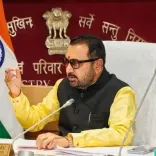
Rijiju fires five questions at Congress over poll integrity
Synopsis
Union Parliamentary Affairs Minister Kiren Rijiju publicly challenged the Congress party with five questions on October 31, 2026, defending electoral-roll revision drives and questioning the party's logic on Election Commission bias — closing with the accusation that a 'one family party with outside forces' is undermining the Constitution.
Key Takeaways
Rijiju asked how Congress won only 44 Lok Sabha seats in 2014 if its own government appointed Election Commissioners.
He noted that Gyanesh Kumar was not Chief Election Commissioner during the 2024 elections , challenging the bias narrative.
He demanded Congress CMs explain why they have not resigned if they believe those elections were fraudulent.
He asked directly whether voter-roll entries for illegal immigrants, deceased, shifted, or duplicate registrants should be removed.
He listed eight historical rounds of Special Intensive Revisions stretching back to 1952–56 to argue the practice is apolitical and long-standing.
He closed by accusing Congress — 'one family party' — of working with 'outside forces' to undermine Indian democracy.
Five pointed questions and one sweeping accusation — Union Parliamentary Affairs Minister Kiren Rijiju turned up the heat on the Indian National Congress on Saturday, October 31, 2026, publicly challenging the opposition party to answer what he framed as glaring contradictions in its campaign against the Election Commission of India and ongoing electoral-roll revision exercises.
The five questions Rijiju wants Congress to answer
Rijiju's broadside is structured as a logical stress-test of the Congress position. His first question cuts straight to the 2014 result: if the Election Commission was stacked with commissioners appointed by the Congress-led government, how did the party win only 44 seats in that Lok Sabha election? The arithmetic of that historic rout, he implies, is a poor advertisement for the 'partisan commission' thesis.
The second question zeroes in on Gyanesh Kumar, the current Chief Election Commissioner. Rijiju notes that Kumar was not in that role during the 2024 general elections, yet Congress suffered what he calls a 'hat-trick defeat' — asking how the party squares that timeline with its claims of institutional bias. The third question is blunter still: if the commissions that formed state governments between 2014 and 2026 were rigged, should sitting Congress chief ministers resign and apologise for taking office on the strength of those very elections?
The voter-list question at the heart of the SIR debate
Questions four and five go beyond political point-scoring into the policy substance of the dispute. Rijiju asks directly whether names on electoral rolls belonging to illegal immigrants, deceased persons, relocated voters, or duplicate entries should be removed — a question that frames the ongoing Special Intensive Revision (SIR) drive not as suppression but as basic housekeeping.
His fifth question draws on the full arc of independent India's electoral history. He lists Special Intensive Revisions carried out in 1952–56, 1958–61, 1965–66, 1983–84, 1987–88, 1993, 1995, and 2002–2004 — exercises conducted across governments of all stripes — and asks whether Congress considers all of them illegal too. The historical list is a deliberate anchor: the Representation of the People Act, 1950 has mandated periodic roll revisions since the very first general elections, and the practice predates the BJP's political dominance by decades.
The larger accusation — and what it signals
Rijiju closes with a characterisation rather than a question: 'One family party with outside forces is trying to destroy the Constitution and Indian Democracy.' The phrase 'one family party' is a standard BJP reference to Congress's Nehru-Gandhi dynastic leadership. The addition of 'outside forces' raises the stakes, signalling that the BJP intends to fight this electoral-integrity battle on nationalist as well as institutional ground.
The exchange fits a pattern that has intensified around every major election cycle since 2014 — the BJP defending Election Commission processes as lawful and historically routine, Congress alleging structural tilt. With state election seasons perpetually on the horizon, Rijiju's five questions are less a genuine inquiry and more a carefully constructed political document designed to put the opposition on the back foot.
The ball is now in Congress's court — and the silence or the rebuttal will itself become the next news cycle.
Point of View
The BJP attempts to neutralise the Election Commission controversy before it hardens into an electoral liability. The 'outside forces' addendum is a deliberate escalation — it shifts the Congress critique from institutional to national-security terrain, a move that has repeatedly worked in BJP's favour with undecided voters. Congress must now either answer the five questions in detail or risk ceding the narrative on an issue it raised. The exchange underscores how electoral-integrity discourse has become a permanent front in Indian politics, not a seasonal one.
NationPress
31 Oct 2026
Frequently Asked Questions
Why is Kiren Rijiju challenging Congress over the Election Commission?
Rijiju is responding to Congress allegations of bias in the Election Commission by asking five pointed questions that he says expose contradictions in the party's position — including why Congress lost badly in elections overseen by commissioners it had appointed.
What is a Special Intensive Revision (SIR) of voter lists?
A Special Intensive Revision is a comprehensive door-to-door exercise by the Election Commission to update electoral rolls — removing dead, shifted, duplicate, or ineligible names and adding eligible new voters. Rijiju cited SIRs going back to 1952–56 to argue the practice is routine and non-partisan.
Who is Gyanesh Kumar and why is he relevant?
Gyanesh Kumar is the current Chief Election Commissioner of India. Rijiju's point is that Kumar was not in that position during the 2024 general elections, so Congress's 'hat-trick defeat' cannot be attributed to him.
What did Congress win in the 2014 Lok Sabha election?
The Indian National Congress won only 44 seats in the 2014 Lok Sabha election — its worst-ever performance — despite the Election Commission having been constituted under its own government-era appointments, which is the contradiction Rijiju highlights.
What does Rijiju mean by 'one family party with outside forces'?
'One family party' is a BJP reference to Congress's association with the Nehru-Gandhi family dynasty. The phrase 'outside forces' is an accusation that external interests are backing the party's campaign against Indian democratic institutions, though Rijiju did not name specific actors.