Rijiju Hails CRPF's Zero Operational Fatalities in 47-Year Milestone

Synopsis
Union Minister Kiren Rijiju congratulated the CRPF on recording zero operational fatalities in a year — a milestone in the force's 47-year history — highlighting preparedness, vigilance and personnel safety as the drivers behind the landmark achievement.
Key Takeaways
Union Parliamentary Affairs Minister Kiren Rijiju posted on 5 November 2026 acknowledging the CRPF's zero operational fatality record.
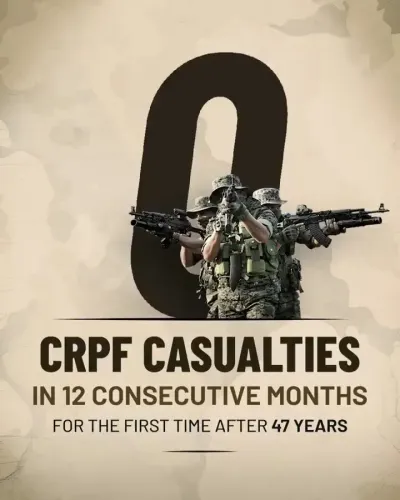
The CRPF described this as a milestone in a 47-year operational history .
Rijiju attributed the record to 'preparedness, vigilance and the safety of our personnel.' The CRPF is India's largest central paramilitary force, deployed in counter-Naxal, counter-insurgency and law-and-order operations.
Indian central paramilitary forces have recorded a broader decade-long decline in annual operational casualties through improved training, gear and intelligence.
Official Ministry of Home Affairs annual casualty data and parliamentary questions on force modernisation will be the next benchmarks to watch.
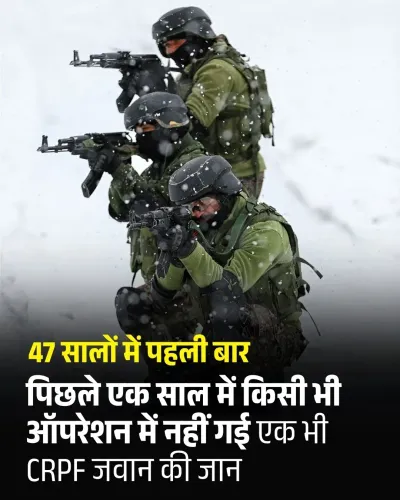
In a rare operational landmark, India's largest central paramilitary force has gone through an entire year without a single combat death — and Union Parliamentary Affairs Minister Kiren Rijiju marked the moment on Thursday, 5 November 2026, calling it a proud achievement in the Central Reserve Police Force's 47-year operational history.
What zero fatalities actually signals
A year of zero operational fatalities is not simply an absence of bad news — it is a measurable outcome of years of investment in training, protective gear, real-time intelligence and improved tactical protocols. The CRPF, which operates across the country's most volatile theatres — from counter-Naxal operations in central India to counter-insurgency deployments in the northeast and Jammu & Kashmir — has historically absorbed some of the heaviest personnel losses among India's central armed police forces.
Rijiju underscored precisely this link, writing that the record 'underscores the importance of preparedness, vigilance & the safety of our personnel.' That framing matters: it positions the milestone not as luck but as doctrine.
A decade of declining casualties in central paramilitary forces
The achievement sits inside a broader trend. Indian central paramilitary forces have recorded a gradual, year-on-year decline in annual operational casualties over the past decade, driven by better body armour, drone-assisted reconnaissance, improved road connectivity to forward posts and sharper human-intelligence networks in Naxal-affected districts. Reaching zero — however briefly — represents the logical endpoint of that trajectory, and sets a benchmark that defence planners and parliamentary committees will now be expected to scrutinise and sustain.
The Ministry of Home Affairs publishes annual data on security-force casualties; that report, alongside any parliamentary questions on force modernisation, will determine whether the milestone becomes a durable baseline or a single-year outlier.
Rijiju's message to the force
Closing his post with 'Best wishes to all our CRPF personnel as they continue their dedicated service to the nation,' Rijiju — a senior BJP leader from Arunachal Pradesh with longstanding ties to India's northeastern security landscape — extended acknowledgment directly to the rank and file. It is personnel on the ground, in forward posts and jungle patrols, who convert policy investment into lived safety outcomes.
For a force that numbers in the hundreds of thousands and whose personnel routinely operate in the country's most difficult terrain, one year without an operational death is not an endpoint. It is a standard to defend.
Point of View
Not a coincidence — it reflects compounding returns on a decade of investment in force modernisation, intelligence integration and risk-reduction doctrine across India's most volatile internal-security theatres. For the BJP-led government, the milestone feeds a broader narrative of muscular-but-disciplined security management ahead of potential parliamentary scrutiny on Home Ministry expenditure. The challenge now is institutionalisation: whether this benchmark gets codified into training standards and equipment procurement cycles, or remains a one-year high-water mark. Rijiju's public acknowledgment from a parliamentary-affairs platform rather than the Home Ministry itself signals that the achievement is being claimed as a whole-of-government success story.
NationPress
5 Nov 2026
Frequently Asked Questions
What does zero operational fatalities mean for the CRPF?
It means the Central Reserve Police Force recorded no combat or operational deaths during the year — a first in its 47-year operational history, according to the post by Union Minister Kiren Rijiju.
Why is a zero-fatality year significant for the CRPF?
The CRPF operates in India's most dangerous security environments, including counter-Naxal and counter-insurgency theatres, where it has historically absorbed heavy personnel losses. Zero fatalities in a year signals a measurable improvement in preparedness, protective gear and intelligence-led operations.
What is the CRPF and what does it do?
The Central Reserve Police Force is India's largest central paramilitary force under the Ministry of Home Affairs. It is deployed for internal security, counter-insurgency, counter-Naxal operations and law-and-order duties across the country.
What has Kiren Rijiju said about the CRPF milestone?
Union Parliamentary Affairs Minister Kiren Rijiju said the record 'underscores the importance of preparedness, vigilance and the safety of our personnel' and offered best wishes to all CRPF personnel for their continued service.
Has India's central paramilitary casualty rate been falling overall?
Yes. Indian central paramilitary forces have reported a gradual decline in annual operational casualties over the past decade, driven by better training, body armour, drone reconnaissance and improved intelligence networks in conflict zones.