Rijiju: MoRTH clears 17 road projects worth ₹611 cr for Arunachal
Synopsis
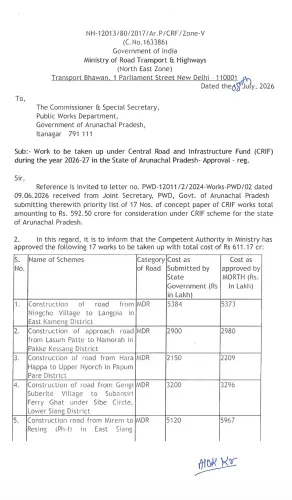
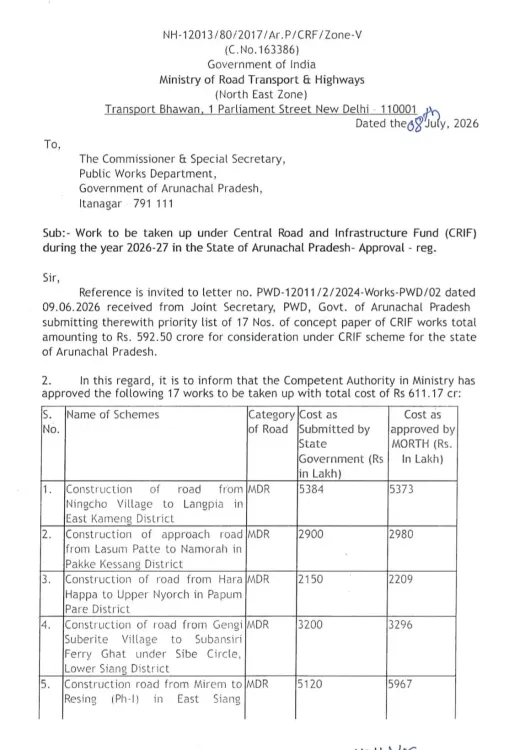
The Ministry of Road Transport and Highways has approved 17 road projects worth ₹611.17 crore under the Central Road and Infrastructure Fund for Arunachal Pradesh in 2026–27. Union Minister Kiren Rijiju announced the decision on 9 July 2026, citing PM Modi's sustained support for Northeast infrastructure.
Key Takeaways
17 road projects worth ₹611.17 crore approved for Arunachal Pradesh under CRIF 2026–27 .
Approval granted by the Ministry of Road Transport and Highways (MoRTH) , announced by Union Minister Kiren Rijiju on 9 July 2026 .
Funds come from the Central Road and Infrastructure Fund (CRIF) , financed through a cess on fuel.
Arunachal Pradesh has been a recurring beneficiary of CRIF allocations due to its difficult terrain and strategic border with China.
The approvals continue the Union government's pattern of front-loading central resources for Northeast states since 2014 .
State-level tendering and construction timelines will be the next milestones to watch.
Union Parliamentary Affairs Minister Kiren Rijiju announced on Thursday, 9 July 2026 that the Ministry of Road Transport and Highways (MoRTH) has approved 17 road projects worth ₹611.17 crore for Arunachal Pradesh under the Central Road and Infrastructure Fund (CRIF) for the financial year 2026–27. The minister credited Prime Minister Narendra Modi for sustained support for infrastructure development across the Northeast.
Context
Posting on X, Rijiju stated that the approvals were made 'considering the need of the State,' and that PM Modi 'has given huge support for infrastructure development in Arunachal Pradesh, and whole of North East.' The announcement covers 17 projects aggregating ₹611.17 crore, to be funded through the CRIF — a central pool financed by a cess on fuel and earmarked for road and infrastructure works across states.
Policy Backdrop
The Central Road and Infrastructure Fund was expanded under the Finance Act, 2018, which renamed and broadened the earlier Central Road Fund to cover a wider range of infrastructure categories beyond highways. Arunachal Pradesh has featured in successive annual CRIF allocations, reflecting the state's challenging terrain, limited internal revenues, and strategic location along the India-China frontier. The broader national push for Northeast connectivity traces back to the Bharatmala Pariyojana, launched in 2015, which prioritised arterial highways and border-area roads across the eight northeastern states.
Since 2014, successive Union Budgets have front-loaded central resources for states with difficult geography and thin tax bases, with Arunachal Pradesh among the primary beneficiaries. Road connectivity in the state is considered both an economic imperative — linking remote communities to markets — and a strategic necessity given the active border with China.
Stakeholders and Impact
The immediate beneficiaries of the ₹611.17 crore allocation are residents of Arunachal Pradesh, particularly communities in interior districts where road access remains seasonal or unreliable. Improved connectivity is expected to ease movement of goods, reduce logistics costs, and support local livelihoods. Border communities in particular stand to gain from all-weather road links that also carry strategic significance for defence mobility.
MoRTH functions as the nodal ministry for CRIF disbursements, working alongside state public works departments for project execution. The state government will now initiate tendering processes for individual project packages once funds are formally released under the 2026–27 schedule.
What's Next
Attention will now shift to state-level tendering, contractor mobilisation, and physical progress on the 17 approved projects. Monitoring of fund utilisation and construction timelines will be key, given the Northeast's short working season constrained by monsoon conditions. Any supplementary allocations or additions to the project list may be signalled in the next Union Budget or through mid-year CRIF reviews by MoRTH.
Point of View
As a senior BJP figure from Arunachal Pradesh himself, is well-positioned to amplify such announcements, lending them both political weight and local credibility. The invocation of PM Modi by name signals that Northeast infrastructure remains a flagship narrative for the ruling party heading into future electoral cycles. Whether these approvals translate into on-ground delivery within the financial year will be the real test, given the Northeast's well-documented challenges of contractor capacity and monsoon-disrupted construction windows.
NationPress
9 Jul 2026
Frequently Asked Questions
What are the 17 road projects approved for Arunachal Pradesh under CRIF 2026-27?
The Ministry of Road Transport and Highways approved 17 road projects worth ₹611.17 crore for Arunachal Pradesh under the Central Road and Infrastructure Fund for 2026–27. The specific list of individual projects has not been publicly detailed in the announcement; state-level tendering is expected to follow.
What is the Central Road and Infrastructure Fund (CRIF)?
The Central Road and Infrastructure Fund is a central government pool financed through a cess levied on petrol and diesel. It is used to fund road and broader infrastructure projects across states, and was expanded under the Finance Act, 2018, from the earlier Central Road Fund.
Why does Arunachal Pradesh receive special infrastructure funding from the Centre?
Arunachal Pradesh receives significant central funding because of its difficult mountainous terrain, limited state revenues, and strategic location along the India-China border. Improving road connectivity there serves both economic development and national security objectives.
Who is Kiren Rijiju and why did he make this announcement?
Kiren Rijiju is the Union Minister of Parliamentary Affairs and Minister of Minority Affairs, and a senior BJP leader from Arunachal Pradesh. As a minister from the state, he regularly highlights central government approvals and infrastructure investments benefiting the region.
How much has the Centre invested in Arunachal Pradesh roads since 2014?
Exact cumulative figures are not available in this announcement. However, since 2014 the Union government has markedly increased central funding for road infrastructure in Arunachal Pradesh through successive CRIF allocations, Bharatmala Pariyojana, and special Northeast packages.