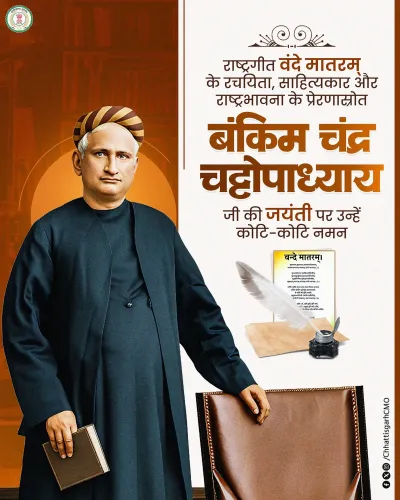
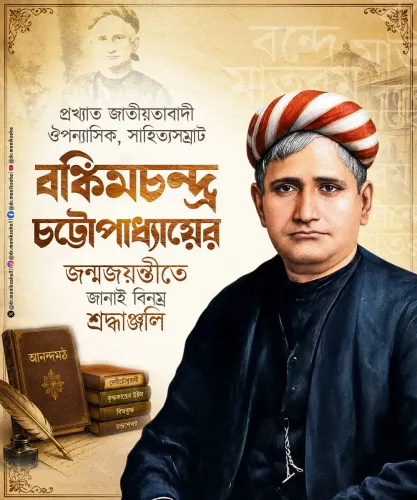
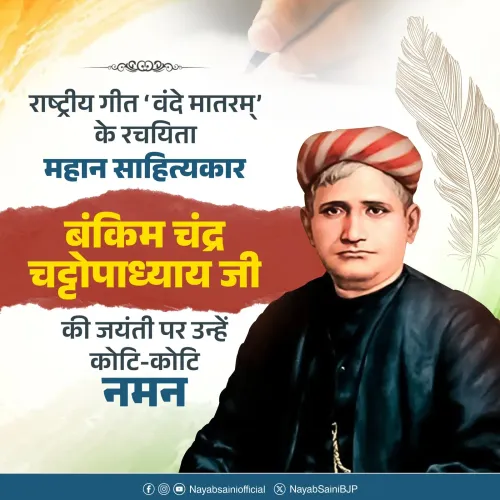
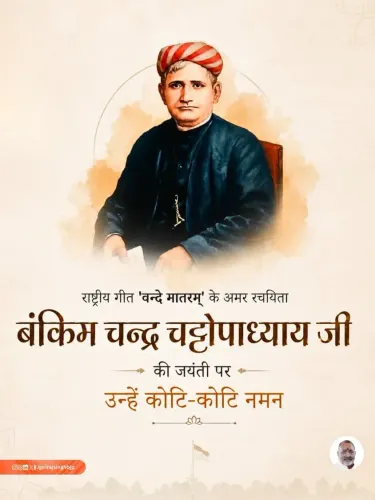
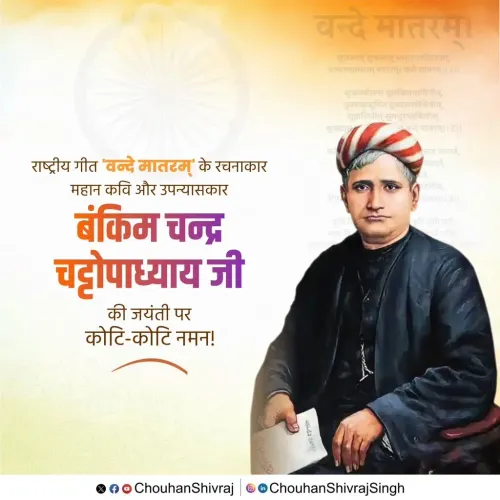
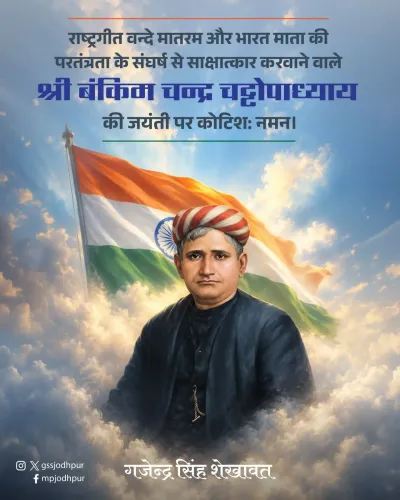
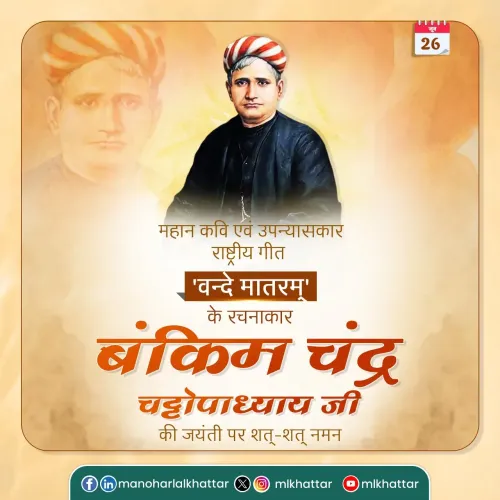
Rijiju pays tribute to Bankim Chandra on birth anniversary
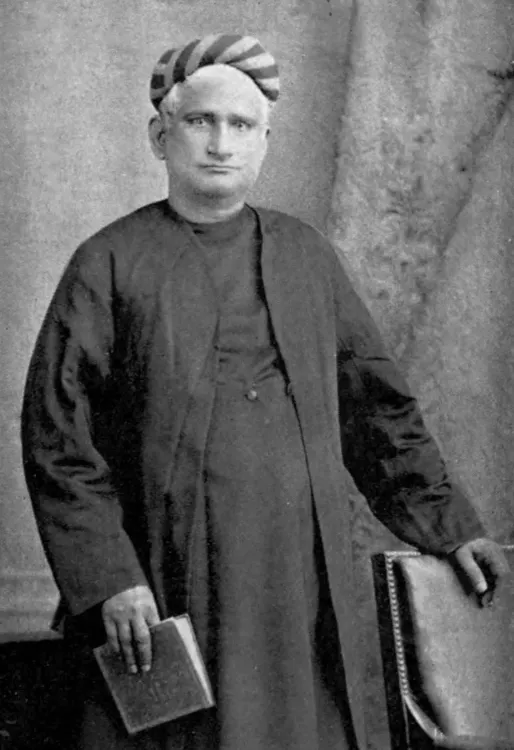
Synopsis
Union Parliamentary Affairs Minister Kiren Rijiju on 27 June 2026 paid tribute to Bengali literary icon Bankim Chandra Chattopadhyay on his birth anniversary, honouring Vande Mataram as an immortal creation born of the Sanyasi Revolt that became the anthem of India's freedom struggle and endures as a national and cultural heritage.
Key Takeaways
Kiren Rijiju paid homage to Bankim Chandra Chattopadhyay on his birth anniversary on 27 June 2026 .
Bankim Chandra Chattopadhyay ( 1838–1894 ) composed Vande Mataram , first published in 1875 and featured in the novel Anandamath in 1882 .
The poem was composed against the backdrop of the Sanyasi Revolt and became a rallying anthem during India's independence movement.
The Constituent Assembly adopted Vande Mataram as India's national song in January 1950 , alongside Jana Gana Mana .
Rijiju described Vande Mataram as an 'invaluable creation' that is a part of India's national and cultural heritage.
The tribute aligns with a broader government practice of honouring 19th-century literary figures linked to the freedom struggle.
Union Parliamentary Affairs Minister Kiren Rijiju on Friday, 27 June 2026, paid homage to Bankim Chandra Chattopadhyay, the celebrated Bengali novelist, poet, and journalist, on the occasion of his birth anniversary, calling him a 'luminary pillar of Bengali literature' and honouring his enduring legacy for the Indian nation.
Context
In his post, Rijiju offered koti-koti naman (countless salutations) to Bankim Chandra Chattopadhyay, describing him as a prakhyat kavi, lekhak, sahityakar evam patrakar (renowned poet, writer, literary figure, and journalist). He specifically highlighted Vande Mataram — composed against the backdrop of the Sanyasi Revolt — as an immortal creation that became the voice of revolutionary consciousness and patriotism during India's freedom struggle.
The minister described Vande Mataram as an 'invaluable creation' that remains a part of India's national and cultural heritage, inspiring generations to dedicate themselves to the service of the nation and the protection of the motherland.
Policy Backdrop
Bankim Chandra Chattopadhyay (1838–1894) is widely regarded as a foundational figure of modern Bengali prose and Indian literary nationalism. He first published Vande Mataram in 1875, later featuring it in his landmark 1882 novel Anandamath, which fictionalised the Sanyasi Revolt against British colonial rule.
The poem went on to become one of the most powerful rallying anthems of the Indian independence movement. In January 1950, the Constituent Assembly formally adopted Vande Mataram as India's national song, placing it alongside Jana Gana Mana as a symbol of sovereign identity.
Stakeholders and Impact
Successive Indian governments have consistently invoked Vande Mataram in official ceremonies, school curricula, and national-day observances to underscore themes of cultural nationalism and territorial integrity. Rijiju's tribute reflects this institutional continuity, situating Bankim Chandra Chattopadhyay's contribution within a living tradition rather than a purely historical one.
Literary scholars, educators, and cultural organisations across West Bengal and the broader Indian diaspora mark the anniversary annually. The tribute also resonates with Rijiju's portfolio as Minister of Minority Affairs, given Bankim Chandra's cross-community cultural significance in the subcontinent.
What's Next
Ministerial tributes of this nature are typically part of a broader calendar of commemorations tied to the freedom struggle, with similar messages expected around 15 August (Independence Day) and 26 January (Republic Day). Vande Mataram is also periodically referenced in parliamentary debates on national symbols and cultural policy, and Rijiju's post may foreshadow such engagements in the upcoming session. As India continues to foreground its 19th-century literary and nationalist heritage in public discourse, figures like Bankim Chandra Chattopadhyay are likely to receive growing institutional recognition.
Point of View
The post subtly anchors the national song in a tradition of armed resistance against colonial rule — a framing that carries ideological resonance beyond mere commemoration. As Parliamentary Affairs Minister, Rijiju's public messaging on national symbols can also signal the thematic agenda the government may bring to upcoming parliamentary sessions. The tribute thus functions simultaneously as cultural homage and soft political signalling.
NationPress
26 Jun 2026
Frequently Asked Questions
Who was Bankim Chandra Chattopadhyay?
Bankim Chandra Chattopadhyay ( 1838–1894 ) was a pioneering Bengali novelist, poet, and journalist widely regarded as a foundational figure of modern Bengali literature. He is best known for composing Vande Mataram , which became India's national song.
What is Vande Mataram and why is it significant?
Vande Mataram is India's national song, first composed by Bankim Chandra Chattopadhyay in 1875 and later featured in his 1882 novel Anandamath . It served as a powerful rallying anthem during the Indian independence movement and was formally adopted as the national song by the Constituent Assembly in January 1950 .
What is the Sanyasi Revolt connection to Vande Mataram?
Vande Mataram was composed against the backdrop of the Sanyasi Revolt , an 18th-century uprising against British colonial and zamindari oppression in Bengal. Bankim Chandra Chattopadhyay fictionalised this revolt in his novel Anandamath , in which the song first appeared as a patriotic hymn.
Why did Kiren Rijiju pay tribute to Bankim Chandra Chattopadhyay?
Kiren Rijiju , Union Parliamentary Affairs Minister, posted a tribute on 27 June 2026 to mark the birth anniversary of Bankim Chandra Chattopadhyay , honouring his contributions to Bengali literature and his authorship of Vande Mataram , which Rijiju called an invaluable national and cultural heritage.
What is the difference between Vande Mataram and Jana Gana Mana?
Jana Gana Mana is India's national anthem, while Vande Mataram is India's national song — both were adopted by the Constituent Assembly in January 1950 . Jana Gana Mana, composed by Rabindranath Tagore , is sung at official state functions, whereas Vande Mataram holds equal constitutional honour as a symbol of national identity.