Rijiju Highlights Khelo India, TOPS Milestones on #12YearsOfYuvaShakti
Synopsis
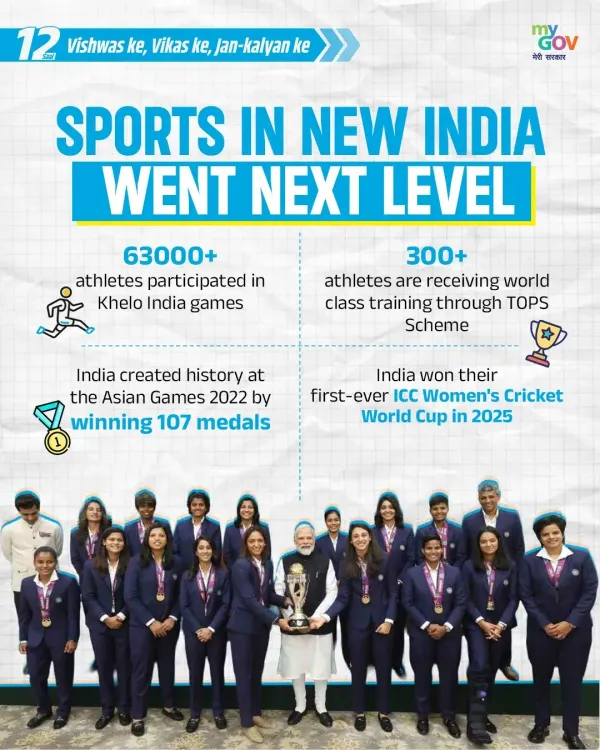
Union Minister Kiren Rijiju on June 13, 2026, credited Khelo India and TOPS for benefiting over 63,000 athletes, linking the schemes to India's record 107-medal haul at Asian Games 2022 and the claimed first ICC Women's Cricket World Cup title in 2025.
Key Takeaways
Kiren Rijiju posted on June 13, 2026 under the hashtag #12YearsOfYuvaShakti , highlighting government sports investment outcomes.
The Khelo India scheme has reportedly benefited over 63,000 athletes through grassroots competitions and talent identification since its 2017 launch.
The Target Olympic Podium Scheme (TOPS) , introduced in 2014–15 , has supported more than 300 elite athletes with high-performance training resources.
India recorded a historic 107 medals at the Hangzhou Asian Games 2022 , its highest-ever tally at the event.
Rijiju cited India's claimed first ICC Women's Cricket World Cup title in 2025 as a landmark outcome of sustained sports investment.
The government's focus is expected to intensify toward the 2028 Los Angeles Olympics as the next major performance benchmark.
Union Parliamentary Affairs Minister Kiren Rijiju on Saturday, June 13, 2026, pointed to two flagship sports schemes — Khelo India and the Target Olympic Podium Scheme (TOPS) — as drivers behind India's recent sporting achievements, citing a record medal haul at the Asian Games 2022 and what he described as India's first ICC Women's Cricket World Cup title in 2025.
Context
Rijiju's post, tagged #12YearsOfYuvaShakti, states that 'over 63,000 athletes have benefited through Khelo India, while TOPS has helped more than 300 athletes train at the highest level.' He frames the outcomes as evidence that 'when young talent gets the right support, history is created.' The post coincides with a broader government communication effort around the 'Yuva Shakti' theme, which celebrates youth empowerment milestones.
Policy Backdrop
Khelo India was launched in 2017 to build a national sports culture through grassroots talent identification and annual multi-discipline competitions across states. TOPS, introduced in 2014–15 ahead of the Rio Olympics, provides focused financial, coaching, and logistical support to elite athletes with realistic medal prospects at global competitions. Together, the two schemes represent a shift from ad-hoc patronage to structured, high-performance pathways modelled on successful sporting nations. The Sports Ministry has substantially raised annual budget allocations for athlete training and infrastructure since 2014.
India's tally of 107 medals at the Hangzhou Asian Games 2022 — the country's highest-ever at the quadrennial event — is cited by Rijiju as a concrete outcome of these investments. The minister also references the 2025 ICC Women's Cricket World Cup triumph as a historic first for Indian women's cricket.
Stakeholders and Impact
The primary beneficiaries of these schemes are young athletes from across India, many from smaller towns and rural areas, who gain access to competitive exposure, coaching, and financial support that was previously unavailable to them. Women cricketers feature prominently in Rijiju's narrative, with the claimed 2025 World Cup win held up as a landmark for women's sport in the country. The Khelo India framework also feeds state-level sporting ecosystems, creating pipelines for future national and international representation.
Broader stakeholders include state sports academies, the Sports Authority of India (SAI), and national sports federations that coordinate with the central government on athlete selection and training calendars under TOPS.
What's Next
The immediate policy focus is expected to shift toward the 2028 Los Angeles Olympics, where India will look to convert the momentum from recent Asian Games performances into Olympic podium finishes. Analysts and sports administrators will watch whether the Union Budget expands allocations for both Khelo India and TOPS in the coming fiscal cycle. Rijiju's post signals that the government intends to keep sporting achievements central to its youth-empowerment narrative as it builds toward Los Angeles 2028.
Point of View
Anchoring two policy instruments — Khelo India and TOPS — to tangible, headline-friendly outcomes ahead of a likely budget cycle discussion on sports funding. By pairing a multi-sport milestone (Asian Games) with a cricket achievement (Women's World Cup), the minister broadens the appeal beyond the traditional athletics audience. The '#12YearsOfYuvaShakti' framing ties sports performance to a wider BJP youth-empowerment narrative, reinforcing the party's claim of structural — rather than incidental — progress in Indian sport. The real test of this policy arc will come at the 2028 Los Angeles Olympics, where podium finishes will either validate or complicate the government's high-performance investment story.
NationPress
22 Sept 2026
Frequently Asked Questions
What is the Khelo India scheme and how many athletes has it benefited?
Khelo India is a central government programme launched in 2017 to promote grassroots sports and identify talent through annual competitions. Minister Rijiju stated that over 63,000 athletes have benefited from the scheme.
What is the Target Olympic Podium Scheme (TOPS)?
TOPS is a Ministry of Youth Affairs and Sports initiative introduced in 2014–15 that provides focused financial, coaching, and logistical support to elite Indian athletes targeting medals at the Olympics and other top international events. More than 300 athletes have trained under it, according to Rijiju's post.
How many medals did India win at the Asian Games 2022?
India won a record 107 medals at the Hangzhou Asian Games 2022, its highest-ever tally at the quadrennial multi-sport event, a figure cited by Rijiju as evidence of the schemes' impact.
Has India won the ICC Women's Cricket World Cup?
Minister Rijiju's post claims India achieved its first ICC Women's Cricket World Cup triumph in 2025, describing it as a historic milestone for Indian women's cricket.
What is #12YearsOfYuvaShakti?
#12YearsOfYuvaShakti is a hashtag used in the post to mark what the government frames as twelve years of youth empowerment initiatives, linking sports policy achievements to a broader narrative of structured investment in India's young population.