Rijiju's 7-Point Advice to Rahul Gandhi Sparks Political Row
Synopsis
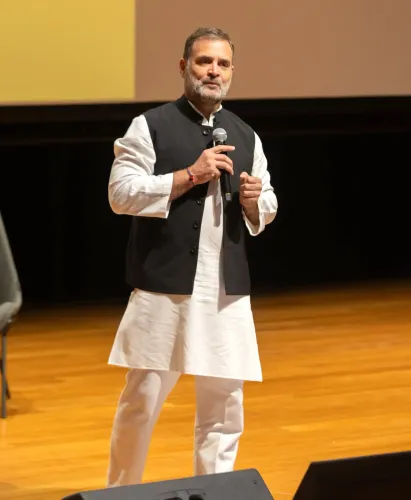
Union Parliamentary Affairs Minister Kiren Rijiju publicly issued a seven-point advisory to Congress leader Rahul Gandhi on November 16, targeting foreign vacations, dynastic politics, parliamentary conduct, and what he called anti-India associations — framing it as 'unsolicited advice.'
Key Takeaways
Kiren Rijiju posted a numbered seven-point list directed at Rahul Gandhi on November 16, 2026 , calling it 'unsolicited advice.' The post opened with a Hindi line criticising Gandhi for making 'a mockery of oneself' and 'embarrassing the country.' Rijiju urged Gandhi to spend more time in India, respect party elders, and stop meeting 'anti-India people.' He called on Gandhi to treat BJP as a political opponent rather than an enemy, and to end what he described as deep hatred toward RSS and Prime Minister Modi .
Points five and six directly target parliamentary responsibility — asking Gandhi to take Parliament seriously and allow MPs to participate in debates.
Point seven calls for ending dynastic politics within Congress , a cornerstone BJP critique since the 2014 general elections.
A senior Union minister has turned the volume up on an already charged political season. Union Parliamentary Affairs Minister Kiren Rijiju posted a pointed seven-point list on X on Monday, November 16, 2026, openly telling Congress leader Rahul Gandhi what the opposition party must do to 'win some trusts of the people' — framing it, with deliberate irony, as 'unsolicited advice.'
Opening with a sharp Hindi line — 'खुद का मज़ाक बनवाया, देश को भी शर्मिंदा कराया' ('Made a mockery of oneself and embarrassed the country too') — Rijiju set the tone before launching into his list.The Seven Points, Unpacked
Rijiju's list covers ground that BJP has staked out repeatedly since its landmark 2014 campaign, but the specificity and the numbered format gave this post an unusual sharpness. Point one asks Gandhi to 'spend more time in India and avoid secret foreign vacations frequently' — a dig the ruling party has deployed consistently since 2019 to question the Congress leader's commitment to domestic politics. Points two and three invoke Indian tradition and national loyalty, urging respect for party elders and an end to what Rijiju calls meetings with 'anti-India people.'
The list sharpens further with point four, which calls on Gandhi to 'end deep hatred against BJP, RSS and Modi Ji' and treat the ruling party as a 'political opponent, not enemy.' That phrasing — the distinction between opponent and enemy — is notable: it casts Congress's posture as existentially adversarial rather than competitively democratic. Points five and six target parliamentary conduct and constitutional institutions directly, with Rijiju urging Gandhi to 'take Parliament more seriously' and 'let MPs take part in debates and discussion' — a pointed reminder of opposition walkouts and disruptions that have dogged recent sessions.
The Dynastic Politics Charge — BJP's Oldest Weapon
Point seven may be the most politically loaded: Rijiju asks Gandhi to 'allow Congress party to function as a democratic party and smash dynastic politics.' This critique is as old as the BJP-Congress rivalry in its modern form. Since Narendra Modi's first campaign, the ruling party has weaponised the Gandhi family's hold over the Indian National Congress as evidence of an organisation that preaches democracy but doesn't practise it. Coming from the minister responsible for parliamentary affairs, the charge carries an institutional edge — a senior custodian of legislative business publicly questioning whether the principal opposition leader takes that business seriously.
Congress Yet to Respond; Next Session in Focus
An immediate rebuttal from Congress was not available at the time of publication. The post arrives at a moment when parliamentary observers are watching how opposition participation shapes up in the upcoming session. Rijiju, as the minister who manages the government's legislative calendar and liaises with all parties in Parliament, occupies an unusually direct position to frame this debate — his advice, 'unsolicited' or not, lands from a desk that depends on opposition cooperation to function.
India's political street has seen ruling-party figures offer public guidance to the opposition before — it is a genre unto itself. But a serving Parliamentary Affairs Minister telling the opposition's most prominent face, in seven numbered steps, how to become credible? That is a different kind of opening salvo. Watch for Congress's counter, and watch the floor of Parliament when the session begins.
Point of View
Undemocratic, and insufficiently patriotic. By deploying the message from the chair of Parliamentary Affairs, the BJP elevates a political attack to what appears to be an institutional concern about legislative functioning. The move fits a pattern stretching back to 2014 of using Congress's internal contradictions — dynasty, parliamentary walkouts, foreign-visit controversies — as proxies for broader questions of governance credibility. The Congress response, or the absence of one, will itself become a data point in that narrative.
NationPress
16 Nov 2026
Frequently Asked Questions
What did Kiren Rijiju post about Rahul Gandhi?
Rijiju posted a seven-point public advisory on November 16, 2026, telling Rahul Gandhi to spend more time in India, respect party elders, avoid meetings with anti-India elements, end hostility toward BJP and RSS, take Parliament seriously, respect constitutional institutions, and dismantle dynastic politics within Congress.
Why is Rijiju criticising Rahul Gandhi's foreign trips?
BJP has consistently raised Rahul Gandhi's foreign visits as a political concern since at least 2019, framing them as evidence of insufficient engagement with Indian domestic politics. Rijiju's post continues that line of attack, though specific recent trips cited in the post are not independently verified.
What does Rijiju mean by 'dynastic politics' in Congress?
The term refers to the Gandhi family's dominant role in the Indian National Congress, with leadership roles historically held by members of the Nehru-Gandhi dynasty. BJP has used this critique since the 2014 campaign to contrast its own stated internal democracy with Congress's centralised family control.
What is Kiren Rijiju's role in Parliament?
Rijiju is India's Union Minister of Parliamentary Affairs and Minority Affairs, responsible for managing the government's legislative agenda, coordinating with all parties in both Houses, and ensuring the smooth functioning of parliamentary sessions.
Has Congress responded to Rijiju's seven-point list?
No official Congress response was available at the time of publication on November 16, 2026. Political observers are watching for a counter-statement ahead of the next parliamentary session.