Sadhvi Ritambhara in Puri: India already Hindu Rashtra, needs political declaration
Synopsis
From the sacred precincts of Puri, Padma Bhushan awardee Sadhvi Ritambhara has made her most direct call yet: India must be formally declared a Hindu Rashtra at the political level. Her argument, unusually, leans on the universalist philosophy of Vasudhaiva Kutumbakam rather than exclusion — reframing an incendiary demand in the language of world harmony.
Key Takeaways
Sadhvi Ritambhara declared on 2 September that India is already a Hindu Rashtra culturally and must be formally declared one politically.
She grounded her argument in Vasudhaiva Kutumbakam and the philosophy of Sanatan Dharma .
She cited the Indian Constitution's references to Lord Ram Chandra and the motto Satyameva Jayate as evidence of the country's Hindu ethos.
She called on governments to stop revenue generation from cow meat sales , terming it a 'grave sin.' She is in Puri for a seven-day Bhagavata Katha at Seven Hills, Baliapanda , and visited the Shri Jagannath Temple during the trip.
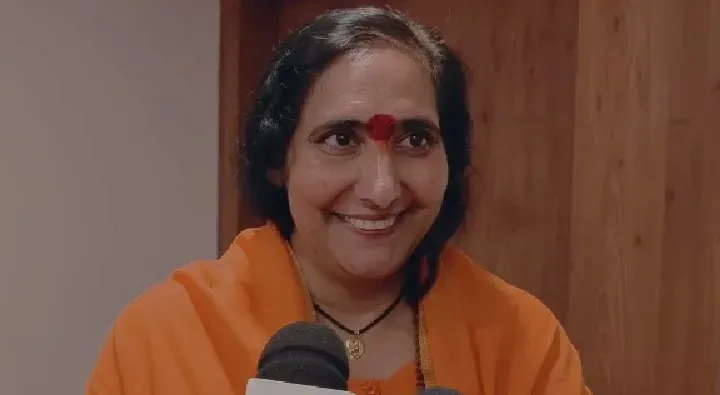
Padma Bhushan awardee Sadhvi Ritambhara on Wednesday, 2 September declared that India already embodies the essence of a Hindu Rashtra through its cultural traditions, collective conduct and way of life — and called for the country to be formally recognised as one at the political level. She made the remarks during a visit to Puri, Odisha, where she is delivering a seven-day Bhagavata Katha at Seven Hills in Baliapanda.
What Sadhvi Ritambhara Said
Speaking on the longstanding political debate over a formal Hindu Rashtra declaration, Sadhvi Ritambhara grounded her argument in the philosophy of Vasudhaiva Kutumbakam — the idea that the world is one family. She argued that this ethos is already embedded in India's constitutional identity.
'This country is already a Hindu Rashtra. The Constitution of this country, from references to Lord Shri Ram Chandra to the motto Satyameva Jayate, reflects this very ethos. The welfare of Hindus means the welfare of India. We are a Hindu Rashtra in terms of our emotions, in terms of our conduct, and in terms of our way of life. But politically, too, India should be declared a Hindu Rashtra; there is an urgent need for this today,' she said.
She further urged political parties to carry this vision to the world: 'The only way to spread the spirit of Vasudhaiva Kutumbakam across the world is to promote the fundamental philosophy of Sanatan Dharma,' she added.
On Cow Protection and Governance
Sadhvi Ritambhara also addressed the issue of cattle slaughter, stressing that cow protection is a matter of both religious duty and social harmony. She issued a direct appeal to governments, saying: 'Earn revenue in any way you wish, but earning money by selling cow meat is a grave sin and a great religious wrong. It should not be done.'
She linked the protection of cows, women and unborn children to the broader pursuit of peace and well-being, arguing that violence against any of these could not coexist with a harmonious society.
Visit to Jagannath Temple
Earlier in the day, Sadhvi Ritambhara visited the Shri Jagannath Temple in Puri and sought the blessings of Mahaprabhu Jagannath. She described the experience as deeply moving and spiritually significant. 'This is a land of harmony, a land that embraces everyone and humbly offers them at the feet of God. This is Purushottam Kshetra, the sacred Shri Kshetra. By coming here, all sins are cleansed, and a person experiences liberation while still in this very life,' she said.
Context and Significance
The demand for a formal Hindu Rashtra declaration has been a recurring flashpoint in Indian political discourse, particularly among right-wing Hindu organisations. Sadhvi Ritambhara's remarks, delivered from one of Hinduism's most sacred pilgrimage sites, are likely to reignite that debate. Notably, her framing positions the demand not as exclusionary but as rooted in the universalist philosophy of Vasudhaiva Kutumbakam — a rhetorical approach that distinguishes her argument from more strident versions of the same demand. Her Bhagavata Katha at Puri continues through the week.
Point of View
Designed to pre-empt the charge of exclusionism. Yet the demand itself remains constitutionally contentious: India's secular framework, enshrined in the Preamble, directly conflicts with a formal religious-state declaration. What is striking is that such calls are now being made openly from pilgrimage sites of national significance, signalling that the conversation has moved from fringe to mainstream within certain Hindu religious circles. Whether political parties — including the ruling Bharatiya Janata Party, which has historically kept the formal demand at arm's length — respond to this pressure will be the real story to watch.
NationPress
17 Oct 2026
Frequently Asked Questions
What did Sadhvi Ritambhara say about Hindu Rashtra in Puri?
Sadhvi Ritambhara stated that India is already a Hindu Rashtra in terms of its cultural ethos, traditions and collective consciousness, and called for a formal political declaration to that effect. She made the remarks on 2 September during her visit to Puri, where she is delivering a seven-day Bhagavata Katha.
What is Sadhvi Ritambhara's argument for calling India a Hindu Rashtra?
She argues that India's constitutional identity — including references to Lord Ram Chandra and the motto Satyameva Jayate — already reflects a Hindu ethos. She further contends that the majority community's philosophy of Vasudhaiva Kutumbakam, meaning 'the world is one family,' is the foundation of India's cultural character.
What did Sadhvi Ritambhara say about cow protection?
She urged governments to stop earning revenue from the sale of cow meat, calling it a 'grave sin and a great religious wrong.' She linked the protection of cows, women and unborn children to the broader goal of peace and social harmony.
Why is Sadhvi Ritambhara in Puri?
She is in Puri to deliver a seven-day Bhagavata Katha at Seven Hills in Baliapanda. During her visit, she also sought the blessings of Mahaprabhu Jagannath at the Shri Jagannath Temple.
Is the demand for a Hindu Rashtra constitutionally valid in India?
India's Constitution enshrines secularism in its Preamble, which legal experts broadly interpret as precluding a formal religious-state designation. The demand for a Hindu Rashtra, while recurring in political and religious discourse, remains constitutionally contested and has not been adopted as official policy by any ruling government.