RJD MP Sudhakar Singh challenges ₹5 crore defamation notice, to approach Supreme Court
Synopsis
RJD MP Sudhakar Singh isn't just disputing a ₹5 crore defamation notice — he's framing it as a constitutional crisis. By invoking the 'chain of command' to argue that a junior officer cannot sue a senior elected representative, and by alleging undisclosed land worth 'hundreds of crores' against Bihar IPS officer Kundan Krishnan, Singh is transforming a defamation row over the Bharat Bhushan Tiwari encounter into a high-stakes political and legal battle headed for the Supreme Court.
Key Takeaways
RJD MP Sudhakar Singh challenged a ₹5 crore defamation notice from Bihar IPS officer Kundan Krishnan on 25 October , calling it constitutionally invalid.
The notice stems from Singh's remarks on the June 17 alleged encounter death of Bharat Bhushan Tiwari in Bhojpur and an incident involving a teenage girl in Jamui .
Singh raised three procedural objections: lack of authority under the Service Act, absence of Chief Minister's permission, and use of a private lawyer instead of the government's Advocate General.
The MP alleged Krishnan purchased 16 acres and 88 decimals of land in Kaimur district that has not been publicly disclosed, and claimed the officer holds assets worth 'hundreds of crores.' Singh has announced he will approach the Supreme Court for a constitutional interpretation on whether a serving officer can issue a notice to an elected representative.
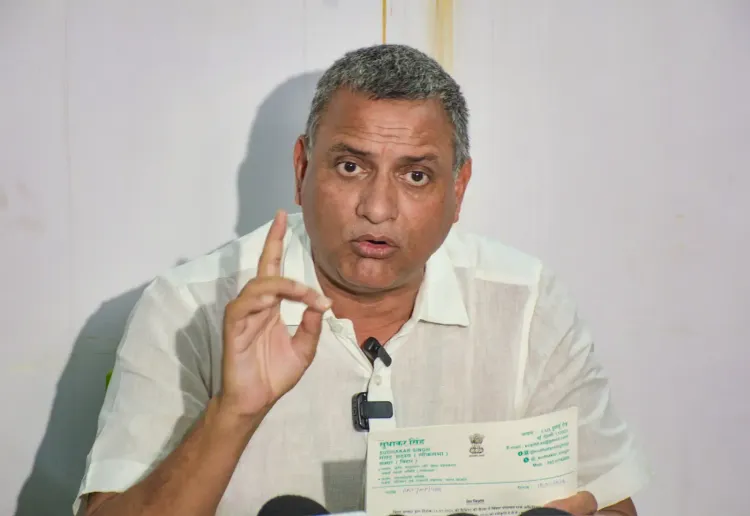
Rashtriya Janata Dal (RJD) MP Sudhakar Singh on Sunday, 25 October publicly challenged the legality of a ₹5 crore defamation notice served on him by senior Bihar IPS officer Kundan Krishnan, asserting that the 'chain of command' in the state's law enforcement hierarchy had been 'broken' — and announced he would seek a constitutional interpretation from the Supreme Court. The notice relates to remarks Singh made concerning the death of Bhojpur youth Bharat Bhushan Tiwari in an alleged encounter and a separate incident involving a teenage girl in Jamui.
Background: The Bharat Bhushan Tiwari Case
The controversy centres on a June 17 encounter in which Bharat Bhushan Tiwari, a young man from Bhojpur, was killed. Sudhakar Singh had publicly alleged that senior police officials — including Kundan Krishnan, who was heading the Special Task Force (STF) at the time — should be held accountable for the incident. The RJD MP called for an inquiry into the leadership chain rather than limiting action to lower-ranking personnel. Krishnan's legal notice contends that Singh's statements were baseless and caused serious damage to his public image and professional reputation.
Singh's Three-Pronged Challenge
Addressing reporters, Sudhakar Singh outlined three specific objections to the notice. 'First, under the Service Act of the Constitution, they do not have the authority to issue a notice to me. Second, I have asked the Chief Minister whether he granted permission to file a case against me. Third, when the Bihar government has an Advocate General, why was a notice issued to me through a private lawyer?' he said.
Singh also raised questions about the authenticity of the notice itself, pointing out that Kundan Krishnan had not personally signed it. 'It remains suspicious whether he issued it or someone else did,' he said, adding that he hoped Chief Minister of Bihar would respond — failing which the matter would be taken to court.
The 'Chain of Command' Argument
The MP framed his central argument as a constitutional one, arguing that a serving officer at a lower rank cannot issue a notice to an elected representative who, in his view, holds a higher constitutional position. 'The question here is that a constitutional crisis has arisen: can a junior officer issue a notice to his senior officer? The chain of command has been broken; democracy also functions through a chain of command,' he said.
Singh stated that in the executive command structure, 'a person ranked at 28th' cannot issue a notice to 'someone seated higher up at the 7th rank,' and that the Supreme Court would be the appropriate authority to interpret this question. Notably, the MP did not clarify the specific ranking framework he was referencing.
Disproportionate Assets Allegations Against Krishnan
Going beyond the defamation dispute, Sudhakar Singh levelled allegations of disproportionate assets against Kundan Krishnan, claiming the officer had purchased 16 acres and 88 decimals of land in Kaimur district — details that, he alleged, had not been officially disclosed. 'The properties he possesses are worth nearly hundreds of crores,' Singh claimed, adding that he would present a detailed account of what he described as 'illegal wealth' at a later date.
The MP framed his allegation arithmetically: 'After all, for someone who earned Rs 4 to 5 crore in salary throughout this entire service career and incurred expenses of Rs 2 to 3 crore, how was property worth hundreds of crores generated from those remaining Rs 2 to 2.5 crore?' he asked. These remain allegations and have not been independently verified.
What Happens Next
The matter is set to escalate legally, with Sudhakar Singh indicating he would move the Supreme Court for a constitutional interpretation of whether an in-service officer can sue an elected representative without prior government sanction. The Bihar Chief Minister's office has not publicly responded to Singh's questions as of Sunday. How the government and the judiciary handle this case could set a significant precedent for the interface between elected representatives and the police establishment in Bihar.
Point of View
He shifts the narrative from his own remarks about the Bharat Bhushan Tiwari encounter to the legitimacy of police action against lawmakers. The disproportionate assets allegation, dropped without documentation so far, is a classic escalation tactic designed to put the officer on the defensive. Bihar's political and police establishment will be watching carefully: if the Supreme Court entertains the argument that government sanction is required before an officer can sue an MP, it could meaningfully reshape the accountability landscape for both sides of that equation.
NationPress
25 Oct 2026
Frequently Asked Questions
What is the ₹5 crore defamation notice issued to RJD MP Sudhakar Singh?
Bihar IPS officer Kundan Krishnan issued a ₹5 crore defamation notice to RJD MP Sudhakar Singh over remarks Singh made regarding the June 17 alleged encounter death of Bhojpur youth Bharat Bhushan Tiwari and a separate incident involving a teenage girl in Jamui. The notice contends that Singh's statements were baseless and damaged Krishnan's professional reputation.
Why is Sudhakar Singh challenging the defamation notice?
Singh has raised three procedural objections: that the Service Act does not permit an officer to issue such a notice to an MP without permission, that no clearance was obtained from the Chief Minister, and that a private lawyer was used instead of the Bihar government's Advocate General. He also noted that Krishnan did not personally sign the notice, calling its authenticity into question.
What is the 'chain of command' argument made by Sudhakar Singh?
Singh argues that in the executive hierarchy, a lower-ranked official cannot issue a legal notice to a higher-ranked elected representative, describing it as a constitutional crisis. He plans to approach the Supreme Court to seek a formal interpretation of whether a serving officer can sue an elected representative without prior government sanction.
What allegations has Singh made against Kundan Krishnan regarding assets?
Singh has alleged that Krishnan purchased 16 acres and 88 decimals of land in Kaimur district without disclosing it, and that the officer's total properties are worth 'hundreds of crores' — disproportionate to his estimated lifetime earnings of ₹4–5 crore. These allegations are unverified and Singh has said he will present a detailed account later.
What is the background of the Bharat Bhushan Tiwari case?
Bharat Bhushan Tiwari, a youth from Bhojpur district in Bihar, died in what was described as an encounter on June 17. RJD MP Sudhakar Singh publicly alleged that senior police officials, including Kundan Krishnan who headed the STF at the time, should be held accountable, prompting the defamation notice from Krishnan.