Sachin Pilot Pays Tribute to APJ Abdul Kalam on Death Anniversary
Synopsis
Congress general secretary Sachin Pilot on 27 July paid tribute to former President Dr. A.P.J. Abdul Kalam on his death anniversary, honouring Kalam's transformative contributions to India's space and defence research and calling his values a lasting guide for future generations.
Key Takeaways
Sachin Pilot , Congress general secretary and Chhattisgarh in-charge, posted a tribute to Dr.
Abdul Kalam on 27 July , the anniversary of Kalam's death in 2015 .
Pilot credited Kalam with establishing India's identity as a global power in space and defence research.
Kalam served as India's 11th President (2002-2007) and led the Integrated Guided Missile Development Programme at DRDO .
Kalam played a key role in the Pokhran-II nuclear tests of 1998 as Chief Scientific Adviser to the Prime Minister .
Tributes to Kalam on 27 July have become an annual cross-party observance since his passing at age 83 .
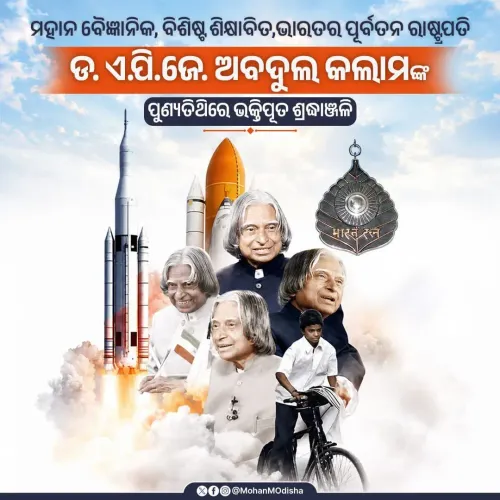
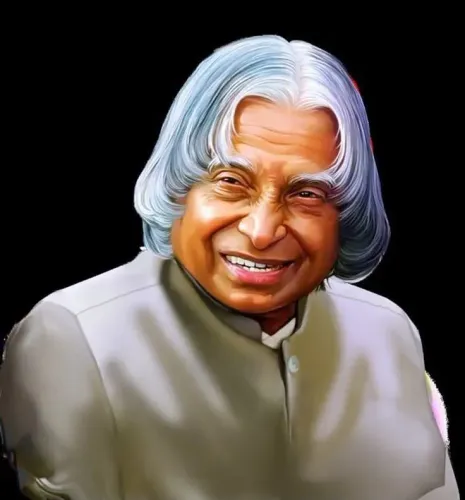
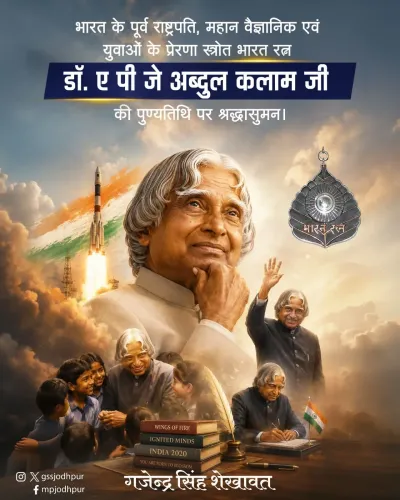
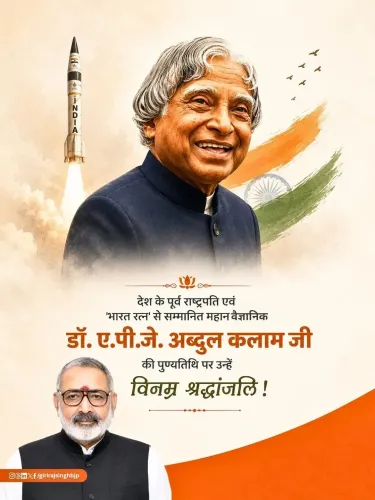
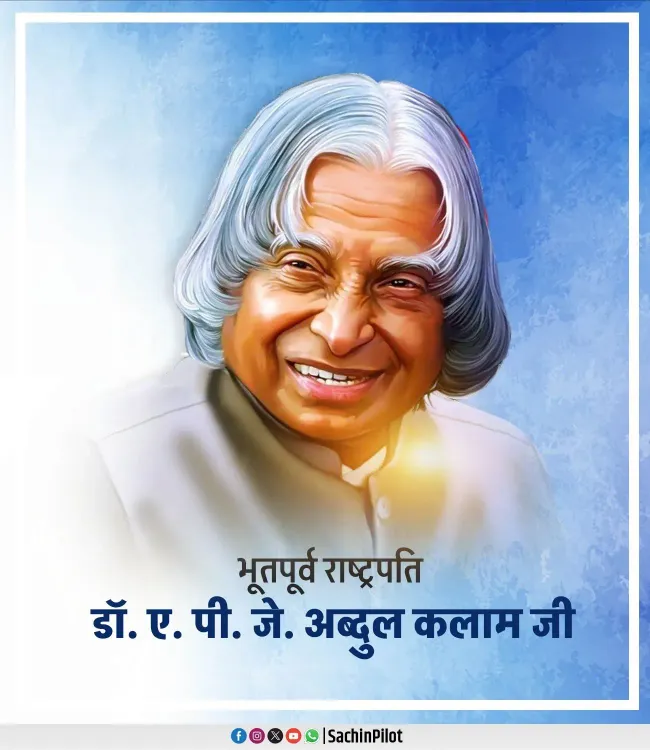
Congress leader and party general secretary Sachin Pilot on Monday, 27 July paid tribute to former President and scientist Dr. A.P.J. Abdul Kalam on his death anniversary, honouring Kalam's legacy in space and defence research that he said placed India on the global map as a major power.
Posting on X, Pilot wrote: 'भूतपूर्व राष्ट्रपति एवं विश्वविख्यात वैज्ञानिक डॉ. ए. पी. जे. अब्दुल कलाम जी की पुण्यतिथि पर उन्हें विनम्र श्रद्धांजलि अर्पित करता हूँ' ('On the death anniversary of former President and world-renowned scientist Dr. A.P.J. Abdul Kalam, I offer my humble tribute'). He added that Kalam's ideals, moral values, and inspiring thoughts 'will always guide the generations to come.'
Context
Dr. A.P.J. Abdul Kalam passed away on 27 July 2015 while delivering a lecture at the Indian Institute of Management, Shillong. He was 83 years old. Since then, 27 July has been observed each year as a day of national remembrance, with leaders across the political spectrum paying their respects.
Kalam served as the 11th President of India from 2002 to 2007, having risen through decades of scientific work that earned him the informal title 'Missile Man of India.' His appeal transcended party lines, making tributes to him a near-universal political and civic ritual.
Policy Backdrop
Kalam's scientific career spanned two of India's most consequential strategic institutions. He worked with ISRO — the Indian Space Research Organisation — on early launch-vehicle projects before moving to DRDO, the Defence Research and Development Organisation, where he led the Integrated Guided Missile Development Programme (IGMDP). The programme produced missile systems central to India's defence architecture.
He also served as Chief Scientific Adviser to the Prime Minister from 1999 to 2001 and played a key role in overseeing the Pokhran-II nuclear tests of 1998, which established India as a declared nuclear power. Pilot's tribute specifically cited Kalam's contributions to space and defence research as the basis for India's recognition as a global power — a characterisation consistent with Kalam's documented legacy.
Stakeholders and Impact
Kalam is remembered with particular reverence by India's scientific community and the country's youth, whom he addressed extensively through books, lectures, and public engagements throughout his post-presidential years. His vision of a self-reliant India in strategic technology continues to be invoked in policy discussions around indigenisation in defence and space.
Annual observances on 27 July serve a dual purpose: honouring a scientist-administrator who symbolised technological self-reliance, and reinforcing the political consensus around strategic autonomy — a theme relevant to ongoing programmes at both ISRO and DRDO.
What's Next
Government bodies, academic institutions, and civil society organisations typically mark Kalam's death anniversary with lectures, youth events, and commemorative programmes that link his vision to active space and missile initiatives. His legacy is likely to remain a reference point as India advances its ambitions in areas such as human spaceflight and next-generation missile development.
Tributes from across the political spectrum on this date reflect a rare bipartisan consensus — one that successive governments have drawn upon to frame India's strategic technology programmes as a continuation of Kalam's foundational work.
Point of View
Honouring Kalam also carries a degree of institutional ownership — it was the UPA government that backed Kalam's presidential candidacy in 2002. More broadly, annual Kalam tributes function as soft endorsements of strategic self-reliance in defence and space, themes that carry increasing policy weight as India expands its missile and human spaceflight programmes. The ritual underscores how Kalam's legacy has been absorbed into the political mainstream as common ground.
NationPress
27 Jul 2026
Frequently Asked Questions
When did APJ Abdul Kalam die?
Dr. A.P.J. Abdul Kalam died on 27 July 2015 while delivering a lecture at the Indian Institute of Management, Shillong . He was 83 years old at the time of his death.
Why is Sachin Pilot paying tribute to APJ Kalam?
Sachin Pilot paid tribute on 27 July , the death anniversary of Dr. Kalam , honouring his contributions to India's space and defence research. The date is observed annually across India with commemorative messages from political leaders and institutions.
What was APJ Abdul Kalam's role in India's defence and space programmes?
Dr. Kalam led the Integrated Guided Missile Development Programme at DRDO and worked on launch-vehicle projects at ISRO . He also served as Chief Scientific Adviser to the Prime Minister and was associated with the Pokhran-II nuclear tests of 1998 .
Which party supported APJ Abdul Kalam's presidential candidacy?
Dr. Kalam was elected as the 11th President of India in 2002 with support from the NDA government then in power, and notably also received backing from the Congress-led opposition , reflecting his cross-party standing.
What does Sachin Pilot's post say about APJ Kalam?
Pilot wrote that Kalam's contributions in space and defence research gave India recognition as a major power on the global stage, and that his ideals, moral values, and inspiring thoughts 'will always guide the generations to come.'