Sachin Pilot Slams Police Action Against Students
Synopsis
Congress general secretary Sachin Pilot on 27 July 2026 condemned reports of police brutality against students, calling it a misuse of state power and a violation of Article 19 constitutional rights, and challenged the government on the message such treatment sends to the country's youth.
Key Takeaways
Sachin Pilot , Congress general secretary, posted on 27 July 2026 condemning reported brutality against students and misuse of police power.
He cited Article 19(1)(a) of the Constitution, which guarantees freedom of speech and expression to all citizens.
Pilot called any attempt to suppress student voices 'against democratic values.' He directed a pointed question at the government, asking what message it intends to send by treating students this way.
The Indian National Congress has a consistent record of raising civil-liberties concerns over alleged police action during student demonstrations.
Formal responses from state governments or police, and possible parliamentary references, are expected to follow.
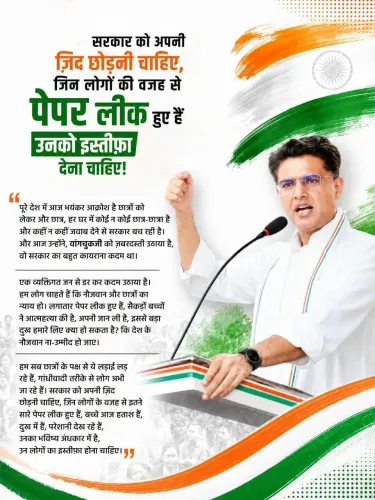
Congress leader and general secretary Sachin Pilot on Monday, 27 July 2026, sharply condemned what he described as brutality against students and the misuse of police power, questioning the message the government seeks to send through such actions. Writing in Hindi on X, Pilot invoked constitutional guarantees of free speech and called attempts to suppress student voices an affront to democratic values.
Context
In his post, Pilot wrote: 'छात्रों पर हुई बर्बरता और पुलिस की शक्ति के दुरुपयोग की जो खबरें सामने आ रही हैं, वे बेहद चिंताजनक हैं' — 'Reports of brutality against students and misuse of police power are extremely worrying.' He added that freedom of expression is a constitutional right of every citizen, and that any attempt to silence or crush student voices runs counter to democratic values.
Pilot concluded with a pointed question directed at the government: 'Students are the future of the country. What message is the government trying to send by treating them this way?' The post carried no images or video, relying entirely on the force of the written word.
Policy Backdrop
Article 19(1)(a) of the Constitution of India, 1950, guarantees every citizen the right to freedom of speech and expression, subject only to reasonable restrictions laid down by law. Opposition parties have long cited this provision when challenging what they characterise as disproportionate state responses to student demonstrations.
The Indian National Congress has consistently positioned itself as a defender of civil liberties on campuses, issuing statements on alleged police excesses during student protests across multiple states over successive years. Pilot's post fits squarely within that pattern, amplifying concern at the national level even when incidents may be localised.
Stakeholders and Impact
University and college students form the most directly affected constituency, particularly those involved in demonstrations or political activity on campuses. Opposition parties, civil society groups, and legal advocates who monitor the use of police power against civilian protesters are also key stakeholders in such episodes.
For the ruling dispensation — at whichever level the incidents occurred — a high-profile Congress leader's public rebuke adds political pressure and risks drawing wider national attention to law-and-order decisions that might otherwise remain regional news. Student unions across party lines often respond to such statements, making the discourse broader than any single incident.
What's Next
Formal responses from the concerned state government or police department, if any, will be closely watched. Past episodes of this nature have frequently been raised during Parliament sessions or in state assemblies, and Pilot's statement may foreshadow similar moves when legislators next convene.
Civil liberties organisations are likely to demand independent inquiries into the reported incidents. Whether the controversy translates into sustained political pressure or fades without official accountability will depend on the specifics that emerge in the days ahead.
Point of View
A framing that is harder for governments to dismiss than partisan criticism alone. By asking what 'message' the government is sending, Pilot shifts the burden of explanation to the ruling side without needing to name a specific incident, a tactic that keeps the statement legally safe while maximising political reach. The post fits a well-established Congress playbook of using student issues to consolidate support among younger voters and urban liberals ahead of electoral cycles. Whether it gains traction will depend on how quickly verifiable details of the underlying incidents enter the public domain.
NationPress
27 Jul 2026
Frequently Asked Questions
What did Sachin Pilot say about students and police action?
Sachin Pilot condemned reports of brutality against students and misuse of police power in a post on 27 July 2026, calling it a violation of the constitutional right to free speech and an affront to democratic values.
Which constitutional article protects students' right to protest in India?
Article 19(1)(a) of the Constitution of India, 1950, guarantees freedom of speech and expression to all citizens, and is frequently cited in debates about the right to protest and demonstrate.
Why is Sachin Pilot speaking out on student protests?
As Congress general secretary and a senior opposition leader, Pilot has used the party's consistent position on civil liberties to challenge what he characterises as disproportionate state responses to student dissent.
What action is Congress demanding over police action on students?
Pilot's post stops short of listing specific demands but implicitly calls on the government to justify its conduct, a step that often precedes formal demands for inquiry in Parliament or state assemblies.
What could happen next after Pilot's statement on student protests?
Possible follow-up steps include formal statements from state governments or police, civil society demands for independent inquiries, and the issue being raised during the next session of Parliament or relevant state assemblies.