CM Saini Marks World Bicycle Day, Urges Greener Lifestyle
Synopsis
Haryana Chief Minister Nayab Singh Saini greeted citizens on World Bicycle Day, calling the bicycle a key medium for health, fitness and sustainable development. He urged Haryana residents to adopt a healthy lifestyle and step towards a cleaner environment, aligning the state's message with global observances and India's wider push on non-motorised, low-carbon mobility.
Key Takeaways
Haryana CM Nayab Singh Saini posted World Bicycle Day greetings on 3 June 2026.
He described cycling as a medium for health, fitness and an active lifestyle.
Saini linked cycling to environmental conservation and sustainable development.
World Bicycle Day was proclaimed by the UN General Assembly in 2018.
The message aligns with the Fit India Movement launched in 2019.
Focus now shifts to state-level cycling infrastructure follow-through.
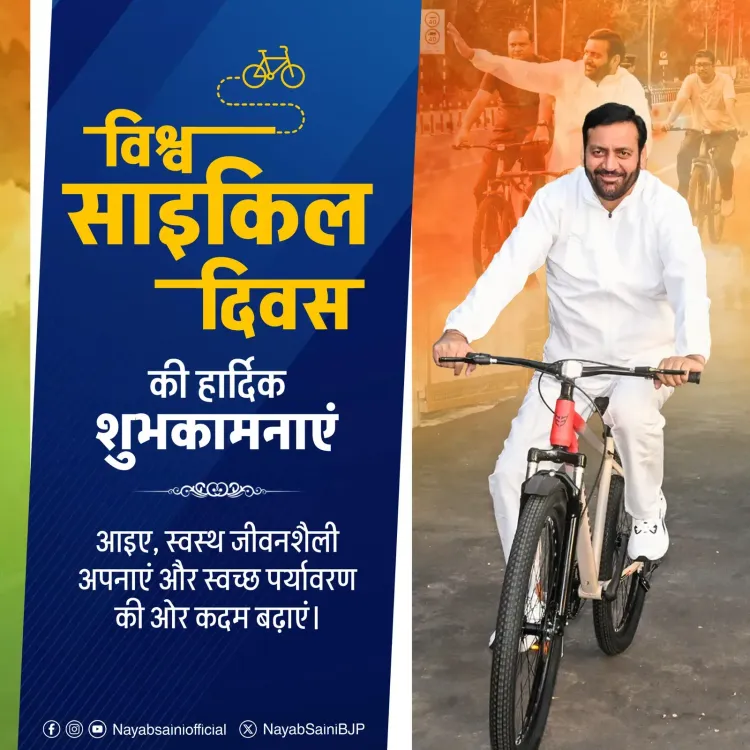
Haryana Chief Minister Nayab Singh Saini on Wednesday, 3 June 2026, extended greetings on World Bicycle Day, framing cycling as a vehicle for both personal health and environmental stewardship. In a post on X from Chandigarh, the Chief Minister urged citizens to embrace cycling as part of a cleaner, more active lifestyle.
'Heartfelt greetings on World Bicycle Day,' Saini wrote, adding that the bicycle 'is an important medium for promoting health, fitness and an active lifestyle, while also advancing environmental conservation and sustainable development.' He appealed to people to 'adopt a healthy lifestyle and take steps towards a clean environment' to mark the day.
Context
World Bicycle Day is observed every year on 3 June following a United Nations General Assembly resolution adopted in 2018 that recognised the bicycle as a simple, affordable and sustainable means of transport. The day has since become a fixture in political and civic calendars across India, with leaders using it to spotlight non-motorised mobility.
Saini, who took charge as Chief Minister of Haryana in 2024, has frequently used his social media channels to amplify lifestyle and wellness messages alongside formal policy announcements. Wednesday's post follows that pattern, linking an international observance to broader themes the state government has been championing.
Policy backdrop
The Chief Minister's message dovetails with the Fit India Movement, launched nationally in 2019 to encourage regular physical activity, including cycling, among Indians of all ages. It also echoes India's commitments under the Sustainable Development Goals, which place non-motorised transport at the heart of efforts to cut urban emissions and improve public health.
Across Indian states, governments have progressively integrated cycling into urban planning, from dedicated lanes in smart-city projects to public bicycle-sharing systems. The framing of cycling as both a fitness and climate tool — as Saini did — has become a standard talking point for state leaders on this day.
Stakeholders and impact
The message is aimed at a wide audience: urban commuters navigating congested roads in cities such as Gurugram, Faridabad and Panchkula; school and college students; and environmental groups pushing for low-carbon mobility. For these constituencies, statements from the head of government can shape expectations about future investment in cycling-friendly infrastructure.
Public-health advocates have long argued that even modest increases in daily cycling can reduce the burden of non-communicable diseases such as diabetes and cardiovascular illness. Environmental groups, meanwhile, view active mobility as one of the most cost-effective levers available to states grappling with worsening air quality.
What's next
Attention will turn to whether the Chief Minister's symbolic message is followed by concrete state-level interventions — such as expanded cycle tracks, last-mile connectivity at metro and bus stations, or procurement support for community cycling programmes. State observances of World Bicycle Day in coming years are likely to be judged against the gap between rhetoric and infrastructure on the ground.
For now, Saini's post adds Haryana's voice to a chorus of Indian leaders linking everyday choices to the country's climate and health ambitions — a reminder that the politics of the bicycle is no longer confined to nostalgia, but tied to how cities of the future will move.
Point of View
The Chief Minister positions Haryana within the national Fit India and SDG conversations without committing to specific outlays. The real test, as with most observance-day posts, lies in whether the state translates symbolism into cycle lanes, safer roads and last-mile connectivity. For now, it reflects the steady mainstreaming of climate-adjacent vocabulary in routine political communication.
NationPress
19 Sept 2026
Frequently Asked Questions
When is World Bicycle Day observed?
World Bicycle Day is observed every year on 3 June. It was proclaimed by the United Nations General Assembly in 2018 to recognise the bicycle as a sustainable, affordable and environment-friendly means of transport.
What did Haryana CM Nayab Singh Saini say on World Bicycle Day 2026?
Saini extended greetings and described the bicycle as an important medium for health, fitness and an active lifestyle, as well as for environmental conservation and sustainable development. He urged people to adopt a healthy lifestyle and move towards a cleaner environment.
Why is cycling considered important for sustainable development?
Cycling produces no tailpipe emissions, eases urban congestion and improves public health, making it central to climate and Sustainable Development Goals. It is widely promoted as a low-cost alternative to motorised transport in Indian cities.
How does Saini's message link to the Fit India Movement?
The Fit India Movement, launched in 2019, encourages regular physical activity including cycling. Saini's appeal to adopt a healthy, active lifestyle echoes the movement's core message and extends it to environmental goals.
Has Haryana announced any new cycling scheme along with this message?
The Chief Minister's post on World Bicycle Day did not announce a specific new cycling scheme. It was a message of greetings and a general appeal to citizens to embrace cycling for health and environmental reasons.